Showing posts with label Francisco Delgado. Show all posts

Birdie’s Beauty Parlor / El salón belleza de Birdie

author: Lee Merrill Byrd
translator: Luis Humberto Crosthwaite

illustrator: Francisco Delgado

Cinco Puntos Press, 2020

preschool-up

Chicana


What do you do if you’re a little girl with a great imagination and not very much to do and the only person you have to play with at the moment is your grandma? And she’s all worn out. What do you do? You go through her drawers and dump all her makeup and everything else you need on her bed; you put a towel under her head to make sure she’s comfortable—and the grandma makeover is on!


Birdie’s Beauty Parlor / El salón belleza de Birdie uproariously depicts the close relationship between a patient, loving Chicana abuelita and her artfully ambitious young nieta.


Although Birdie’s Beauty Parlor / El salón belleza de Birdie is based on a true story about Lee Merril Byrd and her own granddaughter, Emma “Birdie” Byrd, fronteriza artist Francisco Delgado used his children, Citlali and Itzel, as models for bossy beautician Birdie; and his mother-in-law—whose many skills include relaxing under pressure—posed for Abue.


Delgado’s art— on a background spray-painted with thinned acrylic and illustrations filled in with colored pencil and acrylics—complements both Birdie’s entusiasmo sin fin and Abue’s paciencia sin fin. On one spread, for instance, Birdie is focused on pulling out one of her abuelita’s gigantic chin hairs while Abue is focused on not screaming. And on another illustration, Abue even allows her nieta to pinch her lips (¡Ay!) in order to apply the lipstick just-so. 


As always, Crosthwaite’s talent in idiomatic translation follows the hilarious tone of the story and illustrations while maintaining their rhythm and exuberance, so both young hablantes and English-speakers will laugh out loud at Birdie’s abuelita’s makeover. For instance, the rhyming English on the back cover tells young English-readers:


When Grandma’s ready to hit the hay, there’s still one game you both can play—Birdie’s make up will save the day!


And Crosthwaith’s rhyming Spanish speaks to young hablantes: 


Abue nada más se quiere acostar, pero todavía se puede jugar—maquillala bien y hazla brillar! 


(The direct English translation would be: “Grandma just wants to go to bed, but you can still play—put her makeup on and make her shine!”)


Together, Byrd’s riotous, no holds-barred story, Crosthwaite’s brilliant idiomatic Spanish translation and Delgado’s delightful illustrations are filled with humor and warmth and demonstrate the love between an exuberant little girl and her ever-patient abuelita. 


Finalmente, after treating her abuelita to a foot massage, putting earrings in her ears and expertly wrapping a bufanda around her head, Birdie holds up a mirror so both she and Abue can admire her handiwork.


Indeed, Abue’s face is a work of art: almost totally enveloped in rouge, her eyebrows and eyelids are purple, blue and yellow; white dots of talcum powder cover her chin, and bright, bright red lipstick fills much more than just her lips. ¡Birdie es la jefa¡


Now done with Abue, Birdie turns to the story’s young readers: “Who’s next?” she asks. “¿Quién sigue?”


As with Byrd’s and Delgado’s earlier Juanito Counts to Ten / Johnny cuenta hasta diez (2010), young hablantes who want to learn English and English speakers who want to learn Spanish will revel in this hilarious family story. 


*Highly recommended for all home, classroom and library collections. 


—Beverly Slapin

(published 7/28/20)


[Note: With only the English title displayed on the cover, there’s no indication until the first story page that Birdie’s Beauty Parlor / El salón belleza de Birdie is bilingual. Whether this was an error or a design decision, it needs to be corrected in the next edition—BHS]


¡Sí, Se Puede! Yes, We Can! Janitor Strike in L.A.


author: Diana Cohn
translator: Sharon Franco
illustrator: Francisco Delgado
Cinco Puntos Press, 2002
grades 3-up
Mexican, Mexican American

Through the eyes of a janitorial worker’s young son, readers come to know the conditions that united some 8,000 workers in the Justice for Janitors campaign in Los Angeles in April of 2000.

Carlitos’ mother is a present-day hero, struggling to support her family. She works nights as a full-time janitor, and cleans houses and takes in laundry on weekends. Still, she is not paid enough to afford the medication that his grandmother needs. Mamá explains to Carlitos that she and the other workers will have to go on strike for higher wages and a better life, including more time to spend with their families. As Mamá tucks her young son into bed, Carlitos wonders how he can help.

The answer comes when he shows newspaper photos of the striking workers and supporters to his classmates, and finds out that some of their parents are on also on strike. His teacher, whose grandfather was part of the farm worker struggle, tells the children, “When many people join together, they can make a strong force.” Together, the children make signs for the marchers and, with their teacher, join the three-week strike, which is ultimately successful. After, Carlitos takes his sign and marches with his mother, who, as an organizer, is off to assist the hotel workers:

 “I took down my sign from the living room wall and walked out with her,” Carlitos says. “That afternoon, we joined the workers and marched up and down in front of the hotel. Mamá and I met lots of new friends. And together we shouted, ‘¡Sí, Se Puede!’”

Cohn’s writing is straightforward, political and evocative, with stories from this and other strikes and struggles woven into the text. The book ends with a two-page essay by acclaimed author, poet, and union organizer, Luis J. Rodríguez, who profiles union organizer Dolores Sánchez, “a woman of struggle, a woman of hope.” And on the final page, an amazing poem that ends: “The truly human who now step into the streets, into our tomorrows,/ And declare: Basta! Enough! What we clean, we also make sacred.”

Franco’s Spanish translation, for the most part, rarely goes beyond the English text. In a few places, though, it sings. When Miss Lopez tells her young class about her grandfather’s struggle together with other immigrant farm workers, Carlos asks if they won, and Miss Lopez answers with real passion: “¡Claro que sí! Cuando mucha gente se junta, puede tener mucho poder.”

Delgado’s illustrations, in colored pencil and pastels, are strong and bright, reminiscent of the mural paintings of José Clemente Orozco. Here is Mamá, her forearm muscles bulging, pushing her mop across an office floor. Here is Miss Lopez, talking with her children about the importance of this struggle. Here are the strikers, silently standing together, holding candles, the “glowing light of our strength.” Here, on another day, is a striker, playing a trashcan like a big steel drum; and other strikers, shaking maracas made of soda cans filled with beans. Here is Carlitos’ mother, standing on a podium, taking a strike vote, with hundreds of janitors shouting, “¡Sí, se puede!” Here are the children, waving their handmade placards in the air. Here are thousands and thousands of people, all of them strong and resolute, “a celebration of courage.”

For Raza children, ¡Sí, Se Puede! Yes, We Can! is a gift, a rare connection with their own families’ lives and struggles. For all children, it’s one of the few picture books that celebrate the power of people uniting for a cause, and that invite discussion of contemporary issues of social justice, of exploitation, of migration and immigration, of the struggle for a living wage, of the need for strong unions, of modern-day heroes, and of women as leaders. Highly recommended.

—María Cárdenas
(published 2/14/14)

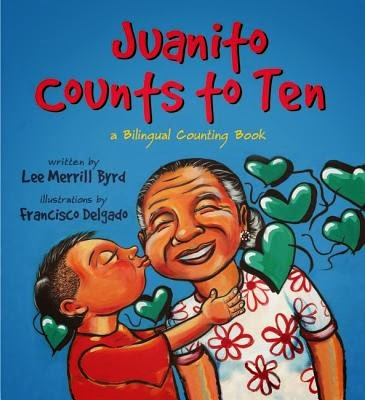
Juanito Counts to Ten/ Johnny cuenta hasta diez


author: Lee Merrill Byrd
illustrator: Francisco Delgado
Cinco Puntos Press, 2010
preschool-up
Mestizo, Mexican American

It’s so sweet to count kisses! Narrated by Juanito’s grandma, the simple little story is about who receives Juanito’s delicious kisses. Beginning with one little kiss for his big sister, two big kisses for his daddy, three wet ones for his momma, and, as he counts to nine, Abuelita’s worrying that he might have run out of kisses. But—of course not—he has ten delicious ones for her!

Who would think of a counting book that is so loving, so family-oriented, so delightful? Clearly, Juanito Counts to Ten is not just about counting. And, while “traditional” counting books usually count just the objects, this one actually describes each kiss. With appropriate idiomatic Spanish, Juanito Counts to Ten is language expansion at its best.

Delgado’s artwork, in rich, saturated oils, complements the loving, enthusiastic text and carries the emotions. Big sister is grossed out, Beatriz’s dog is jealous—and the cat’s not especially loving it, either. Here, he portrays Juanito’s family, friends and everyone else he kisses (but not girls outside of the family, whom he wants to but doesn’t) as real Mestizo people and community. And one of the messages—an important one—is that it’s totally OK for Latino boys to kiss their close friends and relatives. Highly recommended.

—María Cárdenas
(published 1/16/14)