Showing posts with label Candlewick Press. Show all posts

La selva de Zonia // Zonia's Rain Forest

author: Juana Martinez-Neal 
illustrator: Juana Martinez-Neal
Candlewick Press, 2021 
all grades (Asháninka)


[Reviewer’s note: La selva de Zonia // Zonia’s Rain Forest is reviewed in two parts. The story and the back matter are discussed separately.

—BHS]


La selva de Zonia // Zonia’s Rain Forest: The Story


Young Zonia’s rain forest home is calm and beautiful—everything is “green and full of life.” A hammock hangs between two trees, and the presence of metal pots, a woven basket, a gourd and wooden bowls signals to young readers that this story takes place in the present. As Zonia looks on, her mom contentedly nurses her baby brother. Green grows all around, and a blue morpho butterfly flits around them.


“Every morning, the rain forest calls to Zonia,” and, every morning, she answers. With the butterfly in the lead, Zonia greets the forest’s creatures: two-toed sloths, red Andean cock-of-the-rocks, and South American coatis. She takes a ride on the back of a jaguar and says hello to Amazon river dolphins, congratulates an anteater family on the arrival of their new babies, plays hide-and-seek with a spectacled caiman, hangs upside-down on a high branch with a boa constrictor, and visits with a group of Arrau turtles. And after Zonia’s visit, the butterfly guides her home—almost.


What she sees frightens her—much of the forest has been clearcut; all that’s left are stumps. Zonia’s animal friends are gone; only her butterfly guide remains. She runs home and tells her sorrowful mama that the forest needs help.


“It is speaking to you,” says Zonia’s mama.

“Then I will answer,” says Zonia, “as I always do.”


On the final spread, Zonia is no longer a carefree child. Her face is painted and she wears a patterned dress. With one hand on a remaining tree trunk, she looks forward. She is ready for the struggle ahead. With the butterfly circling around her and showing her the way, Zonia tells young readers:


“We all must answer.”


It’s no surprise that Martinez-Neal tells the Spanish version, La selva de Zonia, at least as beautifully as the English. Especially, in the Indigenous struggle to save the rain forest, her repetition of a particular phrase—“verde y llena de vida” (“green and full of life”) strikes an emotional chord, because, by the “end” of the story, young readers ascertain what’s coming and what has to be done—and that it is far from the end of the story.


Martinez-Neal sets every full-bleed double-page spread—rendered in acrylic, colored pencil, pastel, ink, and linocuts and woodcuts—on handmade textured banana bark paper, which she purchased from women paper artisans of Chazuta. In most of the illustrations, gentle rainforest greens frame Zonia’s bright yellow dress; and the blue butterfly on the right of each spread leads to the next page. Young readers see the soft textures and blending of art and story coming together in a gentle, satisfying whole.


On the acknowledgements page, Zonia’s guide—the blue morpho butterfly—circles around a statement issued by the United Nations International Labour Organization at the Indigenous and Tribal Peoples Convention in 1989:


The peoples concerned shall have the right to decide their own priorities for the process of development as it affects their lives, beliefs, institutions and spiritual well-being and the lands they occupy or otherwise use, and to exercise control, to the extent possible, over their own economic, social and cultural development. In addition, they shall participate in the formulation, implementation, and evaluation of plans and programmes for national and regional development which may affect them directly.


As this particular story—La selva de Zonia // Zonia’s Rain Forest—ends, young readers understand that this brave little girl knows who she is, what she comes from, and all that she has been given to do. And the story of all the “Zonias”—the struggle of all the Indigenous peoples who acknowledge the Amazon rain forest as their home—“green and full of life”—continues.


Told in a way that engages the youngest readers and listeners—and everyone else—La selva de Zonia // Zonia’s Rain Forest is a beautiful and important story that encourages compassion and activism. 


*Highly recommended for all home, classroom and library collections.


— Beverly Slapin

(published 12/12/2020)


La selva de Zonia // Zonia’s Rain Forest: About the back matter


“Todos debemos de responder.” // “We must all answer.” In the last few words of the story, Zonia acknowledges the Indigenous peoples who, for some five millennia, have sustainably managed the rain forest—and are now struggling to save it. And she calls out to allies all over the world to join them. 


Asháninka is the name of Zonia’s people, the language that’s spoken at home, and the language of one of the largest Indigenous nations struggling to save the Amazon rain forest. The author acknowledges and thanks the many people who worked to translate this story into Asháninka Satipo-Junin, and others who worked to vet it for fidelity and accuracy. So it’s unfortunate that the Asháninka version was relegated to one page in the back matter and accompanied only by an illustration of a sloth hanging upside down. 


Although Candlewick took the extra step of hiring a team to translate this beautiful story into the Asháninka language, no one who speaks or reads the language will benefit from its placement in any substantial way. Rather, Asháninka speakers will have to turn back to the illustrations to enjoy this story.


Since this book is set to be published in Spanish and English only—and the decision was made not to incorporate the Asháninka version into the story—I would like to see the story in Asháninka, perhaps in a limited print run, donated to the Asháninka people. As it stands, the inclusion of the Asháninka text on a single page, while a well-intended gesture of respect, is ultimately hollow and performative because it’s unlikely that anyone from that region will benefit from the translation of this story about their beloved rain forest in their own language.


The rest of the back matter is divided into seven  sections: “The Asháninka People,” “A Few Facts about the Amazon,” “Threats to the Amazon,” “Illegal logging,” “Farming,” “Mining,” and “Oil and Gas Extraction.” The back matter is limited and confusing. It contains numerous errors and is full of Eurocentric markers as well. 


Here are examples:


1. Text: Zonia is Asháninka, which is the largest Indigenous group living in the Peruvian Amazon… 


What’s wrong: Referring to an Indigenous nation as a “group,” rather than “people,” “nation,” or “society”—diminishes them. 


Corrective: Zonia is Asháninka, which is the largest Indigenous nation living in the Peruvian Amazon.


2. Text: They have a long history of insisting on self-determination….


What’s wrong: “Insisting on self-determination” diminishes their continuous struggle, recognized by the United Nations. 


Corrective: They have a long history of struggling for self-determination and freedom—to exercise control over their own economic, cultural and social development. 


3. Text: Those rights continue to be ignored and violated, and harassment grows because of others’ impatience to develop, cultivate and mine the world’s tropical forests for profit. 


What’s wrong: Placing the Asháninka people’s difficulties into the passive tense—things that happen to them—rather than the active tense—who’s doing it and why—in a sense, blames the victim. 


Corrective: They are answering the call to protect the rain forest—their home—from the rapacious multinational logging and mining industries that continue to destroy the world’s tropical forests for profit. 


4. Text: The Amazon rain forest takes carbon dioxide out of the air and turns it into oxygen, producing more than twenty percent of the oxygen on our planet…


What’s wrong: This is a widely held myth that’s been debunked by scientists for years. See “Why the Amazon doesn’t really produce 20% of the world’s oxygen,” in National Geographic, 2019: https://www.nationalgeographic.com/environment/2019/08/why-amazon-doesnt-produce-20-percent-worlds-oxygen/


Corrective: The trees in the Amazon rain forest filter and reprocess huge amounts of carbon dioxide, which helps stabilize climates locally and globally.


5. Text: The Amazon rain forest shrinks by 18.7 million acres every year, or the size of twenty-seven soccer fields every minute. It shrank 17 percent in the last fifty years alone. 


What’s wrong: This phrasing hints that “shrinking” is something that happens naturally. 


Corrective: Depredation and degradation caused by the rapacious logging and mining industries destroys some 18.7 million acres every year, or the size of twenty-seven soccer fields every minute. In the last fifty years alone, they have demolished some 17 percent of the rain forest.


6. Text: The Amazon rain forest is home to between four hundred and five hundred different Indigenous groups—some of which are isolated or uncontacted.


What’s wrong: Besides referring to Indigenous peoples as “groups,” the phrasing suggests that they can’t be found by anyone.


Corrective: In some of the larger areas, difficult access has allowed them to remain isolated from the outside influences of the settler society.


7. Text: Every day, the Amazon rain forest is being changed by development. Large infrastructure projects (dams, roads, hydroelectric power plants) and extractive industries (oil wells, mining) have transformed the lives of the people who live there, sometimes permanently and not always in positive ways.


What’s wrong: The infrastructure projects and extractive industries do not ever “transform” the lives of the people impermanently or in positive ways.


Corrective: Every day, large infrastructure projects (such as dams, roads, hydroelectric power plants) and extractive industries (such as oil wells, mining) destroy the land and endanger the lives of the Indigenous peoples who have, for millennia, lived and thrived in the vast Amazon rain forest. 


8. Text: Forests are being burned down and cleared to make room for pastureland on which to graze commercial livestock. Destroying the rain forest also destroys a key source of oxygen (which all living things need in order to keep on living).


What’s wrong: See #4.


Corrective: The Amazon rain forest is critical to the world because of its rich biodiversity, its enormous stores of carbon, and its effects on many species of plants and animals found nowhere else. Forest clearing for increased commercial agricultural development, such as cattle grazing, decimates the balance of the rain forest.


9. Text: While illegal gold mining is done on a small scale, its effects are anything but small. Illegal mining causes an increase in other types of crime. And, to find even trace amounts of gold, mercury is dumped into the rivers and streams, poisoning the water and all that lives and depends on it.


What’s wrong: Gold mining not only pollutes the rivers and streams, it significantly limits the regrowth of Amazon forests. 


Corrective: The extraction process of mining strips nitrogen from the soil and contributes to the presence of mercury within forests and rivers. This process not only contaminates food sources from the rivers, it also limits the forest’s important capacity to accumulate and store carbon. (See https://www.sciencedaily.com/releases/2020/06/200629090012.htm)


10. Text: Oil and gas exploration and extraction take place largely in Indigenous territories. Due to poor environmental practices by these industries, the ability of the people and the land to recover from such damage is severely limited.


What’s wrong: This section makes the assumption that the Indigenous peoples of the rain forest are helpless.


Corrective: Decades of oil and gas extraction have widely contaminated much of the Amazon rain forest in Peru. Other negative results of the pipelines include sharp declines in fish stock, interruption of seed dispersal and natural forest regeneration, and habitat destruction. In the last 15 years, protests by Indigenous organizations against the oil companies have exposed the toxic results of this contamination.


—Beverly Slapin

(published 12/12/2020)


Míl gracias a mis colegas David Bowles, Judy Zalazar Drummond, and Ricardo Ramírez.


Gustavo, el Fantasmita Tímido // Gustavo, the Shy Ghost


author: Flavia Zorilla Drago
illustrator: Flavia Zorilla Drago

Candlewick Press, 2020

preschool-up 

Mexican


Gustavo is a young ghost. He enjoys doing all “the normal things that paranormal beings do”—he can change his shape, make objects fly, pass through walls, and glow in the dark. And he loves playing beautiful music on his violin. But Gustavo is shy beyond words, and making friends is, well—more than terrifying. 


He’s so shy that no one else in his ghostly barrio notices him—even when he’s right in front of them in any of his many different forms: a balloon, a lampshade, a surfboard, a soccer ball, a sheet drying on a clothesline, a soap bubble, and one of Diego Rivera’s unfinished paintings.


This child of mixed parentage (dad is a ghost and mom is a skeleton) is secretly in love with Alma, “the prettiest monster in town.” She is popular and so is her name (it’s Spanish for “soul” or “spirit”)—and appropriately headless (with eyeglasses in front of where her eyes would be).


Gustavo finally musters the courage to overcome his timidity and organize a violin concert at the Día de los Muertos party—“next full moon” at the local cemetery—and sends invitations to all of the monsters in town. 


But no one shows up. So Gustavo does what he loves most—his music makes him so happy that he literally glows. Soon, everyone is there. Gustavo’s concert is a success and all of his paranormal neighbors want to be friends with him. “And they never stopped loving him.”


Zorilla Drago’s multimedia artwork—combined with, as she notes, “a bit of digital sorcery”—has a childlike quality as vibrant and playful as her storyline, and is loaded with folk, mythological, and (refashioned) pop-culture figures. Her palette consists of mostly flat, neutral colors alongside touches of Mexican pinks (seen on art, design, clothing and buildings all over México) and bright oranges (for cempazuchitl, or “marigolds”—the national flower that decorates ofrendas and cemeteries during Día de los Muertos celebrations). These two colors frame the awesome book jacket as well.


Besides Diego Rivera as a zombie, youngsters will encounter Posada’s La Catarina as a vain young skeleton; the gruesome beheaded Ichabod Crane as an adorable pumpkin-head boy, the Gingerbread Man, Disney’s Milo the Fish, an anime Catgirl, and many others. And (this took some research): Zorilla Drago depicted the International fútbol (soccer) star, Roberto López Ufarte, nicknamed “the Little Devil”—as a little devil.


There are also small images and details that will engage young readers, such as Edgar Allen Poe’s ever-present raven, a goldfish skeleton swimming in a fishbowl, a tiny Indigenous ghost-doll, strings of papel picado skulls, an ofrenda, a floating teapot pouring tea into a floating teacup, a skeleton violinist on a poster advertising “Danse Macabre,” and drawings and portraits of ghost families lining the walls. 


Yet with all of these illustrations to pore over, nothing is crowded. Rather, Zorilla Drago’s art and book design maintain their physical integrity and every detail is allowed its space. And there is nothing frightening here. After all, this is Gustavo’s barrio—his neighborhood, his culture, his people. All of the paranormal characters are normal ghosts or skeletons, and they are all smiling.


Young hablantes and English-speakers will love how Zorilla Drago’s rhythmic story and playful art come together in a soft, satisfying whole. 


Both in Spanish and English, as well as in the art, Zorilla’s Drago’s humor shines. In the English version, for instance, an ice cream vendor’s cart is brightly painted “EYE-SCREAM” and in Spanish, it’s “HELADOS YETI” (or “Yeti ice cream”).


In the story as well, neither the Spanish nor the English version is a direct translation of the other; rather each has its own rhythm and syntax. For example, while an English passage reads, “More than anything, he wanted to make a friend,” the Spanish reads, “Más que nada, soñaba con tener un amigo” (“More than anything, he dreamed of having a friend.”)


*Highly recommended for all home, classroom and library collections.


—Beverly Slapin

(published 8/3/20)


[Note: Although this awesome story and art, in Spanish and English, depicts an aspect of Día de los Muertos, it is not solely about this important cultural holiday. Around Día de los Muertos time, educators who might not be familiar with Mexican culture might want to supplement Gustavo, El Fantasmita Tímido // Gustavo, the Shy Ghost with George Ancona’s beautiful photojournalistic essay, Pablo Remembers: The Fiesta of the Day of the Dead (Lothrop, 1993).

—BHS]


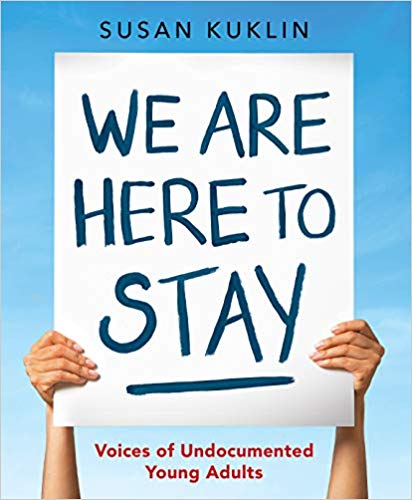
We Are Here to Stay: Voices of Undocumented Young Adults

Author / Photographer: Susan Kuklin
Candlewick Press, 2019 
grades 5-up 
Colombian, Mexican, Ghanaian, South Korean, Samoan

The original title of Kuklin’s book of interviews with undocumented young people was to be Out of the Shadows: Voices of Undocumented Young Adults. This was during the time of the Obama administration’s DACA (Deferred Action for Childhood Arrivals) program, which allowed individuals who were brought to the US as babies or children without documentation—US passports, green cards, or visas—to receive renewable two-year periods of deferred action from deportation and become eligible for Social Security, work permits, driver’s licenses and other necessary documentation. The book was to feature Kuklin’s stunning portraits of the young tellers who were, indeed, out of the shadows. 

However, after the book was imagined and planned and accepted by Candlewick Press for a 2017 release, the interviews accomplished, the portraiture shot and developed, and the book laid out and ready to go to print—the incoming Trump administration moved to repeal DACA, spreading hateful, divisive messages about immigrants, migrants, and refugee and asylum seekers. And the young people, among some 700,000, were forced back into the shadows.

A painful decision had to be made, and everyone decided to stop the presses. But after some two years, during which this volume of young people’s important, truth-telling stories sat in a drawer somewhere, all agreed—Kuklin, Candlewick, and the courageous young people themselves—to bring the book into publication. This was too important, they all said in their own ways, to leave it unpublished. At the same time, it was decided that changes had to be made for the protection of these young people. Here, they are referred to only by their first initials, empty frames replace their portraits, and all other identifying information has been redacted. As Kuklin told me (see interview below), their safety was everyone’s first priority.

In We Are Here to Stay: Voices of Undocumented Young Adults, nine young people from Colombia, Mexico, Ghana, Independent Samoa, and South Korea—now living under the constant threat of deportation to their countries of birth—narrate their “American” lives and, for those who remember, what their lives were like in their countries of birth and what circumstances brought them here. Each chapter is narrated by one or more of the young people. Their narrations are raw and honest. 

Kuklin’s stark, black-and-white photos in Chapter 3 are foreboding images that complement the young people’s stories. They include a sign that warns travelers about encountering “smuggling and illegal immigration,” a heavily-armed Border Patrol officer, a barbed-wire-topped enclosure, surveillance towers, footprints and empty water jugs. 

From G—, who came here from Mexico:

When I say good morning to my parents, I’m never sure that I will be able to say good night to them. I’m afraid to go to school, because it could be the last time I see them for a while. My dad’s got to go to work. He’s got to drive to get there. Because he does not have a US license, if a police officer pulls him over, he could end up in jail. Once he’s in jail, he could go through deportation proceedings. It’s happened to some of my friends—their parents get deported, and they are left alone.

And from Y—, who arrived from Colombia:

A lot of people grow up with shame and anxiety about being undocumented. It’s not something you want to share with people. On the news you hear about “the illegals,” and about all the resources they take from Americans. I don’t think people have a particularly nice image of us. So when I say, “I’m undocumented,” it’s hard to tell how people are going to react….

Maybe next time they hear someone railing about how terrible immigrants are, they’ll think about me. I’m a real person. I go to school with their kids. I have a wonderful family. Maybe after listening to me they will feel differently about immigrants.

Rather than being told (and interpreted) by outsiders, the voices in We Are Here to Stay: Voices of Young Undocumented Adults are authentic and impassioned and moving. This volume is *highly recommended for all home, classroom and library collections; and I look forward to holding an edition in which readers can feel the voices and see the faces of these courageous young people.

—Beverly Slapin
(published 5/1/19; revised 5/2/19, last sentence above.)

*Highly recommended for all home, classroom and library collections.


Note: Susan Kuklin is an award-winning author and photographer whose main interest in her more than 30 books for children and young adults is to address important social issues. Her photographs have been shown in the Museum of the City of New York and in documentary films, as well as published in Time magazine, Newsweek, and the New York Times. She cares very much about young people and getting the story right and, as I found out, she is generous with her time as well. 


INTERVIEW WITH SUSAN KUKLIN


Beverly Slapin: How did you originally envision this book? How has this project evolved? How and why have you and the young people you interviewed had to change your plans since the election of Trump?

Susan Kuklin: The book depended upon who came forward and volunteered to do an interview. One person led to another person. For example, Y told me that she felt really safe in New York but had she lived in Arizona, she probably would not have felt safe. P, a young woman from Mexico, really wanted her story to be in the book, but she was shy. Very, very shy. We met four or five times, but I was unable to get the details and introspection necessary for a narrative. Oh, how she wanted to do this. At one point in between our interviews, I went to Arizona, into the desert, and took photographs for an essay that appears in the book. When I returned, P— and I attempted another interview. I just happened to show her the photographs. “That’s exactly where I was!!!” All of a sudden, her experiences came rushing out. It was a magical moment. And by the way, she’s not shy any more. In fact, P’s arms are on the cover of the book and in the video on my Website.

So these interviews are organic—they’re flashes of memories, with one memory opening to another deeper memory.

How have the young people you interviewed reacted to Trump’s election? How have their lives changed since the election?

Their emotions range from scared to angry to defiant. And those emotions changed from day to day—from hour to hour. Can you imagine what it’s like to wake up one morning and learn that all your documentation—all your hopes and dreams—are down the drain? And also a new government hostile to immigrants has your address and telephone number and all your personal information?

The election was scary for me, so I can only imagine how it was for them. But still, the participants wanted the book to come out.

I felt responsible for their safety and well-being. I didn’t want to do anything to put them in jeopardy. I also realized that I was in effect sending them back into the shadows, the very shadows we saw the book as obliterating. They were much braver than I was. They kept texting me to stop worrying so much!

How has the book been received? How have the tours been received?

Very, very positively. People have been so compassionate about these kids and want to know how they’re doing now. Since the book came out, I’ve gone to border states and have met a number of DREAMers there who appreciate that the book was published.

The full-page frames with no photos in them are jarring; especially since they are all captioned as if they in fact contain portraits. They remind me of so many of the “disappeared” in countries such as Argentina, Chile, Guatemala and other fascist regimes of the time, whose families and communities still struggle to obtain the remains of their “disappeared” relatives. Who arrived at this decision to focus on the young people by “disappearing” their faces and names? Was it a collaborative decision? What do the young people think of it now?

Although it was not my intention to write a political book, the young people’s stories make a statement about what is going on now. 

For the year-and-a-half the manuscript and photos were in a drawer somewhere, I thought the book would never be published. But the participants had made it clear that they wanted their stories told, and those stories needed to be told. I gave them options to help me make the final decision: publish the book as is, publish it using names but not photographs, publish it using photographs but not names, or publish it without names or photographs. They also had the option of dropping out of the project. Everybody had a different idea of what they wanted to do. I decided—based on their views and based on their safety—that we should omit both the photos and names. I told them that I wanted to protect the most vulnerable people in the book. Basically, everyone agreed to protect each other.

I see these empty frames as telling people who look at them that we live in an unfree country and that many people who live here are in real danger. 

Yes, this is our reality. 

Despite the fact that these are all narratives, the book reads like an authentic collaboration. None of the young people who entrusted you with their stories have been named. How were they involved in the editing process? How were they involved in the decision-making process? 

While I was working with my editor, the young people had the opportunity to read the drafts for accuracy, authenticity, and voice. It was back and forth almost until the book went to print. Everything is in their voices, their syntaxes, their rhythms. Their stories are intimate. It was a true collaboration. 

Where are they now?

On one hand, they are in limbo and, on the other hand, their lives go on. Five have graduated from college, four are in graduate school, two are teachers, one’s becoming a journalist, one’s married, another has been able to bring his whole family here. They were raised as typical American kids. They know how to organize. They don’t take fools lightly. At the book launch that most of the New York participants attended, they immediately felt comfortable with each other——it was like they’d been friends forever.

All the participants are looking forward to the time when we can republish the book with their names and photographs—when they can actually come out of the shadows. 


Merci Suárez Changes Gears

author: Meg Medina
Candlewick Press, 2018 
grades 4-7 
Cuban American

It’s the beginning of Mercedes (Merci) Suarez’s sixth grade year, and right away she notices big changes. There’s a new boy in class, just moved to South Florida from Minnesota, and Merci has been assigned to be his Welcome Buddy, but wealthy, popular classmate Edna Santos has set her sights on him. Merci’s older brother Roli has his driver’s license and will soon be leaving for college. Most ominous of all, though, are the changes in Merci’s beloved grandfather, Lolo, who forgets more and more, and now has begun to act strangely—fighting with loved ones and wandering off into traffic. All the older people in Merci’s extended family—all of whom live in three small adjacent houses they call Las Casitas—seem to know what’s going on but won’t tell her.

In this eventful year, Merci encounters bullying, feeling out of place because her private-school classmates can buy things her lower middle class family cannot, family responsibilities that keep her from trying out for sports teams (despite her athletic ability), and facing Lolo’s decline. More than anything else, Merci wants a new bicycle, but all her efforts to make money (or win a contest with a cash prize) end in failure. Nonetheless, the family that takes away is also the family that gives her more than she can imagine as they come together to understand and address a sad situation with no solution. In this novel for middle grade readers, veteran author Medina portrays a close-knit Cuban American family and the diversity of South Florida’s Cuban American community. Her use of humor leavens the serious subject matter while foreshadowing perils to come. For instance, in describing Roli’s attempts to drive, she writes,

Roli has only had his license for a few weeks and already we’ve lost a mailbox and two recycling bins to his skills behind the wheel. Even our cat, Tuerto, has learned to hide when he hears the jingle of car keys.

A determined, engaging protagonist and likeable, true-to-life secondary characters—not only Merci’s lovable family but also her classmates who sometimes hurt her yet have their redeeming qualities—make Merci Suarez Changes Gears a solid and satisfying read. 

*Highly recommended for all home, classroom and library collections.

—Lyn Miller-Lachmann
(published 8/22/18)

This review first appeared in The Pirate Tree (thepiratetree.com). We thank The Pirate Tree for permission.

Julián Is a Mermaid

author: Jessica Love 
illustrator: Jessica Love
Candlewick Press, 2018
preschool-up
Dominican American

On the front endpapers, young Julián, wearing red swim trunks, joins his abuela and her friends as they swim in the local pool. While the adult women hold on to the pool’s wall, Julián swims like a fish, happily blowing air bubbles. On the back endpapers, Julián’s abuela and all her friends—still wearing their swim caps and patterned bathing suits—have become mermaids, the pool has become open water and all of them are submerged and blowing bubbles. At the forefront is Julián, a purple mermaid with a long yellow tail, his hair loose and flowing. He’s looking directly at the readers, inviting them to join the party. 

In an exemplary model of “show, don’t tell,” Love limits her-matter-of-fact text (“This is a boy named Julián. And this is his abuela. And those are some mermaids. Julián LOVES mermaids.”), and employs her luscious art to welcome young readers into Julián’s world. 

As the story begins, we meet Julián and his abuela, returning from the beach and headed towards the subway. Julián is holding a large picture book about mermaids that his abuela has given to him. When the two sit down, Julián turns to his abuela, his eyebrows raised, questioning. Soon after, three fabulous turquoise mermaids board the train and one waves at the entranced Julián.


In a dream sequence inspired by the pictures in his book and by the three mermaids, the train fills with water as Julián strips down to this tighty-whities and transforms himself into a fabulous mermaid with long, flowing hair, a purple lower body and yellow tail. In a sea of gorgeous turquoise-green, he swims with a variety of sea creatures, and accepts a necklace from a large blue fish with white patterned scales. Hold that thought, and look for the blue-and-white pattern later on.


Copyright © 2018 by Jessica Love. Reproduced by permission of the publisher, Candlewick Press, Somerville, MA.

Abuela wakes him. It’s time to go. Julián and the mermaids wave to each other. On their way home, he asks Abuela if she had seen the mermaids. “I saw them, mijo,” she says. As the two reach their front door, Julián tells her that he is also a mermaid. Now, having come out to her, Julián’s posture has changed. He’s standing tall now, relaxed and smiling. 

While Abuela takes a bath, Julián has an idea. He strips down to his tighty-whities again, creates a headpiece with wavy fronds from Abuela’s potted fern and flowers from her vase and a mermaid’s tail from a gauzy, flowing curtain, and finishes the look with Abuela’s purple lipstick. He. Is. Fabulous. As he reaches for a hanging philodendron, Abuela comes out, looking upset. Uh-oh. She retreats to the bathroom and soon emerges—in a blue dress with white patterns. And she gives Julián a necklace. Together, they walk to the Mermaid Parade, where she tells the shy little boy, “Like you, mijo. Let’s join them.” And they do. In the parade are many of the sea creatures Julián had swum with in his dream sequence and, at the head of the line are the three mermaids who had been on the train. Julián waves. They wave back. Everyone is fabulous.

Love skillfully uses vibrant watercolors, gouache and ink in mostly double-spread, full-bleed illustrations whose vivid details virtually glow against the soft matte background of brown kraft paper. She lovingly depicts the broad range of complexions and body types and ages of the community’s women; and attends to small but important details, such as Julián’s raised eyebrows when he’s trying to figure out Abuela’s expression, or a slight slump of his shoulders when he’s not sure of something, or his chin held high when he becomes part of the parade. There is also not-so-hidden symbolism, such as the relationship between Abuela and the giant blue fish, or that between three girls joyfully playing at an open fire hydrant and the three mermaids Julián meets on the train. In addition, many of the full-bleed, double-page spreads are wordless, so child readers can discern the action without being told exactly what’s happening. 

And not least importantly, it’s refreshing to see Spanish words that are not italicized.

In giving Julián this picture book about mermaids, Abuela is both acknowledging and encouraging his emerging self. In this sense, it’s clear that both Julián and Abuela have agency. Throughout, their relationship is strong; he questioningly looks to her for guidance, and her loving affirmation feeds his spirit and enriches his life. 

When Julián quietly tells his abuela that he is also a mermaid, the little boy is telling her that he’s finding his place in the world. And, on the end papers, when he joyfully swims with his own abuela and the community’s other abuelas—all of whom are also mermaids—he’s claimed his own identity and has found his place. 

While Dominican American children who live in Brooklyn will recognize the people, the neighborhood, the G train to Coney Island, and, of course, the annual Mermaid Parade, the author wisely leaves the door wide open, so to speak, as an invitation for other children to enter the story as well. 

Throughout this delightful, life-affirming picture book, young readers will see young Julián growing into the person he was meant to be. Full of love and joy, Julián Is a Mermaid is for all questioning children and children who may not conform to the “norms” of their genders—and for everyone else as well. Julián Is a Mermaid is highly recommended.

—Beverly Slapin
(published 5/13/18)

[Note (9/29/18): Please see “Another look at JULIAN IS A MERMAID” here]


Míl gracias a mi coleja y amigo, Noam Szoke. You’re FABULOUS!

(Y gracias a Candlewick Press for permission to reprint the illustrations in the body of this review.)