Showing posts with label Lee & Low. Show all posts

Zombies Don’t Eat Veggies! // ¡Los zombis no comen verduras!


author: Megan Lacera
illustrator: Jorge Lacera 
translator (Spanish): Yanitzia Canetti 
Lee & Low, 2019
kindergarten-grade 3 
Zombie

In the latest series of Kraft Foods TV commercials, non-Zombie parents who insist that their children eat nutritious foods chase them around the room or verbally battle with them—until discovering that offering them macaroni and cheese solves everyone’s problem. 

Ineffectual parenting
notwithstanding, the point is that just about all families want their children to be healthy. Although their definitions of “healthy” might be different from those of the rest of ours, Zombie families want the best for their kids, too. 

In Zombies Don’t Eat Veggies! and its Spanish version, ¡Los zombis no comen verduras!, young Zombie Mauricio (“Mo”) Romero cannot and will not abide his parents’ cultural food preferences. Among them are—yum!—arroz con spleens, chili con ojo, dori-toes, and arm-panadas. No, Mo is different. He has a secret, “deep, dark, dreadful, devious” craving for something “absolutely despicable”—horrors!—vegetables. Vegetables of all kinds! 

Mo earnestly attempts to convince his parents to integrate vegetables into their Zombie culinary world. First, he presents them with the stomach-churning (to them) book, Eating Vegetables by "Jonathan Saffron Gore," a Zombie tongue-in-cheek reference to Eating Animals, in which author Jonathan Safran Foer challenges readers to examine their eating habits.

When that argument fails, what Mo secretly concocts for his parents—with ingredients from his hidden veggie garden and prepared in his secret kitchen—is too good to divulge. (OK, it’s a delicious vegetarian gazpacho disguised as a delicious bloody mess, which he calls “blood bile bisque.”) Although Mo’s ploy is a bust—his Zombie parents hate the gazpacho—they know they must support their young Zombie son because they are a Zombie family and they love him beyond death.

Megan Lacera fills her tale with hilariously exaggerated puns (Mo’s mom offers him a bowl of delicious “finger foods,” and Mo begs his parents to “give peas a chance”), which Jorge Lacera complements with over-the-top cartoon images on a Zombie-centric palette of mostly darkened browns and greens. Here, for instance, young readers will see Mo and Mom proudly gazing at Dad, who displays his first-place trophy in the much-(Zombie)-coveted “competitive brain-eating contest.”

Lacera’s digitally rendered illustrations, in which the individuals in this Zombie family have varying complexions—Dad is brown, Mom is dark green, and Mo is light green—authentically reflect the multiethnic reality of the Zombie community. Plus, they’re very, very funny.

While the English version contains appropriate conversational code-switching, super-talented translator Yanitzia Canetti’s Spanish version not only reflects the cultural nuances of the spoken language, but effortlessly blends in spot-on Zombiana, which she has apparently studied. While Mom hopefully presents Mo with a bowl full of (literal) “finger foods,” the Spanish might be “comida de dedos.” But Canetti refers to it as “deditos en salsa” (literally, “little fingers in sauce”). She also adds or subtracts words or word parts to Zombify the Spanish, creating delightful names for the foods to reflect an unmistakable Zombie-centric flavor. For instance, she uses a hyphen to morph “patatas” (potatoes) into “pata-tas,” with “pata,” of course, meaning “foot.” As well, she employs Espanglish phrases in a way that will have young hablantes giggling. For instance, when Mo’s parents hesitantly agree to try his vegetarian dishes, an illustration shows them grimacing and taking (in English) “only a teeny tiny bit,” while in Espanglish, it’s “una probadita rechiquitita” (“a tiny retch-inducing taste”).

Hablantes and English-speakers—Zombies and non-Zombies alike—will love this well-done and totally silly story of the meaning of family, yearning to belong and daring to be different. And non-Zombie kids will see connections to their own lives as well. 

*Highly recommended for home, classroom and library collections. 

—Beverly Slapin
(published 7/18/19)


Muchísimas gracias a mis amigas Zombistas, Judy Zalazar Drummond y Lyn Miller-Lachmann.

Home at Last

author: Susan Middleton Elya
illustrator: Felipe Davalos 
Lee & Low, 2002 
grades 1-3 
Mexican

Eight-year-old Ana Patiño and her family—Mamá, Papá, and baby twins, Jesús and Julio—come from a village somewhere in Mexico and move to “a town surrounded by corn” somewhere in the US. We don’t know what circumstances brought them here; all we know is that, from the first page, Mamá is “already missing home.” (Apparently, this “town surrounded by corn” does not contain Spanish-speaking agricultural workers—actually, it doesn’t contain any agricultural workers at all. Maybe it’s the off season, even though the illustrations show a field full of corn that’s ready to be harvested.) The first spread shows Ana, curiously looking out the window at the field full of corn. Maybe she’s wondering about the absence of farm workers, too.

“After the family settles in,” the story continues, Ana is in school, in what appears to be a friendly, multiethnic third-grade classroom with a supportive teacher who encourages her to say “hello.” At first, Ana is too shy, but by afternoon, she’s saying “hello.” By the next spread, we are told that Papá has gotten a job at the factory where Uncle Luis works, and Ana likes school. Mamá is in the kitchen, and the babies are probably taking a nap. On the next spread, Ana is back in school. There are a calculator and lots of art supplies, all the students are smiling and the teacher is looking on as the students share their artwork.

The next day Ana learned to say her name in English. Everyone in the class practiced with her. By the end of the day she had said “My name is Ana Patiño” a dozen times.

Let’s stop here for a moment. The child’s name is Ana Patiño. It’s the same name in English as it is in Spanish. A name is a name. Exactly what is it that she’s practicing? And why is everyone else practicing? And why is it taking all day? Everyone is sure devoting a lot of time to saying Ana’s name. If this is a third-grade classroom as it appears to be, don’t the students and their teacher have anything else to do? Like study for standardized tests?

On the next spread, Ana and Papá are practicing English together and keeping the babies entertained while Mamá is boiling rice and beans (because that seems to be all that Mexicans eat). Mamá wants to understand English, but when Ana suggests that she could learn, she responds with “¡Imposible!” (Except for “¡Imposible!” just about every Spanish question or phrase in the dialogue is repeated in English. This is annoying.) 

The next pages depict Mamá’s problems because she doesn’t speak English: a rude grocery clerk who overcharges her, an inability to read Ana’s teacher’s note, and finally—The Crisis That Changes Everything. Mamá panics because baby Jesús is running a fever, Papá’s not home from work yet, and their neighbors “didn’t understand her frantic Spanish.” Or gestures. Or the fact that she’s holding a sick baby and apparently doesn’t know what to do because she doesn’t speak English. 

Let’s stop here for a moment. Why, with two babies and an eight-year-old, is Mamá so helpless that she can’t treat a baby with a fever? Why isn’t she resourceful, as Mexican parents are? Why doesn’t the family have remedies in the apartment? Such as baby aspirin or Tylenol? Or apple cider vinegar to mix with water? Or alcohol to rub on the legs? Or chicken broth? Or any of a number of Mexican herbs? Why can’t the English-speaking neighbors understand the gestures of a panicky mother with a sick baby? Why can’t Ana, who speaks English, find a neighbor who can help or go to the store and get something?

Finally, Mamá agrees to learn English. So she goes to evening school while Ana and Papá prepare “overcooked pork wrapped in a tortilla” for her (because only Mexican mothers know how to cook), she learns “how to count, how to answer the phone, and how to shop at the store,” and—aces her test! With Ana watching proudly, Mamá corrects the grocery store clerk who had cheated her the first time (after which “she dances around on the sidewalk”). And one might surmise that she now knows what to do when one of her babies gets sick. 

After hurrying back to the apartment where Papá, Uncle Luis, and the twins are waiting, she declares (in English), “We’re home!” Meaning the US, not Mexico, is now their home. The End.

Home at Last was probably written to help English-speaking children understand the struggles of new immigrants. But this unrealistic and didactic story serves only to reinforce the stereotype of Mexican women as helpless and dependent; and to infantilize a Mexican mother with several children, who needs the pressure of her husband and daughter to learn to speak English, which will be interpreted as the only road to empowerment, not to mention survival.

Davalos’s vivid oil paintings, on a bright and varied palette that beautifully depicts facial expressions as well as a multiethnic neighborhood and classroom, are not enough to save this poorly conceived and poorly written story. Home at Last is not recommended. 

—Beverly Slapin
(published 10/26/17)

¿Hasta Dónde Me Amas? // How Far Do You Love Me?

author: Lulu Delacre 
illustrator: Lulu Delacre 
translator /interpretor (English): Verónica Betancourt 
Lee & Low, 2013 
all grades

Stories about children or anthropomorphic young animals looking for boundaries appeal to youngsters all over the world. Sometimes these are teaching stories that give young listeners or readers a safe place in which to think about the limits of what they can and cannot do.

In Margaret Wise Brown‘s delightful Runaway Bunny, a little kid bunny verbally spars with his momma bunny, testing her unconditional love by declaring his plans to run away from home. As the momma bunny joins in the game, the little kid bunny’s imagined escapades—from becoming a fish to a flower to a rock to a bird to a tree to a sailboat to a circus performer to a little (human) boy—finally land him at home, where momma bunny reassures him that she’ll always be around to take care of him. In 1942, when much of the world was at war, momma bunny’s calm reassurance resonated with little human kids and, along with Brown’s Goodnight Moon (1947), still does.

In the years following the publication of The Runaway Bunny, there have been many picture books that focus on children’s or young animals’ testing their parents’ unconditional love for them; each one ends with the parent (usually the mother) affirming an everlasting love for the child.

In 1991, author Barbara M. Joosse and illustrator Barbara Lavallee created the first best-selling “multicultural” version of a child’s testing a parent’s unconditional love: Mama, Do You Love Me?, featuring an Inuk child and her mother. This abysmally written and –illustrated appropriation of Inuit life and culture proved to be a lucrative project, and in 2005, the Joosee-Lavallee team followed with the equally awful Papa, Do You Love Me?, which featured a Maasai child’s testing his father.[1]

An earlier, and much better written, story of the love between mother and child is On Mother’s Lap by Ann Herbert Scott and illustrated by Glo Coalson. This story, originally published in 1972 and republished in 1992, also takes place in the Arctic, but focuses on “showing” rather than “telling.” And the little-known but no less beautiful Mama’s Little One by Kristina Heath, may be difficult to obtain, but is well worth searching for.[2]

And now, multi-talented (and multiple award-winning) artist, author and poet, Lulu Delacre, has created ¿Hasta Dónde Me Amas? and How Far Do You Love Me?, two gorgeous picture books about love for youngest listeners to readers of all ages—containing neither conflict nor testing nor “runaway multiculturalism.” Rather, her lyrical verses that describe the love between adults and children—in both Spanish and English versions—are deceptively simple, yet complex in their connection with the lands and peoples; and stunningly illustrated with soft pastels, lush with intense color.


Each dazzling double-page spread tells a story of its own. From the beautiful sandy beaches of Vieques, to the top of the Grand Canyon, to a freshwater spring in Yucatán, to the unimaginable heights of Machu Picchu, to an enormous glacier in Antarctica, to where the sun and the rain produce a rainbow on the Serengeti Plain, to the crests of the desert in the Sinai, to the lavender fields of Provence, to where the river meets the sea in the Alps, to a Himalaya Mountain Range, to the bright pink water lilies floating on the Mekong River, to a gigantic eucalyptus on Kangaroo Island, to the coral reefs on the ocean floor of Queensland, and back to Vieques, are parents and their children, enjoying each other’s company and living in their worlds.

Here, at the top of a peak in the Grand Canyon area of Arizona, a father talks with his daughter who is perched on his shoulders. Here, in the windswept desert of the Sinai, a mother cradles her infant. Here, in a field of lavender in Provence, three girls pick flowers as an adult watches from a distance. Here, in the Mekong River, a joyful little girl and her parents paddle amidst the bright blossoms of water lilies. Here, on Kangeroo Island, a young boy and his father lean against an enormous eucalyptus tree that just about touches the sky.

The books begin and end with a mother and her young son in Vieques, the place of Delacre’s birth. In the first illustration, the two are lying on the warm sand, and the boy asks, “¿Hasta dónde me amas?” or “How far do you love me?” And on one of the final spreads, the circle is closed as Mamá asks her son, “¿Y tu? ¿Hasta dónde me amas?” or “And you? How much do you love me?” To which the child answers, “¡Yo te amo hasta la luna!” or “I love you to the moon!” and as she kisses her child goodnight, Mamá says,

Y yo, hasta más allá de las estrellas,
donde la luz déjà de verse en el espacio
más allá de universos conocidos
y se vuelve en el amor
que anida dentro,
muy adentro de ti.

And I love you farther than the stars,
to the space beyond the space we know,
where light becomes love
that nestles deep,
deep inside you.

“The inspiration for the original poem in Spanish,” Delacre told me, “was a game I used to play with my own daughters when they were little. We never played ¿Cuánto me amas...? We played ¿Hasta dónde...? It was always fun trying to travel farther and farther away by showing the length and depth of our love.” One afternoon, she said, after going for a walk and thinking about the love she felt for her daughters, she sat down to write what she had composed in her head. “I've traveled to many places in my 32 years of marriage when I wrote the poem,” she said, and “without those trips I don’t think the poem would have come to me so effortlessly. So did it take 45 minutes to write it or 32 years?” Maybe somewhere in between, I’d guess. In any event, it’s clear that Delacre did not sit down to write a marketable bedtime picture book with conflict that called for resolution. And I’m glad for that.

After writing the lyrical Spanish, Delacre gave the text over to her daughter, Verónica, who worked with her mother to craft these books into an evocative dual-language expression of love. Without polemic and without belabored notes about “multiculturalism,” what Delacre shows—rather than tells—is that, across continents, cultures, ethnicities and religions—caring adults love their children.

Some other plusses: On the next-to-last spread, Delacre has hand-lettered “the question” in 23 different languages in order to prompt children and loving adults to play in the language of their choice. There’s also a map that references the 13 locations around the world in which the poems are situated.

However, there was a missed opportunity here that I feel must be addressed, so I’ll direct these questions to the publisher: Why was this brilliant book—originally written in Spanish—published first in a small English-only hardcover, and then later, seemingly as an afterthought, in an even smaller, Spanish-only paperback? Why wasn’t this awesome work seen as important and beautiful enough to have been made into a much larger, hardcover, bilingual book, with the Spanish text predominant? Such an effort would have given more space to the art and would have made the one book accessible to both hablantes and English speakers. And, finally—wow! Why didn’t someone catch that the title on the title page of the Spanish version is missing an initial interrogation mark? (This was a major typo.)

As they stand, both ¿Hasta Dónde Me Amas? and How Far Do You Love Me? encompass a beautiful journey of endless love, without conflict, without testing; and they are highly recommended. Lulu Delacre is a kind, generous spirit—an international treasure whose art and words are a gift. Muchísimas gracias, Lulu.

*Highly recommended for all home, classroom and library collections.


—Beverly Slapin
(published 5/1/16)


[1] See my essay, “Runaway Multiculturalism,” in MultiCultural Review, vol. 15, no. 3 (Fall 2006), p. 114.

[2] See reviews of both of these titles, along with Mama, Do You Love Me?, in A Broken Flute: The Native Experience in Books for Children, edited by Doris Seale and Beverly Slapin (AltaMira Press, 2005), p. 302.

Summer of the Mariposas


author: Guadalupe García McCall
Lee & Low, 2012 
grades 7-up 
Mexican American

Following the success of her verse novel, Under the Mesquite, Guadalupe García McCall’s excellent second novel explores the Mestizo heritage of her characters through a story filled with mystery and magic realism. Fifteen-year-old Odilia Garza, the eldest of five girls living in a Texas town across the river from Mexico, has always thought of herself as descended from the Spanish conquistadores. Although her mother is darker, her father, who abandoned the family several years earlier, has the complexion of a European.

After Odilia and her sisters discover the dead body of a man floating in their favorite swimming hole, the ghost of La Llorona—the mythical woman who drowned her children and is doomed to wander the earth forever—visits her. Here though, La Llorona is mourning not only her own children but also the Aztec people who have lost their connection to their noble past. As La Llorona tells Odilia,
It is an eternal atonement, to watch over the children of the sun, the children of my people, the Azteca bloodline…Yes. You are descendent of a great people. 
La Llorona gives Odilia a magic pendent—the ear pendant of the Aztec Serpent God Cihuacoatl—and together with her bickering sisters, Odilia drives across the border to return the dead man to his family and to find her estranged paternal grandmother. McCall interweaves traditional legends, magic realism, and the hero’s journey to create a powerful tale of understanding and triumph featuring a resourceful and memorable heroine.

One of the major contributions of this novel is the reconsideration of the legend of La Llorona, who, like La Malinche, has been used for centuries to enforce patriarchy and the subjugation of women. Even Odilia has absorbed the myth that portrays women as weak and treacherous, needing protection from their own impulses:
I had heard so many awful things about Llorona that I couldn’t help it, I pulled away from her and took a few steps back. “But you . . . killed your children.” It was common knowledge, more than a legend. 
In Summer of the Mariposas, the male adults are the weak ones—the father who abandons the family and the dead man who needs the girls to return his body and spirit to his wife and children. As La Llorona explains to Odilia, 
“You were chosen for the goodness in your heart…. Like Juan Diego, the most humble of the Virgen’s children, you are noble and kindhearted. You displayed great courage when you jumped into the water to save my sons. Your sister was right when she said finding the body of the drowned man was not an accident.” 
Also memorable are the other sisters, each of whom has her own personality and strengths, as one of Odilia’s tasks is to get them to work together rather than against each other. Summer of the Mariposas is a gripping tale that is also a welcome commentary on going beyond what’s “common knowledge” to get at the truth, and the importance of discovering and appreciating one’s mixed heritage. Highly recommended.

—Lyn Miller-Lachmann
(published 7/4/15)

Birthday Swap


author: Loretta Lopez
illustrator: Loretta Lopez
Lee & Low, 1999
kindergarten-grade 3
Mexican American

In this sweet autobiographical story, six-year-old Lori, who lives with her family in a town on the US side of the border with Mexico, wants to find the perfect birthday gift for her teenage sister, Cookie. On the day before the annual family reunion that marks Cookie’s birthday, Lori and her mother go shopping at a mercado on the Mexico side. Although Lori finds things she would like for herself—such as a donkey piñata or a puppy—she just doesn’t find anything she thinks her sister would like. When they arrive home, the whole family’s involved in preparation for the party; and the next day, Lori, whose birthday is in December, finds that Cookie has “swapped” birthdays so that Lori could have a huge summer party, too. And, there’s the donkey piñata she had seen at the mercado and, best of all—the puppy.

The text is in English with a smattering of Spanish terms, mostly family words and endearing phrases; this is very common with families who’ve been in the US for several generations.

Lopez’s illustrations, rendered in gouache and colored pencils on watercolor paper, are warm and bright and inviting. The text is attractively bordered with pictures of objects commonly sold in mercados, so different from supermarkets here. And I especially appreciate that Lopez has portrayed Lori and her relatives—actually, Lopez’s own relatives—as real people, clearly Latino, without exaggerated features, with varying skin tones. It’s unfortunate that this is not the case in many, if not most, picture books in today’s “multicultural” market.

Based on the author’s own surprise birthday party, Birthday Swap realistically depicts an event in the life of a Mexican family residing in a border town, easily moving back and forth between the US and Mexico to visit, shop and run errands. Although it was disappointing that Lori did not wind up finding or making a gift for her older sister, Birthday Swap is a good addition to a collection about Latino families, and is recommended.

—María Cárdenas
(published 2/21/14)

Amelia’s Road // Lights on the River


author: Linda Jacobs Altman
illustrator: Enrique O. Sanchez
Lee & Low, 1993
kindergarten-grade 3
Mexican American


author: Jane Resh Thomas
illustrator: Michael Dooling
Hyperion, 1994
grades 2-4 
Mexican, Mexican American

Since 1960, the terrible conditions of migrant agricultural workers in this country have been public knowledge.[1] Today, hundreds of thousands of children in the US work in agriculture[2] and, since César Chávez and Dolores Huerta founded the United Farm Workers in 1962, the organization has exposed and campaigned against the dangers of agricultural labor, particularly to child workers.

It’s not required for a picture book about a tough subject to overwhelm young readers. But children are capable of complex thinking, and empathy comes from understanding one’s own life and the lives and struggles of others. There are wonderful picture books, for instance, about the struggles of agricultural workers for human rights.[3] It can be done.

The story of families who are migrant farm workers is the focus of two children’s picture books, both published in the early 1990s. But Amelia’s Road and Lights on the River are very different from each other in the ways that each author relates the issues. One encourages empathy and discussion; the other encourages only pity.

Every time Amelia Luisa Martinez’s father picks up a map, it means the family has to move again, to follow the ripening crops. The child longs for a place she can call home, where the teacher knows her name, where she has friends, where her family doesn’t have to “mark all the important occasions of life by the never-ending rhythms of harvest.” One day after her morning’s work, Amelia hurries off to school. Here, she meets Mrs. Ramos, who introduces her to the other children and, when Amelia draws a picture of a house with a large tree in the yard, gives her a red star. When Amelia takes a different road back from school, she sees a large tree just like the one she has drawn, and feels connected to this tree and this place. Although Amelia and her family have to move on, she gives the tree a gift that ensures that she will return. Amelia has set down roots; for now, this is her road, this is her place. Sanchez’s acrylic-on-canvas paintings, on a palette of rich, bright, colors, show a loving family, working hard and being together. Amelia’s Road will resonate with young readers, especially those who work in the fields. Highly recommended.

In Lights on the River, young Teresa doesn’t work and doesn’t go to school—her only job is to take care of the younger children while her family toils among the cucumber vines nearby. Here, under a shade tree, she cuddles her doll and dreams of the happy times, spending Christmas Eve with her grandmother in “Mexico, far away,” where there is family, music and plenty to eat. Moving from camp to camp, Teresa and her family are alternately exhausted, sad, miserable, humiliated, enraged, and resigned to their pitiful existence. “We carry our house on our backs,” Teresa’s mother sighs.

At one farm, Teresa’s family is forced to live in a chicken coop with two dirty mattresses, an outside pump and a filthy outhouse. When she accepts a chocolate-chip cookie from the “woman farmer” and sees the contrast between her life and that of the farmer’s family, “her throat was so full of anger that the cookie stuck.” For Teresa, this contrast drives home the hopelessness of the Mexican family’s lives, and fuels both her mother’s silent rage and Teresa’s impossible dreams.


Papi and Gabriel had planted an orchard of their own. Mami ran a café with screened doors and curtains at the windows, where Teresa served beans and chicken and chocolate-chip cookies….Nobody’s stomach growled with hunger. And every night Teresa rested in Abuela’s dooryard with the people she loved, listening to Papi’s guitar.

As Teresa’s mother lights the luminaria candle, a present from her grandmother—“Abuela gave us the sand and the light to keep the village alive in our hearts,” Teresa “listened to Papi’s song as Mami pulled her into her lap, the place that was always home.”

In stark contrast to Sanchez’s artwork in Amelia’s Road, Dooling’s dreary oil paintings, on a palette of mostly dark browns and greens, complement the dreary text of Lights on the River. 

Thomas’ writing is superficial and trite, and full of cultural errors. According to her author’s note, she “wrote this story more than forty years after seeing several migrant farm workers standing at the doorstep of the chicken coop where they were housed on a Michigan farm. The people I saw as a child were Mexican.” It wouldn’t be a stretch to opine that the pity she felt as a child remained when she wrote Lights on the River. Mexican children of migrant agricultural workers deserve much more than this. Not recommended.

—Beverly Slapin
(published 2/17/14)


[1] On the day after Thanksgiving in 1960, “CBS Reports” aired a documentary presented by broadcast journalist Edward R. Murrow. Called “Harvest of Shame,” it brought public attention to the horrible conditions of migrant agricultural workers in the US.

[2] See, for instance, Human Rights Watch, “Labor Department Abandons Child Farm Workers” (http://www.hrw.org/news/2012/05/07/labor-department-abandons-child-farmworkers).

[3] See, for instance, the reviews of César: ¡Sí, Se Puede! Yes, We Can! by Carmen T. Bernier-Grand, Gathering the Sun: An Alphabet in Spanish and English, by Alma Flor Ada and Rosa Zubizarreta, and Harvesting Hope: The Story of César Chávez by Kathleen Krull.

Arrorró, Mi Niño: Latino Lullabies and Gentle Games


selector: Lulu Delacre
illustrator: Lulu Delacre
musical arrangers: Cecilia Esquivel and Diana Sáez
Lee & Low, 2004
preschool-grade 2
Latin American

As a toddler, my son never walked. Every morning, he would practically wake up running! In his exuberance, he would run and fall down, run and fall down, run and fall down. Sometimes, he’d scrape his knee—and cry. And I would comfort him by placing my hand over his knee and whispering:

Sana, sana,
colita de rana.
Si no sanas hoy,
sanarás mañana.

Loosely translated into English, the words are:

Heal, heal,
little frog’s tail.
If you don’t heal today,
you’ll heal tomorrow.

So I was particularly happy to see this rhyme in Lulu Delacre’s little book of 15 lullabies and gentle games from Latin America. In Spanish and English—with the lovely, rhythmic Spanish predominant—this captivating little book shows the many faces of La Raza. Here, parents and grandparents, neighbors, teachers and friends—in school, at the market, in the park, at the library, in a museum, on a farm and in the strawberry fields—demonstrate their love for the community’s children. Delacre’s full-bleed watercolor spreads, with mostly warm earth-toned backgrounds, are calming and perfectly suited to the short rhymes. Several of these offer a few lines of simple instructions for how to play games that accompany the rhymes; and the end of the book provides sheet music so youngsters can sing along. A quiet treasure, Arrorró, Mi Niño is highly recommended.

—Beverly Slapin
(published 6/6/13)

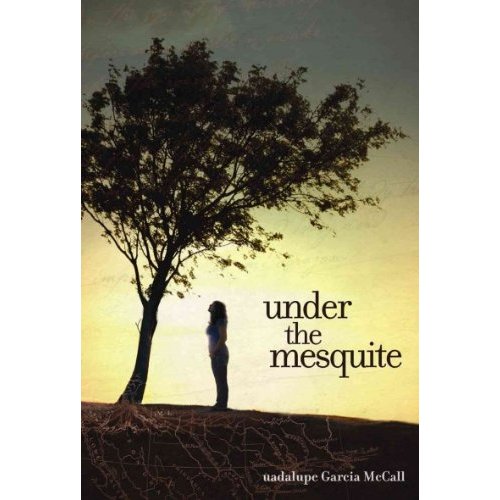
Under the Mesquite

author: Guadalupe García McCall
Lee & Low, 2011
grades 7-up 
Mexican American

 In 2012, the American Library Association announced the winners of the Youth Media Awards, an event one colleague compared to opening a pile of holiday gifts. The “gift” that made me the happiest this year was the Pura Belpré Award for Writing, which went to Guadalupe García McCall’s debut novel-in-verse Under the Mesquite, one of the most achingly beautiful novels I’ve read in a long time. It is a story from the heart, not written to fit into a marketing category but to remember, to honor, and to bear witness.

In Lupita’s freshman year of high school, her beloved mother is diagnosed with uterine cancer. Over the next three years, the budding poet and star student who is the oldest of eight children, chronicles the ups and downs of her mother’s chemo treatments, remission, relapse, and desperate journey from Eagle Pass, Texas, to Galveston in search of a miracle cure. Lupita’s father drains the children’s college accounts to finance his wife’s treatment, and when he accompanies her to the medical center in Galveston for several months, Lupita struggles to control her seven siblings, some of whom withdraw while others rebel and begin to hang out with a fast crowd. Without their father’s regular income and with their savings gone, the eight children go hungry and must beg food from neighbors in their impoverished Mexican-American community. Despite all their love, prayers, and devotion, Mami dies. Lupita finds solace and resolution on a visit to relatives in Mexico, and she comes to realize that she must follow her dreams of higher education and writing rather than continue to sacrifice everything for her family.

Under the Mesquite combines beautiful poetry and a compelling story. The reader sees Lupita’s talent, and her poetry invites us into her rich internal life. It expresses her love for her mother, her dedication to her family, her changing relationships with friends, and her dreams for herself. The poems are layered in meaning and contain words of wisdom passed down through generations: “…while friends / are the familia we choose / for ourselves, we still have to work / at staying close.” The condensed language of the poetry gives this novel emotional power and is perfectly suited to a story about a large, close family thrown into crisis by a mother’s diagnosis of cancer.

A hallmark of great literature is its ability to reveal “between the lines” a culture, a time period, and the struggles facing individuals and communities at that time. As I read Under the Mesquite, I could not help but think of the family impoverished by Mami’s medical bills, the emptying of eight children’s college accounts—their ticket to a brighter future—and children forced to scavenge for food and clothing. Texas has the highest rate of people without health care in the country, leaving thousands of families to make the choice to let loved ones die for lack of funds or face poverty and homelessness in an effort to save them.

I hope that the prestigious Pura Belpré Award, given to the best book written and illustrated by an author of Latina/o heritage, helps to give Under the Mesquite a wide readership. This book is truly a gift. Highly recommended.

—Lyn Miller-Lachmann
(published 4/9/13)

When This World Was New


author: D.H. Figueredo
illustrator: Enrique O. Sanchez
Lee & Low, 1999
kindergarten-grade 4 
Cuban American


Years ago, I used to teach cultural universals by showing young children how to research their own and each other’s cultures. They’d talk about what they’d like to find out about their parents: What kinds of games did they play? What games did their parents and grandparents play in the countries they came from? We’d also research things, such as what kind of work their relatives did, what languages they spoke, what foods they liked to eat. Initially, the children would find out the similarities and differences between themselves and their older relatives and their classmates—and that people are generally more similar than different. Ultimately, this kind of research makes it easier to study peoples who are very different from theirs, and allows them to put these differences into a social and cultural context.

Every culture has things that they do that are similar to every other culture. When you bring together children from various cultures—and encourage them to talk about their cultures—they find much more commonality than difference.

None of this happens in When This World Was New. Here, a young boy from a Caribbean island somewhere where Spanish is spoken emigrates with his mother and father to somewhere else where English is spoken. They meet the boy’s uncle, who sets them up in an apartment, gives them food for a week, and finds the father a job in a factory. This new place has snow. This child has never seen snow before, and he doesn’t know how to walk on ice. But, with his father’s help, the boy’s experience with the snow gives him confidence. The unstated moral is that your circumstances may change but things will probably work out.

A perusal of the back matter, CIP data and dedication—none of which children will see—reveal that the family has emigrated from Cuba to New York.

When This World Was New is a “universal” story, but there is no culture, other than the family speaks Spanish. In an attempt to tell a universal story about moving, the author disappears the social and cultural contexts, and leaves young readers with questions: Where is this child from? Where is the rest of his family? Why did he leave his country of origin? Why is he now in the US? How will he do in school? Young readers who have migrated or emigrated here might have additional questions: How come it was so easy to find plenty of food, a nice place to live and a good job?

This story doesn’t require, or even encourage, any complex thinking. But young children have complex lives and are capable of understanding complexity in other people’s lives. And that’s how you foster compassion: by showing other people’s lives in a way that children can relate to—without taking away the story.

Rather, by creating a “universal” story, the author ignores all the issues and the lived realities that often confront migrant and immigrant children. There’s no culture shock because there’s no culture, only the shock. When This World Was New is as bland as Pablum, but less nourishing. Although I like Sanchez’s soft acrylic paintings, I can’t recommend this book.

—Donna Amador
(published 4/9/13)

Poems to Dream Together / Poemas para sonar juntos


author: Francisco X. Alarcón
illustrator: Paula Barragán
Lee & Low, 2005
grades 2-5
Mexican American


cierra los ojos           
       close your eyes
y ahora prepárate
       and now get ready
para saltar a un sueño
       to hop on a dream


In this collection of 17 short, gentle bilingual poems, Alarcón celebrates hard-working parents, the blessed hands of farm workers, daydreaming children, taking care of the home and the family garden, the great dream of César Chávez, the ultimate relationship of all things, and dreaming together of a better world.

Barragán’s flat, brightly colored, mixed media artwork resembles paper cutouts or silkscreens, but if one looks closer, the intricacies of each design become apparent. The poems and art together are totally engaging and varied in placement: sometimes the Spanish version is above the English, sometimes the English is above the Spanish, sometimes the two are side by side, sometimes they’re on facing pages. Highly recommended.

—Beverly Slapin
(published 4/7/13)