Showing posts with label Elisa Amado. Show all posts

Wounded Falcons


author: Jairo Buitrago

translator (from Spanish): Elisa Amado

illustrator: Rafael Yockteng

Groundwood Books, 2021 

grades 3-up


“It was a bad day at school.” Young Adrián’s face is bloody and bruised, his shirt is torn, and his fists are clenched with rage. It’s always a bad day at school. Adrián gets into trouble with everyone—except his friend, Santiago, who never has any problems and never has any bad days. Yet the two are friends.


Before going home, the two friends sit in the middle of a garbage-strewn empty lot “that doesn’t belong to anyone, where no one ever comes.” In a clump of grass, Adrián finds a young, wounded falcon, scared and unable to fly. The boy wraps the bird in his jacket to keep her warm, and promises to take care of her.


At home, Adrián looks to his mother for advice about curing the bird’s broken wing—but receives instead a mean-spirited promise: We already know what happened at school…Later, your father will give you what you deserve. The next day, Adrián skips school and meets up with Santiago in the empty lot “where no one ever comes.” Santiago takes him and the falcon to someone who “cures broken bones”—and pays for the treatment with his Christmas money. Together, the two friends gently care for the wounded falcon. And in science class, “even though the others laugh and whisper,” Adrián speaks for the first time, giving a talk “about birds of prey, about their strength, about their beauty.”


Adrián encloses the falcon and her nest in a box he has built and sets it in a tree. When he is sad, he visits with the falcon: “They know each other, they can feel their hearts beating when they are together.” 


Weeks later, there is a storm—and the two friends discover that “the falcon has gone with the squalls of rain and the wind.” The next day, they go back to the lot “that belongs to no one, where no one comes.” They look up and see a falcon—like a bolt of lightning—dive from the sky, grab a pigeon in flight—and scream to salute them. Santiago sees tears on his friend’s cheeks: “his friend who never cries, not even when they were both little children.” As the two friends silently go home,


Santiago thinks that Adrián has a big heart, even if he gets into trouble. Tomorrow when they leave school to go to the empty lot that belongs to no one, where no one comes, maybe they can see the falcon hunting again, and they will be closer than ever.


Young readers will intuit that the title—Wounded Falcons—refers to both the bird of prey and the bullied child. For the falcon and Adrián—both wounded and now healing—it will be a good day.


Buitrago’s sparse descriptions and economy of words—together with Yockteng’s digitally-created illustrations that resemble pen-and-ink drawings—lay out the scenarios and encourage young readers to draw their own interpretations and conclusions. The final illustration will surprise them. 


Wounded Falcons is highly recommended for home, school and library collections.


—Beverly Slapin

(published 9/18/2021)


Cave Paintings


author: Jairo Buitrago

illustrator: Rafael Yockteng

translator (from Spanish): Elisa Amado

Groundwood / House of Anansi Press, 2020

grades 1-4


As young readers follow a young (human) child’s journey across the universe—from deep space all the way to Earth—to visit his beloved grandmother for the summer holidays, they encounter galaxies, comets and planets, and all manner of travelers. 


This is not the first time the young narrator has traveled alone, “from planet to planet. Sun to sun.” On the flight, he encounters airline workers and passengers—lifeforms of varying shapes, colors and species—and when he disembarks, there is his grandmother, along with all kinds of quasi-human creatures. With his grandmother in the lead, the child crosses “one universe to explore another.” Donning headlamps, the two go sight-seeing, and the child is amazed as they examine the eons-old cave paintings (much like the ancient images of animals at Lascaux and Chauvet Cave in France) and finally, when the holidays are over, his grandmother gives him some presents that had belonged to his grandfather and, before that, his grandfather’s grandfather. The boy stares with amazement and joy—at the wonder of a box of colored pencils. “They were good for making marks on paper,” he says. “She gave me that too.”


As the boy waves goodbye to his grandmother and prepares to fly back home, he greets the pilot, a robot, a four-eyed man, a goat, and a sleeping woman. And he draws and draws and draws what he could see out the window—“because what I could see was infinity.”


Buitrago’s spare narrative text, combined with Yockting’s imaginative, double-spread digital illustrations incorporating varying styles of artwork capture the amazement of a child exploring his grandmother’s world on Earth. This seemingly simple story reveals a range of concepts—from the child’s laid-back attitude about intergalactic space travel to his wonder at its infinite expanse to his amazement at a box of colored pencils.


As with their other picture books (Two White Rabbits, Walk with Me), the team of Buitrago and Yockteng, with Amado translating, have created another outstanding story that will resonate with the youngest readers and listeners. 


*Highly recommended for all home, classroom and library collections.


—Beverly Slapin

(published 4/10/21)

Mexique: A Refugee Story from the Spanish Civil War

author: María José Ferrada 

illustrator: Ana Penyas

translator: Elisa Amado

Eerdman’s Books for Young Readers (2020)

grades 2-up (Spanish, Mexican)


During the Spanish Civil War (1936-1939), Generalísimo Francisco Franco led the fascist Nationalist forces—with the assistance of Nazi Germany and fascist Italy—in overthrowing the democratically elected Second Republic. From 1939-1975, his dictatorship—known as the “White Terror”—was marked by forced labor, concentration camps, assassinations and summary executions, leading to an estimated death toll of between 160,000-200,000. During this time, Franco’s deals with US corporations financed his war and the dictatorship that kept him in power. 


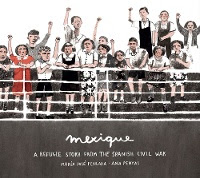
Mexique: A Refugee Story from the Spanish Civil War (originally published by Alboroto Ediciones, Mexico, in 2018 as Mexique: El nombre del barco (Mexique: the name of the ship) is an illustrated photo album from that time, depicting for young children the horrors of what it is to be alone and lost and not knowing what lies ahead. The story is based on interviews with some of the children—now adults—part of a group of 456 refugees whose Spanish Republican families sent them to the safety of Morelia, Mexico, aboard the Mexique at the start of the Spanish Civil War. Their parents were seeking something that most children don’t think about: a life without fear. The art is derived from photographs of the “Children of Morelia” and the ship that brought them to Mexico. The story is dedicated:


To the Children of Morelia. 

And to all those who are moving in search

of a life without fear.


Through the words of a frightened child, young readers will feel the fear of the unknown as the children try to sleep while a volunteer comforts them:


Some cry. Especially at night.

They say that they dream that the ground is crumbling.

The houses are crumbling, and their memories are blank.

Clara, Sonia, Eulalia, María wake us up.

They say it’s just a dream,

one that we all dream together.

Clara, Sonia, Eulalia, María, our sisters,

collect our tears in their handkerchiefs and in the morning

return them to the sea.


The story’s stark, sepia-toned illustrations—many offset with touches of peach and rusted red—complement the fears and uncertainty of the children on the Mexique and their parents, who will never see them again.


On the cover, a large group of children hang off the railings of the ship. Most look forward. With both hands on the railing, a young boy in a white shirt smiles directly at the reader. Many others have their fists in the air. Their expressions range from excitement to sadness to fear. One girl wears a bright red dress. Two boys hold hands. Young readers will see many of these same children, some identified from their clothing, portrayed in the book. 


The final illustration shows 12 adults standing in a semicircle, looking out at the young readers. These people represent some of those who defeated the Spanish Republic and transformed it into the violent and terrifying world that the children have fled. They are soldiers, a nun and priest, spies, businessmen, fascists, and government officials. Sprawled at their feet are tiny figures of dead people: revolutionaries, bloodied and mutilated. They represent the parents, whom the children will never see again. And overhead soar two buzzards. 


Mexique is a photo album of sorts. It is, as artist Ana Penyas (ana penyas libros) writes (in Spanish), “a story that recovers one of the first episodes of the Spanish exile, and at the same time, evokes the history of all the ships that cross the ocean every day, transporting human beings who have the right to a life without fear.”


Here is a mom giving a last hug to her baby. Here is a father embracing his young son for the last time. Here is another mom, handing her little girl over to a stranger as her eyes plead: We trust you with our life’s blood. And here is the stranger, walking up the ship’s ramp with the little girl, looking down at her mom for the last time. 


Elisa Amado is an amazing storyteller and translator, and she pulls no punches here: 


War is a very loud noise. 

War is a huge hand that shakes you 

and throws you onto a ship.


Of course, young children will not understand the violent roots of fascism, how easily it can take hold, and the destruction it leaves in its path. What they will understand, through text and illustrations, is, as the United Nations Universal Declaration of Human Rights (Article 3) states: “We all have the right to live in freedom and safety.” 


*Highly recommended for all home, classroom and library collections.


—Beverly Slapin

(published 2/17/21)

Manuelito, una novela gráfica // Manuelito, a graphic novel

author: Elisa Amado
translator: Elena Iribarren 
illustrator: Abraham Urias
Annick Press, 2019
grades 7-up 
Mayan, Guatemalan

Amado dedicates Manuelito to “the real Domingo, who was disappeared by the Guatemalan army, and to his family and all other Maya who have experienced—and who continue to experience—so much social injustice and violence.”

In Spanish, as in English, “to disappear” (desaparecer) is a verb. When the word, “desaparecido” is used as a noun (“disappeared”) it means that the person was a victim of murder, usually by right-wing government forces. In Latin America, “disappearance” is a tactic to get rid of people who might cause “problems”—a political concept and political reality that’s been used for generations.

Sometimes, families don’t find out about these “disappearances”—numbering hundreds of thousands—until decades later. Beginning in the 1970s and ‘80s, grassroots organizations called Madres de los Desaparecidos (Mothers of the Disappeared) formed all over Latin America; and currently, August 30 marks International Day of the Disappeared.

Amado and Urias present Manuelito as a graphic novel, narrated by a 13-year-old Maya boy whose family sends him to the United States in order to find safety and refuge from the rampant government and gang violence in Guatemala. Manuelito knows that several of his friends and relatives have been disappeared, including his tío, Domingo. 

The story begins in the present and flashes back to Manuelito’s journey.

The first two fully illustrated pages are set in the form of a photo album and Manuelito’s brief, matter-of-fact description of almost all family and friends (except for the coyote—“a very bad man who gets paid to take people like me to the USA.”) Just about everyone is smiling and looking directly at the camera. Readers will notice from the text that Manuel presents some of them in the past tense, a signal that these people are no longer alive. 

In the lower left-hand corner of the second page is the gut punch: “My mother’s brother Tío Domingo. He was disappeared when he was 12, almost 35 years ago.” It’s apparent that family members had kept his last photo—of a boy smiling at the camera—and bestowed his relationship-name, tío, long after he had been disappeared, and long before his nephew, Manuelito, was born.

On the next page, Manuelito shows a photo of himself with his friend: “My friend Coco Loco. He was older than me. His father owned the village store.” Again, Manuelito describes his older friend and Coco Loco’s father in the past tense. Manuelito doesn’t say that they were disappeared as well, but it’s implied. 

The villagers are under armed siege from every angle—harassed by the government soldiers (soldados), the civil patrol (PAC), and the gangsters, the narcotraficantes and “maras,” and the reign of terror is palpable. Villagers frantically phone their relatives in the US, begging them to take in the boys before they’re killed or forced to join a gang. Manuelito’s parents find a coyote and, together with Coco Loco’s parents, raise some money to pay him and to purchase a cell phone for the boys. Manuelito pretends to be brave, and Coco Loco, who is a little older and whose father owns a small store, shores up his confidence a bit. 

The coyote often doesn’t show up as promised, and one of the boys at a temporary shelter warns the two that they had gotten a bad coyote, a dangerous guy: “Les tocó un coyote de los malos, un tipo bien peligroso.” He’s right. 

Manuelito, who is on the road with a family he has met, phones his father and tells him that the coyote they hired to see them across has threatened to kill Coco Loco, which is apparently what had happened. Still, Manuelito continues to hope that his dear friend is alive somewhere. In his imagination, Manuelito looks out the window of his home and sees the maras, the soldiers—and Domingo and Coco Loco. By now the reader suspects that Coco Loco has been murdered and learns that this—or joining the maras or the soldados—“entonces pensé en las maras, en los soldados y en mi tío Domingo”—might be the reality of the socio-political terrorist act known as “disappearance.”

After a two-day bus ride, the family escorts Manuelito and some new friends to the Río Bravo and tells them exactly what to say to the US Border Patrol on the other side. After crossing the river, Manuel recites the exact words he’s memorized:

Me llamo Manuelito López. Soy de Guatemala y pido asilo. Las pandillas dijeron que me iban a matar. (My name is Manuelito López. I am from Guatemala and I ask for asylum. The gangs said they were going to kill me.) 

After a day at a crowded detention facility, the children are escorted to another center—with books and computers, and a TV, and a caring director. He feels safe. But when the heartbroken director tells the children that there is suddenly “no more money from the new government” (read Trump) and the center is closing, Manuelito finds himself on a bus again. He wants to go home. He imagines his family, waiting for him. And he also imagines the mara, and the soldados—and Coco Loco and Domingo.

Arriving in Long Island, Manuelito meets his aunt and begins to settle in. His aunt cautions him not to open the door for any reason but, when he hears the pounding and shouting, he’s afraid not to. It’s an ICE raid, and he’s quickly nabbed and put on an airplane headed for home. 

Manuelito: A Graphic Novel, and Manuelito: una novela gráfica are complex stories that are neither sensationalized nor romanticized. This is how it was then. This is how it continues to be. 

In an afterword, Patricia Aldana presents a short, accurate historical and sociopolitical history of the Northern Triangle (El Salvador, Guatemala, and Honduras), which she describes as “three of the most dangerous peacetime countries in the world.” Unfortunately, the US policy of “regime change” that has and continues to foment terror in this and in other areas of the world, is not discussed.

Urias’ dark and sometimes smudged charcoal illustrations appear rushed and, as so, complement the action and reflect the dread and horror in the story. As well, he portrays most of the faces of the gangsters, soldiers, border patrol, ICE agents and shelter staff, along with the hordes of other child prisoners, as anonymous blurs—the way that newly arrived and terrified young refugees would see them. But it’s the almost photo-realistic portraits of Manuelito and his friends and relatives—and also, his caring teacher and the sneering, menacing coyote—that readers will not soon forget. 

Neither the Spanish nor the English version is a direct translation of the other. Rather, each reflects, not only the natural flow of the language, but how specific characters might actually speak. However, while the coyote’s “street language” is totally realistic and threatening in the Spanish version—he’s a mean, sadistic dude—it appears to have been toned down in the English version. The Spanish appears to have been similarly toned down in other sections as well. 

This is a story without a happy ending and is age-appropriate for middle- and high school students who are coming to see that things don’t always work out for the best. Set in the Northern Triangle, this book is a contemporary, realistic complement to Phillipe Diederich’s Playing for the Devil’s Fire (Cinco Puntos Press), which takes place in Mexico.

Elisa Amado, a Guatemalteca who currently lives in Canada, is a brilliant writer and an excellent translator. And graphic artist Abraham Urias, a Salvadoreño who currently lives in the US, is a remarkable talent as well. For Manuelito: A Graphic Novel, and Manuelito: una novela gráfica, (the creation of which could not have been easy for either author or illustrator), they deserve every award there is. 

*In these difficult and dangerous political times for immigrants, refugees and asylum seekers, both Spanish and English versions are highly recommended for all home, library and classroom collections. 

*Highly recommended for all home, classroom and library collections.

—Beverly Slapin
(published 1/12/20)

Gracias to my friends and colleagues, Judy Zalazar Drummond, Lyn Miller-Lachmann and Noam Szoke. And thanks to Annick Press for the interior image.


Update, 1/15/20

Since there was no translator credit listed in the English version, I mistakenly assumed that Elisa Amado, whom I knew often translates her own work, had been the translator for the Spanish version (which I had received several weeks after the English version). 

After communicating with Annick Press, I learned that (1) Elena Iribarren was the Spanish translator here, and that the order of operations was actually to finalize the English edition first (both text and images) and then to create the Spanish translation, in order to preserve the integrity of the image-to-text relationship. 

Kaela Cadieux, Annick’s managing editor, told me that the author, Elisa Amado, and the translator, Elena Iribarren, have a longstanding working relationship, and that Elisa closely and precisely guided the project, including the translation. Any discrepancies between the English and Spanish versions were the product of careful consideration. Elisa has extensive experience as a writer in both English and Spanish, in addition to her familiarity with the real-life situation that forms the foundation of the story. Working together with the publisher and translator,  the shared intention was to reflect the inherent differences between the two languages and to preserve the truth of each character’s voice. For example, in the Spanish version, the coyote calls Manuel and Coco Loco “cobardes” (cowards), while, in the the English version, he calls them “sissies.” These particular colloquialisms were meant to be accurate, both to the story and to the reading audience in each language.

My Friend / Mi amiga


author: Elisa Amado
illustrator: Alfonso Ruano 
Groundwood Books / House of Anansi Press, 2019 
grades 1-4 
Indigenous, Mexican, Guatemalan

What does it mean to be alone and lonely in a strange place? What might it mean to feel safe? To be loved and accepted? To have a friend you can rely on? And what does it mean when that relationship becomes strained and possibly disrupted? 

In this intimate, heart-wrenching second-person narrative, a newly arrived refugee girl relates the story of her tenuous and emotional relationship with a white girl. In a sense, this narrative style invites young readers into the young girl’s life and challenges them to be like her friend. 

On the cover, the young narrator wears a red-and-white striped polo shirt and her dark hair is neatly braided and pulled into traditional Indigenous chongos. She faces a white girl in denim overalls, whose blond hair is casually pulled back into a loose ponytail. In the background are the Brooklyn Bridge and the East River. 

Amado frames this young girl’s story between two versions of a song written in 1915 by José López Alavés, an Indigenous man from Oaxaca, after he had migrated to northern Mexico. The first, in Spanish—entitled “Canción Mixteca—My Father’s Version”—appears on a front end page. The second, in English—entitled “Mixteca Song—My Translation” is on a back end page. Both languages portray the song as a lonely, mournful yearning for home. In a brief note, Amado informs the reader that her translated version is what she thinks her “favorite family song sounds like in English.” 

“For us, in Spanish,” she writes, “it’s exactly how we feel about living so far from the home that we left behind, that we miss.”

Told from her perspective to her white friend, My Friend is a poignant chapter in a young girl’s refugee story. The second-person narration throughout—without identifying the young girl by name or her family’s specific ethnicity, while inclusively incorporating the various heritages and pan-Indigenous images from the southern Mexico-Guatemala region—transports young readers directly into the story and heightens its intimacy. 

Amado hints at the backstory, so readers will learn from the song—and from a few words from the girl’s father—that this family has survived tough times, has limited choices, and, for better or worse, is settling into a community of strangers. And, for this story, that may be enough. There’s no further explanation because none is necessary.

Soon after the narrator and her family arrive in Brooklyn, she forms a fast friendship with a white classmate; the two are always there for each other. “I knew you would be my best friend the day I came to school the first time,” she says. “I know you and you know me. That is why we are best friends forever.” 

But when she invites her new friend over for a special dinner with her family, things appear to go awry. The girl’s best friend does not seem to like the food. Or the loud music, a song “that makes us remember where we were before we came here and what it was like.” Or the shouting and arguing. “That was so weird!” she says, and decides to go home early.

The narrator is bereft; she’s internalizing the horrible thought that her best friend doesn’t like her anymore. Echoing the song, she says she “feels like dying.” This is not hyperbole; it’s her pain, the loss and betrayal that wrap around her.

“I want to go home,” she cries. “I hate it here!” But for this refugee family, as for so many others forced to come here, returning to their homes and communities is not an option. Her family’s loneliness and sorrow are palpable. “We can’t go back,” her father tells her. “We have no choice. Just be glad you are safe…”

That night, she plays the sad song over and over. “I know you and I thought you knew me…. But you don’t know anything about me!…I was so mad at you that I never wanted to see you again.” On her way to school the next morning, she worries. She’s lost so much and now she’s lost her best friend as well. But as she reaches school and sees the girl, she remembers, among other situations, when her best friend challenged the mean kids who were bullying her: “Drop dead! She’s way cooler than you!

And when her white friend thanks her for dinner and says that she “really had fun,” the two walk in the door together. Best friends.

Ruano’s art, rendered in watercolor on paper, effectively complements this refugee family’s realities, emotions and dreams. In one particular full-bleed double page spread, for instance, while the self-conscious white girl sits on the family’s couch, the young narrator and her father—their exuberance demonstrated by the rainbow colors that pass through them and the Indigenous art that frames them—belt out the song from their homeland and their hearts.


Elisa Amado was born in Guatemala, and it appears that My Friend might be part of her story as well. While the family sings this mournful song of loneliness and despair, the father is enraged at a situation he can’t control—they must stay here. For refugees desperately fleeing to the US—“into the mouth of the shark,” so to speak—this story couldn’t have been published at a better time. 

My Friend will resonate with youngsters who are immigrants, migrants or refugees everywhere. Amado is an amazing translator as well, and I look forward to seeing her Spanish version. Highly recommended. 

—Beverly Slapin
(published 7/11/19)

Muchísimas gracias a mis amigas y colegas, Rachel Byington y Lyn Miller-Lachmann. 


author: Elisa Amado
translator (Spanish): Elena Iribarren
illustrator: Alfonso Ruano 
Groundwood Books / House of Anansi Press, 2019 
grades 1-4 
Indigenous, Mexican, Guatemalan

Elisa Amado is a wonderful writer and an excellent translator. Although Elena Iribarren’s Spanish translation here is adequate, it doesn’t reflect the nuances of the story—especially the child narrator’s own voice and her sense of self. 

Central to the story is “Canción Mixteca,” a song of loneliness and despair and wanting desperately to go home. It’s this refugee family’s favorite song, and the child narrator deeply feels the song’s refrain, “quisiera llorar, quisiera morir” (“I would like to cry, I would like to die”).

Most of the problems children have to deal with in middle school include being dissed and not having friends. For newly arrived immigrant or refugee children, their troubles and anxieties may be multiplied. Both the English and Spanish versions deal with this anxiety; however, Amado’s English version appears more realistic than Iribarren’s Spanish, which is stilted and sometimes misleading.

When kids at school mock the young newcomer as “weird,” her friend immediately shuts them down: “Who cares? We’re best friends. Is that a problem?” In the Spanish version, however, her friend’s words appear self-conscious: “A mí no parece rara. Es mi mejor amiga. ¿Cuál es el problema?” (“She’s not weird to me. She’s my best friend. What’s the problem?”) Today’s tweens don’t talk like that—they’re more confrontational when a friend is dissed. Like, “¿Qué les importa?” (“What do you care?”)

After a special dinner that the new child’s refugee family has prepared, her friend laughs and remarks: “That was so weird!” The child is bereft: “I felt like dying.” 

But the reason for her deep hurt in the English version is not reflected in the Spanish. In that version, her friend says, “Sabes que? Nunca he estado en una cena como esta!” which can be interpreted as curiosity about or enthusiasm for the meal rather than disdain (“You know what? I’ve never been to a dinner like this!”). Yet the protagonist is heartbroken, thinking, “Yo me quería morir” (“I wanted to die”), an emotional disconnect resulting from an awkward translation.

The refugee child is miserable. She doesn’t know how she will exist without a best friend. But then she remembers her friend’s confrontation with the kids who had made fun of her clothes: “Drop dead! She’s way cooler than you.” In the Spanish, however, her friend says, “Callate. Ella es míl veces más interesante que tú.” (“Shut up. She’s a thousand times more interesting than you.”) 

While “callate” would be appropriate here—unless you really wanted a person to die, in which case you’d say, “muerate”—the rest doesn’t even come close to a rejoinder to kids who are trying to embarrass your friend. Rather, you’d probably say “¡Callate—Ella es mucho más chida que tú!” (Shut up! She’s way cooler than you!”)

In comparison to the vividness and specifics of Amado’s English version, Iribarren’s Spanish feels flattened and generic. It doesn’t reflect how tweens express themselves; it fails to convey the passion of a child in pain or the validation she feels when her best friend defends her. While My Friend is *highly recommended for all home, library and classroom collections, Mi amiga is not.

—Beverly Slapin
(published 12/16/19)
Muchísimas gracias a mis amigas y colegas María Cárdenas, Amy Costales, y Lyn Miller-Lachmann.


Illustrations copyright © 2019 by Alfonso Ruano. Reproduced by permission of the publisher, Groundwood Books (www.groundwoodbooks.com).


¿Qué estás haciendo? // What Are You Doing?

author: Elisa Amado 
illustrator: Manuel Monroy 
translator (Spanish): Luis Barbeytia
(Spanish edition, CIDCLI /Brincacharcos, 2011 // English edition, Groundwood, 2011)
kindergarten-grade 2 
Mexican

When his mother reminds young Chepito that today is his first day of school, the child informs her that he doesn’t want to go, and runs outdoors instead. As he traverses his community, Chepito meets a variety of people, each of whom he asks, “¿Qué estás haciendo?” (“What are you doing?”). Everyone’s engaged with a variety of reading materials, and Chepito sings, “¿Por qué? ¿por qué? ¿por qué?” (“Why, why, why?”) A man looks for stats to see who won the game, a girl enjoys a funny comic book, tourists consult a guide because they’re lost, a mechanic pores through an auto repair manual, a young woman scans a magazine for hairstyle ideas, and an archeologist studies hieroglyphics on a stela.

At school, Chepito is attracted by a shelf full of books, and when his teacher lets him borrow one, he runs home and begins to read. (Of course, our young emergent reader is decoding the pictures rather than reading the words, the first step in literacy learning and appreciating the written word.) Soon, he’s asking his younger sister, Rosita, if he can read her the book, and, bringing the story full circle, she sings, “Why, why, why?” 

“Because it’s fun,” Chepito begins to say, but Rosita interrupts him: “Yes. Read it to me.”

Monroy’s characters have varied skin tones and facial features; and his softly-colored pencil, watercolor and digital illustrations, on a limited palette of mostly tans, browns, and greens, complement Amado’s rhythmic and pleasing economy of words. With just the right amount of repetition and humor, ¿Qué estás haciendo? and What Are You Doing? are perfect for emergent readers.

*Highly recommended for all home, classroom and library collections.

—Beverly Slapin
(published 7/6/19)

On the Other Side of the Garden

author: Jairo Buitrago 
illustrator: Rafael Yockteng 
translator (English): Elisa Amado 
Groundwood Books / House of Anansi Press, 2018 
preschool-grade 3 

Jairo Buitrago and Rafael Yockteng, who gifted us Dos conejos blancos // Two White Rabbits and Camino a casa // Walk with Me, present young readers with another beautiful story in which the complexity and symbolism is half-hidden in its seeming simplicity. While children born on this side of the garden will enjoy an evocative story of a little girl’s temporary stay with her loving grandmother while her parents sort out their lives elsewhere, immigrant children born on the other side will see the difficulties they themselves may have had to endure while navigating a new and different world and learning some of life’s lessons along the way.

Textually and visually, sadness permeates almost every page. As young Isabel’s grandmother shows her to the place where she will be sleeping, she looks straight ahead and doesn’t notice an owl-decorated bedspread, a frog planter, some lilies in a vase, and a small framed picture of two mice with a huge hunk of cheese. All she knows is that this house isn’t her house, and she realizes that she no longer lives with her parents. She covers her face with a pillow and sighs: 

My bedroom wasn’t my bedroom…. I lay down on the bed that wasn’t my bed, thinking about the city, about my friends who were far away now, and that Dad would have to come back and get me some day.

In the next spread, Isabel sits up, surprised. She’s not alone. The three creatures—the owl, the frog and the mouse—are alive and peering at her through the window. Rather than being frightened, she opens the window and talks with them. Here, observant readers may notice that everyone speaks the same language and that this story is more than it appears to be.

Yockteng’s textured digitally produced illustrations—mostly on a limited, almost-monochromatic palette of dark, flat blues with only the owl, the frog, the mouse, Isabel’s nightdress and an occasional image in other colors—appear as hand-drawn scratchboard or linocut prints and complement the child’s somber emotions. 

On the cover and on almost every double-page spread that follows Isabel’s initial meeting with the creatures who have come to visit, young readers will see a long wooden fence separating one side of the garden from the other side of the garden. At night, as the owl, the frog and the mouse walk with Isabel along the fence, they caution her:

“Never cross this fence, Isabel,” warned the owl. “There are some fierce dogs on the other side.” 
“And they bite,” said the frog.
“Sometimes I sneak across to eat a little of their food. So if you want to go over there, I can keep watch so they don’t appear all of a sudden,” offered the mouse.

Here is where young migrant or immigrant readers will probably understand the symbolism: The “fence” is the international border, the “fierce dogs” on the other side of the fence represent La Migra, the US Border Patrol; the owl and the frog will stay on this side to warn other migrants and immigrants of the dangers to come as they cross, and the mouse is a “coyote,” a guide who leads groups of migrants and immigrants safely across to the other side. 

As the new day dawns and Isabel begins to grow into her new (for now) environment, Yockteng’s scenes take on more color. The owl, the frog and the mouse remain at their posts while Isabel says goodbye and runs toward her grandmother’s house. Here, on this side of the garden, she is safe in the protective arms of a woman she hardly knows, and she will settle in to await news from her parents on the other side of the garden. The child has taken off her muddy boots and, next to them on the grass, is a plate of bread and jam her grandmother has prepared for her. Isabel’s grandmother is smiling while she shows the child the flowers in her garden, and Isabel, holding a cup of steamed milk, acknowledges that “the garden looked different in the daylight,” but hasn’t yet begun to smile. There’s still danger lurking, though: A black cat is stalking the frog and the mouse, who are trying to conceal themselves and preparing to flee. And on the next spread, the cat has picked up speed and is chasing them.

In the upper right-hand corner, a small falcon navigates the currents of air. And Isabel is almost smiling. Although her parents have not returned (yet), still, she feels less abandoned and, with her grandmother’s love and patience, is beginning to heal. We don’t know how this young person’s story ends, because, in this story as in reality, there is no neat ending to what has occurred and what is continuing to occur. 

Throughout history, the rise of fascism has always been marked by the dehumanization—the “othering”—of some people and often, of children. A carefully guided reading of On the Other Side of the Garden, along with Dos conejos blancos // Two White Rabbits, presents an opportunity for caring educators to make a difference in the difficult lives of migrant and immigrant children who, for one reason or another, may not be able share the realities of their lives. These educators have an opportunity here, however small, to push back against this government’s xenophobic assaults by acknowledging and honoring the children’s struggles and showing them that they are loved. 

*Highly recommended for all home, classroom and library collections.

—Beverly Slapin
(published 6/25/18)