Showing posts with label Colombian. Show all posts

A Thousand White Butterflies


authors: Jessica Betancourt-Perez and Karen Lynn Williams

illustrator: Gina Maldonado Charlesbridge, 2001 

preschool-grade two (Colombian)


It is snowing outside. A young girl, wearing an orange sweater and brown braids with matching orange hair ties, rests her elbow on the windowsill. Next to her is a hot taza de café to keep her warm. She is looking out at the reader, deep in thought, imagining her first day of school in this new country. On the outside, another young girl—a red-haired white child with eyeglasses—holding a snowball and bundled up in cap, coat and boots, glances at her and walks by. 


Young readers will learn that the girl’s name is Isabella and she has immigrated here with her mom. The two are staying with Abuelita, while Papa waits in Colombia for permission to travel. Today is Isabella’s first day of school in the United States, and her excitement is palpable. Until it starts to snow—“Mariposa wings dance in the sky. It looks like a thousand white butterflies”—and school is cancelled for the day.


Isabella narrates the story in English, and speaks Spanish in dialogue with her family. Without clunky translations that often litter children’s books, both languages here are accessible to young readers, who will easily understand who’s speaking and what they’re saying.


For instance, 


“¡Levántate!” Abuelita calls.

But I am already awake.


Maldonado’s digitally-colored illustrations, textured with crayons and acrylic paint, are excellent. Family members—Isabella, Mama, Papa and Abuelita—have varying brown complexions and hair colors and textures from curly to straight. The other children are shown as a mixture of ethnicities, both darker- and lighter-complected. And in comparison, everyone contrasts with the weather forecaster on TV—a blonde-blonde, whose skin is ghostly-pale. 


Although school has been canceled for the day, Isabella makes a new friend—a pale-faced red-haired English-speaker with eyeglasses (the girl who walked by her on the cover) who shows her how to make snow angels. “I don’t know all her words,” Isabella narrates, “but I understand enough.” 


That evening, Isabella draws a picture to send to her Papa: it shows herself and her new friend and their “snowman with its smile the colors of Abuelita’s beads.” When Papa calls her she says that she will tell him that “La nieve es hermosa.”


“Tengo una nueva amiga,” I whisper in the dark.

Tomorrow I’ll go to school. With my new friend.


The back matter contains authors’ notes, “more info” about immigrants and refugees, and a glossary of Spanish words. Sharing a page is an illustration of Isabella and her new friend at school. They are both smiling, and Isabella waves to the young readers.


*Highly recommended for all home, classroom and library collections.


—Beverly Slapin

(published 6/26/2021)

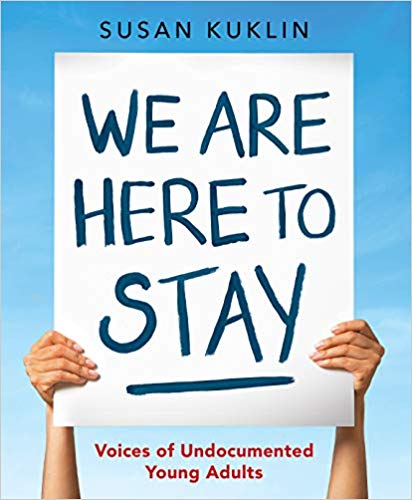
We Are Here to Stay: Voices of Undocumented Young Adults

Author / Photographer: Susan Kuklin
Candlewick Press, 2019 
grades 5-up 
Colombian, Mexican, Ghanaian, South Korean, Samoan

The original title of Kuklin’s book of interviews with undocumented young people was to be Out of the Shadows: Voices of Undocumented Young Adults. This was during the time of the Obama administration’s DACA (Deferred Action for Childhood Arrivals) program, which allowed individuals who were brought to the US as babies or children without documentation—US passports, green cards, or visas—to receive renewable two-year periods of deferred action from deportation and become eligible for Social Security, work permits, driver’s licenses and other necessary documentation. The book was to feature Kuklin’s stunning portraits of the young tellers who were, indeed, out of the shadows. 

However, after the book was imagined and planned and accepted by Candlewick Press for a 2017 release, the interviews accomplished, the portraiture shot and developed, and the book laid out and ready to go to print—the incoming Trump administration moved to repeal DACA, spreading hateful, divisive messages about immigrants, migrants, and refugee and asylum seekers. And the young people, among some 700,000, were forced back into the shadows.

A painful decision had to be made, and everyone decided to stop the presses. But after some two years, during which this volume of young people’s important, truth-telling stories sat in a drawer somewhere, all agreed—Kuklin, Candlewick, and the courageous young people themselves—to bring the book into publication. This was too important, they all said in their own ways, to leave it unpublished. At the same time, it was decided that changes had to be made for the protection of these young people. Here, they are referred to only by their first initials, empty frames replace their portraits, and all other identifying information has been redacted. As Kuklin told me (see interview below), their safety was everyone’s first priority.

In We Are Here to Stay: Voices of Undocumented Young Adults, nine young people from Colombia, Mexico, Ghana, Independent Samoa, and South Korea—now living under the constant threat of deportation to their countries of birth—narrate their “American” lives and, for those who remember, what their lives were like in their countries of birth and what circumstances brought them here. Each chapter is narrated by one or more of the young people. Their narrations are raw and honest. 

Kuklin’s stark, black-and-white photos in Chapter 3 are foreboding images that complement the young people’s stories. They include a sign that warns travelers about encountering “smuggling and illegal immigration,” a heavily-armed Border Patrol officer, a barbed-wire-topped enclosure, surveillance towers, footprints and empty water jugs. 

From G—, who came here from Mexico:

When I say good morning to my parents, I’m never sure that I will be able to say good night to them. I’m afraid to go to school, because it could be the last time I see them for a while. My dad’s got to go to work. He’s got to drive to get there. Because he does not have a US license, if a police officer pulls him over, he could end up in jail. Once he’s in jail, he could go through deportation proceedings. It’s happened to some of my friends—their parents get deported, and they are left alone.

And from Y—, who arrived from Colombia:

A lot of people grow up with shame and anxiety about being undocumented. It’s not something you want to share with people. On the news you hear about “the illegals,” and about all the resources they take from Americans. I don’t think people have a particularly nice image of us. So when I say, “I’m undocumented,” it’s hard to tell how people are going to react….

Maybe next time they hear someone railing about how terrible immigrants are, they’ll think about me. I’m a real person. I go to school with their kids. I have a wonderful family. Maybe after listening to me they will feel differently about immigrants.

Rather than being told (and interpreted) by outsiders, the voices in We Are Here to Stay: Voices of Young Undocumented Adults are authentic and impassioned and moving. This volume is *highly recommended for all home, classroom and library collections; and I look forward to holding an edition in which readers can feel the voices and see the faces of these courageous young people.

—Beverly Slapin
(published 5/1/19; revised 5/2/19, last sentence above.)

*Highly recommended for all home, classroom and library collections.


Note: Susan Kuklin is an award-winning author and photographer whose main interest in her more than 30 books for children and young adults is to address important social issues. Her photographs have been shown in the Museum of the City of New York and in documentary films, as well as published in Time magazine, Newsweek, and the New York Times. She cares very much about young people and getting the story right and, as I found out, she is generous with her time as well. 


INTERVIEW WITH SUSAN KUKLIN


Beverly Slapin: How did you originally envision this book? How has this project evolved? How and why have you and the young people you interviewed had to change your plans since the election of Trump?

Susan Kuklin: The book depended upon who came forward and volunteered to do an interview. One person led to another person. For example, Y told me that she felt really safe in New York but had she lived in Arizona, she probably would not have felt safe. P, a young woman from Mexico, really wanted her story to be in the book, but she was shy. Very, very shy. We met four or five times, but I was unable to get the details and introspection necessary for a narrative. Oh, how she wanted to do this. At one point in between our interviews, I went to Arizona, into the desert, and took photographs for an essay that appears in the book. When I returned, P— and I attempted another interview. I just happened to show her the photographs. “That’s exactly where I was!!!” All of a sudden, her experiences came rushing out. It was a magical moment. And by the way, she’s not shy any more. In fact, P’s arms are on the cover of the book and in the video on my Website.

So these interviews are organic—they’re flashes of memories, with one memory opening to another deeper memory.

How have the young people you interviewed reacted to Trump’s election? How have their lives changed since the election?

Their emotions range from scared to angry to defiant. And those emotions changed from day to day—from hour to hour. Can you imagine what it’s like to wake up one morning and learn that all your documentation—all your hopes and dreams—are down the drain? And also a new government hostile to immigrants has your address and telephone number and all your personal information?

The election was scary for me, so I can only imagine how it was for them. But still, the participants wanted the book to come out.

I felt responsible for their safety and well-being. I didn’t want to do anything to put them in jeopardy. I also realized that I was in effect sending them back into the shadows, the very shadows we saw the book as obliterating. They were much braver than I was. They kept texting me to stop worrying so much!

How has the book been received? How have the tours been received?

Very, very positively. People have been so compassionate about these kids and want to know how they’re doing now. Since the book came out, I’ve gone to border states and have met a number of DREAMers there who appreciate that the book was published.

The full-page frames with no photos in them are jarring; especially since they are all captioned as if they in fact contain portraits. They remind me of so many of the “disappeared” in countries such as Argentina, Chile, Guatemala and other fascist regimes of the time, whose families and communities still struggle to obtain the remains of their “disappeared” relatives. Who arrived at this decision to focus on the young people by “disappearing” their faces and names? Was it a collaborative decision? What do the young people think of it now?

Although it was not my intention to write a political book, the young people’s stories make a statement about what is going on now. 

For the year-and-a-half the manuscript and photos were in a drawer somewhere, I thought the book would never be published. But the participants had made it clear that they wanted their stories told, and those stories needed to be told. I gave them options to help me make the final decision: publish the book as is, publish it using names but not photographs, publish it using photographs but not names, or publish it without names or photographs. They also had the option of dropping out of the project. Everybody had a different idea of what they wanted to do. I decided—based on their views and based on their safety—that we should omit both the photos and names. I told them that I wanted to protect the most vulnerable people in the book. Basically, everyone agreed to protect each other.

I see these empty frames as telling people who look at them that we live in an unfree country and that many people who live here are in real danger. 

Yes, this is our reality. 

Despite the fact that these are all narratives, the book reads like an authentic collaboration. None of the young people who entrusted you with their stories have been named. How were they involved in the editing process? How were they involved in the decision-making process? 

While I was working with my editor, the young people had the opportunity to read the drafts for accuracy, authenticity, and voice. It was back and forth almost until the book went to print. Everything is in their voices, their syntaxes, their rhythms. Their stories are intimate. It was a true collaboration. 

Where are they now?

On one hand, they are in limbo and, on the other hand, their lives go on. Five have graduated from college, four are in graduate school, two are teachers, one’s becoming a journalist, one’s married, another has been able to bring his whole family here. They were raised as typical American kids. They know how to organize. They don’t take fools lightly. At the book launch that most of the New York participants attended, they immediately felt comfortable with each other——it was like they’d been friends forever.

All the participants are looking forward to the time when we can republish the book with their names and photographs—when they can actually come out of the shadows. 


Juana & Lucas

author: Juana Medina 
illustrator: Juana Medina 
Candlewick Press, 2016 
kindergarten-grade 3 
Colombian 

In her almost-breathlessly dramatic narrative, a smart, active, Colombian fourth-grader introduces herself, all the people and places and things important to her, and the issues in her life. Young Juana doesn’t just like things—she LOVES them. She LOVES Brussels sprouts (“more than cheese and chocolate and ice cream”). She LOVES her dog, Lucas (who is her “absolutely-no-single-doubt-about-it best amigo). She LOVES living in Bogotá, Colombia (the city that’s closest to her heart). She LOVES drawing and reading and playing fútbol—and she LOVES Astroman, who glides from galaxy to galaxy in his shiny, intergalactic suit. 

And she has great fun with her very good friend, Juli, because they always have mucho to talk about while Juli shares her most extraordinario and delicioso watermelon gum, blowing bubbles as big as their cabezas—which Seño, the bus driver, definitely doesn’t find entertaining.
But there are also things that Juana STRONGLY DISLIKES. She STRONGLY DISLIKES her uncomfortable PE uniforme, which, like her school uniform, becomes heavy and hot (“like, very hot-celery-soup hot”), and itchy and sweaty and stinky. She STRONGLY DISLIKES accidents, like the tragedia, in which she crushes her favorite kitty-and-rabbit lunchbox and loses her strawberry yogurt, which has explotado. But most of all, Juana STRONGLY DISLIKES surprises. Like when Mr. Tompkins announces that the class is about to have a TON OF FUN:
When a grown-up says something is going to be a ton of fun, it means there will be NO FUN AT ALL. Not even a single bit of fun. Nada de fun.
“My little mischiefs,” he says, “today I’m going to begin teaching you something that will knock your socks off. Prepare for your lives to change…for the better! Today you are going to begin learning the English.”
Julie whispers, “No entiendo nada,” and Juana whispers back that she doesn’t understand a thing, either. Instead of Mr. Tompkins’s promised “ton of fun,” Juana’s first day of school “has become the worst of all first days of schools possible.”

Copyright © 2016 by Juana Medina. Reproduced by permission of the publisher, Candlewick Press, Somerville, MA.

Medina’s ink-and-watercolor cartoon art, on a palette that’s sometimes bright and sometimes subdued, hilariously complements Juana’s pearl-clutching, hyperbole-driven narrative and leaves lots of white space to accommodate often-varying font styles and type sizes. 

And, in the best practices of “show, don’t tell” (especially in an early chapter book), Medina’s illustrations show young Juana’s family members, friends, neighbors and teachers, as culturally and ethnically diverse; and the mix of colonial Spanish-style edifices and modern apartment buildings, large houses and small bodegas show both a geographic and cultural diversity as well.


While Juana’s narration is not exactly code-switching, Medina judiciously plants some Spanish words and phrases throughout, most of which English readers can easily discern from their contexts. Since the Spanish is clear and italicized for emphasis only, Juana’s story will appeal both to English speakers who want to learn some Spanish, as well as to emerging bilingual hablantes who are learning the relationship between both languages.

Juana asks practically every adult she knows why it’s so important to learn a second language, and particularly one that emphasizes the impossible THs and the long and hard-to-say Ls,  and has so many homonyms:
Why are read and read written the same way but sound different? How can I know when people are talking about eyes or ice when they sound about the same? And what about left hand and left the room? So many words, so little sense.
No single person can give her a convincing answer, but despite Juana’s best efforts to resist learning a second language, the different perspectives of relatives, neighbors and others in the community support Juana in her struggle as she manages to learn the English. And when her Abue promises to take her to Spaceland in the US where, in order to meet her super-idol, Astroman, she must be able to communicate in English, well, that seals the deal: Juana works muy, muy hard to learn todo the English that (she) can possibly fit into the space between her pigtails.”  
Before Mr. Tompkins, Mami, the Sheldons, the Herrera brothers, Tía Cris, and my abuelos can believe it, I am a big and loud fountain of English.
What ensues at Spaceland may not be what Juana had been hoping for, but what she discovers segues into author and illustrator Juana Medina’s own personal story:
Because I can speak English so well, I’ve been able to have fun with a lot of new people and make a lot of new friends. And who wouldn’t like for that to happen all around the world? 
The number-two thing I’ve learned is that if I want to travel and make new friends, I will need to learn a gazillion more languages besides English and español!
Juana is a smart, outrageously funny little girl to whom youngsters who speak Spanish, English, or more of one than the other (and other language-learners as well) will easily relate. Juana & Lucas is *highly recommended for all home, classroom and library collections.

Note: Since Juana & Lucas has won a Pure Belpré Prize, I recommend that Candlewick publish a Spanish version as well, with some English words and phrases italicized throughout for hablantes who are learning English. Wouldn’t that be a hoot? And I guarantee it would sell well. ¡Qué good idea! ¿Pués, sí o no?

—Beverly Slapin
(published 5/9/18)


*Highly recommended for home, classroom and library collections. 


Camino a casa // Walk with Me

author: Jairo Buitrago
illustrator: Rafael Yockteng
translator: Elisa Amado 
preschool-up 
Colombian

Fondo de Cultura Económica 
(Camino a casa), 2008 
Groundwood Books / House of Anansi Press (Walk with Me), 2017 


The cover of the Spanish version, Camino a casa, depicts a little girl who’s being held in the safety of whom we soon learn is a lion. The English version, Walk with Me, shows her offering a flower to the lion, who is sitting on a grassy knoll near a pedestal on which is engraved, “1948.” And girl, lion, and pedestal appear on the first full-bleed spread of both versions as well. 

The little girl asks her lion-friend to protect her from “falling asleep” as she navigates her dangerous, dilapidated city, picking up her baby brother from child care, shopping for groceries from the tienda whose owner refuses credit, arriving home to cook dinner, and waiting until her mamá returns from her job at the factory. Finally, the girl gives her lion-friend-protector permission to “go up back into the hills again,” but to be sure to return when she needs him.

Throughout, we see people falling asleep where they stand or lie down. The few adults who aren’t falling asleep are just staring blankly at the lion. And one appears to be dead. Only the children seem to be interested as they exit a school that resembles a prison (with a uniformed guard at the gate). In fact, there appear to be bars everywhere: on the school doors, on buses, even on the windows of the broken-down apartment houses. 

Many of the people in the city are impoverished and shabbily dressed, as is the little girl. A car passes by a man who’s digging through garbage cans. A man wearing a suit ignores a homeless man who’s leaning against a building with his hand out. A child looks out the window while a woman and her child walk up the hill, carrying everything they own on their backs. People pass by an elderly woman who’s dropped her bags of groceries, but no one offers to help. Indeed, complacency to the political and economic climate has put almost everyone to sleep. 

In 1948—the year carved into the pedestal—Liberal Party leader and Presidential frontrunner, Jorge Eliécer was assassinated in an operation widely believed to have been orchestrated by the then newly created US CIA. His murder provoked a riot in Bogotá (known as "El Bogotazo") which, between right-wing and progressive forces, almost completely destroyed Colombia’s capital city, claiming some 200,000 lives. Throughout the country, the more than ten-year epoch of violence became known simply as “La Violencia,” during which many more thousands were killed or disappeared over the years. In 1953, Colombia’s commander-in-chief, Gustavo Rojas Pinella, seized power in a US militarily and financially supported coup and ruled as dictator until 1954, when he was declared President. Today, under many guises, US support for “friendly” right-wing forces throughout Latin America continues to be well-known.

But the lion—the little girl’s protector—appears to be making things happen. As he passes by with the child on his back, people wake up and notice. There’s a car crash but no one is hurt. A young man has pasted a revolutionary poster on a telephone pole and is making a “peace” sign at bus passengers, who are all looking at him and the lion. A woman turns around to wave at the lion. People are looking out of the windows of the neighborhood buildings. A roar from the lion convinces the scared-to-death tienda owner to extend credit. Maybe, just maybe, people are beginning to wake up.

After dinner, with four bowls set out for the three humans and the lion, the girl knows that it’s time to send the lion back into the hills if he wants to go. She knows that he has more work to do.

On the next to the last page, as her little brother and their mother are asleep, the girl places her flower beside a framed family photo. It’s the same flower she has offered to the lion on the cover of the English edition and the first page of both Spanish and English versions. Next to the bed is a chair that holds an empty book bag and beside the chair is a pair of large boots. They are the same boots whose prints we see on the back endpapers. On the floor behind the chair is a stack of newspapers. On the last spread is a closeup of the stack of newspapers, with its headline now visible: “FAMILIAS DE DESAPARECIDOS DE 1985.” Under the headline is a photo of a man giving a statement to the media during a demand for information about all those whom the Colombian government has disappeared. And on the night table is a closeup of a framed photo that depicts happier times together: mother, father, baby and little girl are smiling, and the little girl is holding out her fingers in a “peace” sign. The father has a mane of curly hair—just like the lion who has walked with and guarded the little girl throughout the story. 

On the front endpapers we saw two sets of prints: those of whom belonged to the little girl and those of whom belonged to the lion. On the back endpapers are also two sets of prints; but this time, the lion’s paw prints have been replaced by the boot prints of an adult—the little girl’s father.

Yockteng sketched his illustrations—all on full-bleed spreads—in pencil and then digitally redrew and colored them. On a muted and somber palette of mostly grays, greens, blues, and browns, the only standouts are the girl and the lion—and the one spread that shows the grocer frantically pushing two bags full of groceries to the girl whose lion, in a full roar, exhibits all his teeth. And, as always, Amado’s English translation is excellent.

Together with Rafael Yockteng, Jairo Buitrago, who is Colombian, have written picture books for young children, including Dos conejos blancos // Two White Rabbits, that describe people’s hardships and struggles to survive the economic and political realities throughout Latin America and here in the US. As with Camino a casa // Walk with Me, they appear as quiet stories and are full of symbolism for young children and their teachers to discern and discuss in a non-threatening way—and to support those children who have their own stories to tell.

Throughout Latin America—most notably, Argentina, Chile, Colombia, Guatemala, Honduras, Mexico, Peru, and El Salvador—families of the disappeared and murdered are still holding vigils and protests and demands for information. In some of these countries, unmarked graves have been uncovered and victims identified and, with love, reburied. And in some cases (such as Chile), perpetrators have been tried and imprisoned. Nevertheless, families of the disappeared have kept up the pressure. It is to keep alive the memories of the disappeared, the activism and sorrow of their families, and their prayers for reunification (one way or another)—that Camino a Casa // Walk with Me holds so much hope. These are lovely, poignant, compassionate books. 

*Highly recommended for all home, library and classroom collections.


—Beverly Slapin
(published 10/6/17; revised 10/17/17)

(Note: "El Bogotazo" was not the name of the Liberal Party leader, Jorge Eliécer Gaitán; it was the name of the riots that followed his assassination. I made this correction above. Thank you, Lyn Miller-Lachmann; good catch!)

Yeny and the Children for Peace


author: Michelle Mulder
Second Story Press, 2008
grades 4-7 
Colombian

Yeny is the new kid in her elementary school in Bogotá, Colombia. Her family has recently fled the violence of the grupos armados in their rural village and is now living with her aunt and cousins. Her uncle has been kidnapped, and from time to time her aunt and cousins go to the radio station to broadcast messages to him. At school, Yeny ends up the seatmate of the class bully and has trouble making friends until she hears about a meeting of children who want to organize a peace carnival. Yeny’s father discourages her from attending, but he is torn between wanting to keep his children safe and wanting them to have friends in their new home. Will Yeny persuade her father to let her take part in the children’s campaign for peace? Will this effort by Colombia’s youth make a difference in a nation torn by civil strife, gangs, and narcotraficantes?

Mulder has written a fictional tale based on the real-life efforts of the Colombian Children’s Movement for Peace. Readers will come to understand why this remarkable youth-run movement is a perennial candidate for the Nobel Peace Prize. Black-and-white photos of the children taking part in the organization’s activities lend increased realism to the story; there is also a glossary of Spanish words as they are used in Colombia. The subplot involving the bully promises more drama than it delivers, but the story overall is engaging and hopeful. The author’s enthusiasm and affection for the country and its people shows through. Recommended.

—Lyn Miller-Lachmann
(published 4/9/13)

Waiting for the Biblioburro // Biblioburro: A True Story from Colombia

In Colombia, internal conflict between paramilitaries and guerrilla groups ebbs and flows, exacerbated by political upheaval and the drug trade. In the north of Colombia, in a rural area controlled mainly by paramilitaries, and still under threat of violence and repression, a former schoolteacher has outfitted his burros as a mobile lending library. For ten years, Luis Humberto Soriano Bohórquez has gone from village to village reading to children, helping them with their homework, and lending books to anyone within burro distance. He and his wife have also built a library that serves more than 250 children in the area.


In the course of his travels he has been threatened with violence, has been robbed, and was injured in a fall from his burro. Despite these obstacles, he continues to promote literacy because he believes that it is key to ending violence and bringing peace to his country. Soriano’s courageous work is the inspiration for two recent children’s picture books, both published in English in the US. Waiting for the Biblioburro tells the story through the eyes of a little girl named Ana, whose town receives a visit from the biblioburro. Biblioburro: A True Story from Colombia follows Soriano through a day of trekking into the countryside and back with his library. Both books simplify Soriano’s life and mission, as one would expect, but a closer examination of each text shows the troubling degree to which essential details have been purged and sanitized for a US audience.


author: Monica Brown
illustrator: John Parra
Tricycle Press, 2011
grades 2-4
Colombian

Ana, the protagonist of Waiting for the Biblioburro, lives in a remote farming town. A long-gone schoolteacher once gave her a book, which she treasures, but she craves more stories. One day, a man comes through town with books loaded on his burros. He reads stories to the children and lends books to all. Ana loves having more stories to read and tell to her brother. While waiting for the librarian to return, she makes a book that tells the story of the man with the biblioburros. She presents him with her book on his return, and he adds it to his library to share with children in another town.

Brown’s book is striking in its omissions. Not only is Soriano never named, but the story is never located in a town or even a country. The only mention of Soriano and Colombia is in the author’s note at the end of the book, easily overlooked. The lack of concrete place names mirrors the lack of proper names throughout the book; the only named characters are Ana and the two burros, Alfa and Beto. This lends the entire story a dreamlike quality that is encouraged by John Parra’s illustrations. Removing Soriano’s name and intent creates a child-centered narrative that emphasizes personal charity over collective liberation, and ignores the lived political realities of the Colombian people in favor of a wish-fulfillment story that centers a child’s concerns so completely as to eclipse any other perspective.


author: Jeanette Winter
illustrator: Jeanette Winter
Simon & Schuster / Beach Lane Books, 2011
preschool-grade 1
Colombian

Biblioburro: A True Story from Colombia takes a slightly more accurate approach to the story of Soriano, according him a first name and the story a location. The story introduces Luis, who likes to read. He acquires too many books, and his wife, Diana, complains. He gets the idea to share his books with children, and loads up his burros with books. On his way to a village, he meets a bandit, who steals one of his books. He reaches the village and reads a book about pigs to the children, then returns home to eat dinner and read late into the night.

The book matter-of-factly depicts the amount of work and danger that the bibliotecario faces each day that he sets out on his rounds, rather than presenting him as a Johnny Appleseed-style figure that simply appears when he is most needed. However, it still leaves out the wider political context, recasting a real-life incident in which Soriano was accosted by a group of paramilitaries as an encounter with a single “bandit.” The book has other significant missteps as well. Winter’s illustrations, while beautiful, present Colombia as a cartoon jungle full of oversized animals and few, if any, houses, contributing to the US stereotype of foreign countries (especially those in the Global South) as exotic and backwards.

Winter also decides to portray Diana, Soriano’s wife, as a shrew and a drudge. In the book, Diana’s irritation at the growing piles of books induces Soriano to think of the biblioburro. She packs his books onto the burros and, when he returns, cooks him dinner. The few actions allow her make her seem entirely adjunct to her husband. In reality, Diana also helped to build the library, making it unlikely that she would berate her husband for collecting books. In addition, the couple runs a small restaurant to make their living, which means that she would have little time to assist him in his daily routine.

Both books manifestly underestimate children’s ability to accept what is real. Children encounter trauma, poverty, and loss every day, and see it in the lives of others. There is no reason to traumatize children though their reading, but going to the opposite extreme, removing any signs of struggle from their books, defeats the purpose of telling real stories at all. By the same token, allowing exoticization and stereotyping of other people and countries also serves to diminish the benefit of telling children stories of courage and change. Let us write and buy children's books that respect both the subjects of the stories and the children we are hoping to enrich. Neither Waiting for the Biblioburro nor Biblioburro: A True Story from Colombia is recommended.

For teachers who are moved by the story of Soriano and his family and want to introduce them to their students, consider resources that contextualize the situation in Colombia with more depth and dimension. For example, the website supporting the PBS Point of View documentary “Biblioburro: The Donkey Library” (www.pbs.org/pov/biblioburro/) has a wealth of resources including clips from the film, video news updates from Soriano, and straightforward information about the political and economic violence in Colombia. It also includes interactive maps providing information about literacy rates worldwide as well as videos of mobile libraries in Africa, North America, Australia, Asia, and Europe.

—Katie Seitz
(published 4/9/13)


This review, in a slightly different form, was originally posted at Teaching for Change (http:bbpbooks.teachingforchange.org/blog). We thank the author and Teaching for Change for permission.