Showing posts with label Spanish. Show all posts

Mexique: A Refugee Story from the Spanish Civil War

author: María José Ferrada 

illustrator: Ana Penyas

translator: Elisa Amado

Eerdman’s Books for Young Readers (2020)

grades 2-up (Spanish, Mexican)


During the Spanish Civil War (1936-1939), Generalísimo Francisco Franco led the fascist Nationalist forces—with the assistance of Nazi Germany and fascist Italy—in overthrowing the democratically elected Second Republic. From 1939-1975, his dictatorship—known as the “White Terror”—was marked by forced labor, concentration camps, assassinations and summary executions, leading to an estimated death toll of between 160,000-200,000. During this time, Franco’s deals with US corporations financed his war and the dictatorship that kept him in power. 


Mexique: A Refugee Story from the Spanish Civil War (originally published by Alboroto Ediciones, Mexico, in 2018 as Mexique: El nombre del barco (Mexique: the name of the ship) is an illustrated photo album from that time, depicting for young children the horrors of what it is to be alone and lost and not knowing what lies ahead. The story is based on interviews with some of the children—now adults—part of a group of 456 refugees whose Spanish Republican families sent them to the safety of Morelia, Mexico, aboard the Mexique at the start of the Spanish Civil War. Their parents were seeking something that most children don’t think about: a life without fear. The art is derived from photographs of the “Children of Morelia” and the ship that brought them to Mexico. The story is dedicated:


To the Children of Morelia. 

And to all those who are moving in search

of a life without fear.


Through the words of a frightened child, young readers will feel the fear of the unknown as the children try to sleep while a volunteer comforts them:


Some cry. Especially at night.

They say that they dream that the ground is crumbling.

The houses are crumbling, and their memories are blank.

Clara, Sonia, Eulalia, María wake us up.

They say it’s just a dream,

one that we all dream together.

Clara, Sonia, Eulalia, María, our sisters,

collect our tears in their handkerchiefs and in the morning

return them to the sea.


The story’s stark, sepia-toned illustrations—many offset with touches of peach and rusted red—complement the fears and uncertainty of the children on the Mexique and their parents, who will never see them again.


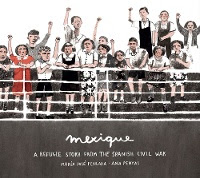
On the cover, a large group of children hang off the railings of the ship. Most look forward. With both hands on the railing, a young boy in a white shirt smiles directly at the reader. Many others have their fists in the air. Their expressions range from excitement to sadness to fear. One girl wears a bright red dress. Two boys hold hands. Young readers will see many of these same children, some identified from their clothing, portrayed in the book. 


The final illustration shows 12 adults standing in a semicircle, looking out at the young readers. These people represent some of those who defeated the Spanish Republic and transformed it into the violent and terrifying world that the children have fled. They are soldiers, a nun and priest, spies, businessmen, fascists, and government officials. Sprawled at their feet are tiny figures of dead people: revolutionaries, bloodied and mutilated. They represent the parents, whom the children will never see again. And overhead soar two buzzards. 


Mexique is a photo album of sorts. It is, as artist Ana Penyas (ana penyas libros) writes (in Spanish), “a story that recovers one of the first episodes of the Spanish exile, and at the same time, evokes the history of all the ships that cross the ocean every day, transporting human beings who have the right to a life without fear.”


Here is a mom giving a last hug to her baby. Here is a father embracing his young son for the last time. Here is another mom, handing her little girl over to a stranger as her eyes plead: We trust you with our life’s blood. And here is the stranger, walking up the ship’s ramp with the little girl, looking down at her mom for the last time. 


Elisa Amado is an amazing storyteller and translator, and she pulls no punches here: 


War is a very loud noise. 

War is a huge hand that shakes you 

and throws you onto a ship.


Of course, young children will not understand the violent roots of fascism, how easily it can take hold, and the destruction it leaves in its path. What they will understand, through text and illustrations, is, as the United Nations Universal Declaration of Human Rights (Article 3) states: “We all have the right to live in freedom and safety.” 


*Highly recommended for all home, classroom and library collections.


—Beverly Slapin

(published 2/17/21)

Picasso: I the King, Yo el rey


author: Carmen T. Bernier-Grand
illustrator: David Díaz
Amazon Children’s Publishing, 2012
grades 6-up
Spanish

As in her other poem-biographies, Bernier-Grand’s elegant free verse is crisp and clean, with every word precisely chosen. Here, in 40 carefully researched poems, she chronicles the creative and turbulent life of Pablo Picasso—profound narcissist (“yo el rey”), notorious philanderer (“ravenous for orgies”), tormented hypochondriac (death, “the mistress that never leaves you”), loving father (“let the children just be children”)—and artistic genius, perhaps one of the most important of the past century. Although Bernier-Grand frankly discusses Picasso’s many relationships and marriages and how the women in his life inspired his artistry (“As paint is to brush, women are to Picasso’s art”), she neither sensationalizes nor demeans them.

Here, Bernier-Grand writes of Picasso’s main obsession:

When Picasso has emptied himself of painting, he draws,
when he has emptied himself of print making, he sculpts,
when he has emptied himself of sculpting, he illustrates,
when he has emptied himself of illustrating, he photographs,
when he has emptied himself of photographing, he writes poems,
when he has emptied himself of writing poems, Picasso paints.
when he has emptied himself of drawing, he make ceramics,
when he has emptied himself of ceramics, he makes prints.

Extensive back matter includes a biographical essay, entitled “Pablo Picasso and the Mistress Who Never Left Him,” which fills in any and all gaps in the poetry; a chronology, a glossary of Spanish words and terms, a list of sources, and copious notes on paintings and quotes.

Interspersed throughout the book are reproductions of some of Picasso’s paintings, including an exhausted woman bent over an ironing board, portraits of Gertrude Stein and Georges Braque, and sex workers in a brothel. I was especially glad to see Picasso’s perhaps most important and definitely most famous painting, “Guernica,” which memorializes the Nazi bombing in 1937 that killed some 3,000 people, injured more than another 1,000, and destroyed the Basque town. Accompanying the painting on a two-page spread are a descriptive poem and short historical note. 

Bernier-Grand writes:

Monday—market day
Guernica
Basque city
bombed.
Peasants shot from the air.
Children and women
horses, sheep, cattle
    slaughtered.
Terrible deaths.

Picasso paints:
eyes open in horror,
mouths shrieking,
a horse screaming,

a shocked bull.


As an introductory biography of a particular artist, Picasso presents myriad opportunities for teachers of middle- and high school students: an introduction to modern art and artists, an exploration of the relationships between art and history and censorship (including point-of-view depictions of world events), a discussion of the many and varied forms of cultural expression, and a model for writing exercises of bio-poems.

In answer to those reviewers who criticized Picasso for not being a “happy” book and/or suggested that children should not be exposed to the seamy sides of Picasso’s life, I would say this: Every child who watches television, and every teenager who reads graphic novels, is exposed to sexuality, death, disease, suffering and war—in situations and circumstances that occur every day. I’d rather have children read an honest biography that discusses the issues of a person’s life than one that obfuscates them. Bernier-Grand is a brilliant storyteller who pushes boundaries and takes great care with her words. She is also ethical; I don’t believe she would ever attempt to conceal unpleasant facts about someone whose biography she decides to research and write. I applaud her choices, especially here. Picasso: I the King, Yo el rey is a remarkable achievement. It’s an illuminating and provocative work of art—poetically and visually. Highly recommended.

—Beverly Slapin
(published 11/21/13; paragraph redacted and note added, 2/15/18)

Note, 2/15/18: Multiple women have come forward with public statements that David Díaz sexually harassed them. After investigating claims against Díaz, the Society of Children’s Book Writers and Illustrators (SCBWI) removed him from its board and conference faculty, and expelled him from the organization. Several other conferences have banned him as well. We have redacted our references to his art in this review.