Showing posts with label David Bowles. Show all posts

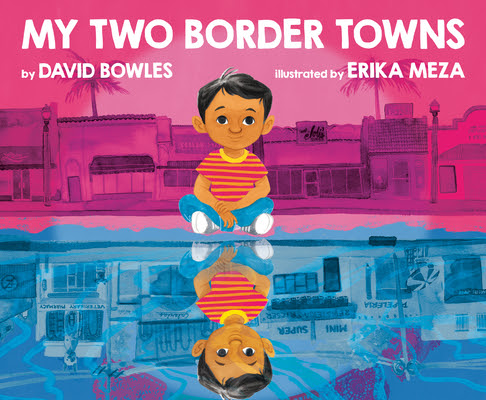
Mis Dos Pueblos Fronterizos // My Two Border Towns


David Bowles
Mis Dos Pueblos Fronterizos // My Two Border Towns 
illustrated by Erika Meza 
Kokila Books, 2021 
Mexican (preschool-grade 4)


Every other Saturday, a young child’s father wakes him up early. It’s time to go shopping, and then to el Otro Lado—the Other Side, across the U.S.-Mexican border. As they cross, the father reminds his son of the time when the Indigenous people—Coahuiltecans—once lived here, before both riverbanks were Mexico.


For the boy, their shopping trip is a large part of his education. On the way, the child’s dad quietly instills in his young son important values, such as respect for elders. As he holds out a dollar and calls to an elderly newspaper seller, “Aqui tiene, Don Memo. Thanks!”—his dad refers to him as “Don,” an honorific. Although the child appears to be unaware that he is learning something important, he is, in fact, learning. Later, he notices that his dad has tipped another elderly man, Don Chava, for washing his truck.


After breakfast at their favorite restaurán, father and son go shopping. They’ve done this often, and the child recites what’s on the list for their friends: medicine, T-shirts, chanclas, bottled water. And “cold, sweet Gansitos and lots of chewy Glorias, too.” And one last stop, for comics, notebooks, pencils, and game cartridges. “I add the things we bought today,” he tells young readers. “I hope all the kids will enjoy them.” 


His dad calls the child’s friends “refugees” …. “stuck between two countries. The U.S. says there’s no room, and Mexico says it can hardly look after their own gente.”


A line of people from the Caribbean and Central America camp along the edge of the bridge, waiting for their numbers to come up; and a border patrol cop, hanging on to his guard dog, suspiciously eyes father and son.


Dad pulls over, and the boy’s young friend, Élder—who lives on the bridge with his mom and siblings—runs to greet him. While he distributes the comics, games, snacks, bottled water and medicine that he and his dad had bought for them, a group of white tourists passes. They look straight ahead, as if the people sitting at the curb with their children and everything they own—hanging laundry, a blanket, a mattress—are invisible. Several women tightly clutch their purses.


The boy may not notice the white tourists who look away, pretending not to see the poverty right in front of them. But the boy’s father tells him and models for him this family’s duty to care for their gente. “I add the things we bought today,” he tells young readers. “I hope all the kids will enjoy them.” (They will. Among the games, snacks and bottles of water are great children’s books: They Call Me Güero and Gustavo, el Fantasmita Tímido.)


Neither Bowles’ Spanish version nor his English is a translation of the other. Rather, he tells the story in Spanish and in English, with each complementing the other. A piece in English reads, for instance, “This town’s a twin of the one where I live…,” and in Spanish reads, “El pueblo es como el nuestro en un espejo…” (“The town is like ours in a mirror…”)


Meza’s artwork—using gouache, soft watercolors, pencil illustrations and “digital gimmicks”—is rich in detail. The broad river does, indeed, resemble “a watery serpent that glints with the dawn.”


Young readers look intently at the cultural images and define them: In dad and son’s favorite restaurán, a string of delicate papel picado hangs overhead and an altar to the Virgen de Guadalupe and el Niño Dios contains a fresh flower in a glass of water as an offering. As an elder woman flips tortillas with her hands, a waiter carefully balances a large basket full of them and a bowl of salsa, and the boy uses a rolled-up tortilla to scoop up his food.


Other illustrations almost force young readers to notice things they otherwise might not. A white woman, for example, looks straight ahead and tightly clutches her purse in fear of the line of Mexican and Central American asylum seekers at the border.


The young boy’s empathy is real. This Mexican kid knows who he is and what he comes from because he absorbs his parents’ compassion—and because they teach him by word and example his responsibilities for his gente. This kind and generous child—of kind and generous parents—is learning that he is part of his gente and his gente are part of him. My Two Border Towns and Mis Dos Pueblos Fronterizos tell an important story. 


Compassionately written and beautifully illustrated, both Spanish and English versions are highly recommended for all home, classroom and library collections.


—Beverly Slapin

(published 9/12/2021)


*Highly recommended for all home, classroom and library collections.


Feathered Serpent, Dark Heart of Sky

author: David Bowles

illustrators: Christian and Ramon Cardenas (“LxsDos”)

Cinco Puntos Press, 2018

grades 7-up (Mexican, Mesoamerican)


In the US schools, Mexican history and the cultures and belief systems of the Indigenous peoples of Mesoamerica—if taught at all—are generally relegated to a paragraph or two, and fraught with egregious historical and cultural erasures. Here’s a typical example:


Quetzalcoatl was a deity-king, kind-hearted (he didn’t believe in human sacrifice) and wise (he was said to have invented the Aztec calendar, books, and writing). The people’s affection for Quetzalcoatl made the rival gods jealous. They acted together to trick him. One day the Evil One went into Quetzalcoatl’s palace holding a mirror. When Quetzalcoatl looked in it, instead of his own reflection, he saw a bearded, long-faced person. He knew that if his people saw him like that, they would be terrified. He had no choice but to leave. He went down to the seashore with his servants and made a raft of serpents. He told his servants that he would leave them, too. The servants wept, but Quetzalcoatl told them not to grieve. He promised that one day he would return and be their king again. Then he sailed away in the direction of the rising sun. (1)


Here is a deconstruction of the paragraph, above:


• His actual name was “Ce-Acatl” (first name, “One Reed”), “Topiltzin” (“our beloved prince,” what the people of Tollan and the rest of the Toltec Empire called him), “Quetzalcoatl” (his title, probably from the Toltecs). 


• Quetzalcoatl was Toltec, not Aztec; so, of course, he did not “invent” the “Aztec calendar, books, or writing.” 


• There was no rival-god-jealousy or tricking. Throughout the reign of Quetzalcoatl, his twin brother and principle rival, Tezcatlipoca, along with the other priests, had lost power and were angered by the elimination of human sacrifice.


• Calling Tezcatlipoca the “Evil One” is a cultural erasure, since Mesoamerican religions didn’t and don’t pit good versus evil. Rather, the struggle was and is between chaos and order.


• Quetzalcoatl did see his own reflection in the mirror. He had been so dedicated to worship and rule that he had not noticed that he was aging. Understanding himself to be mortal and weak, he worried that people would despise him. 


• Before he sailed away “in the direction of the rising sun,” Quetzalcoatl spent years traveling through Mesoamerica, founding new cities, and teaching people respect for the gods and to avoid human sacrifice. Then he left, promising to return.


All this is to say that these traditional stories from Mesoamerica are not simplistic. Unlike European “fairy tales,” they do not pit “good” against “evil.” Rather, they are complex. They are about the struggles between chaos and order—the struggles to find balance.


With Feathered Serpent, Dark Heart of Sky: Myths of Mexico, David Bowles, scholar, historian, linguist, storyteller, Chicano activist—and damn good writer—sets out to correct the record. And he does. All of it. As the well-used idioms go, he pulls no punches and leaves no stone unturned. 


On the stunning cover, executed by “LxsDos’” (Christian and Ramon Cardenas, “street artists from El Paso”)—together on a pen-and-ink drawn, digitally colored, textured dark-blue background representing the cosmos, the dark heart of sky—sit the Dual Gods, the complementary halves, Ometeotl. In the Nahua language, they are lovingly called “the grandparents,” each half enjoying the company of its other half. Surrounded by the feathered serpent, Ometeotl dreams “a vast world and multi-tiered sky, peopled with creatures so diverse and wonderful that the very thought of them brought joy to our grandparents’ hearts.”


Lxs Dos created the interior illustrations with pen and ink on paper. They play around with imagery, and each is symbolic of the contents of a chapter and a hint of what is to follow. And they are all gorgeous. In “The Fifth Age and the Reign of Demigods,” for instance, readers will see an Indigenous woman, kneeling over a large metlatl to grind up—not corn, which is an essential life metaphor, but skeletons. Over her right shoulder flits a tiny butterfly and over her left shoulder, a hummingbird hovers. Both are signs of rebirth and life. It is the Fifth Age, remember? “The present era. Our time.” This Indigenous woman—the Divine Mother—is creating, from the old bones, a new and better race of people. 


In Feathered Serpent, Dark Heart of Sky, every story is a treasure that younger readers (and adults alike) will enjoy reading and rereading—as each reading becomes a new and exciting experience. Each story in a theme (“The First Three Ages of the World,” “The Fourth Age and the Hero Twins,” “The Fifth Age and the Reign of Demigods,” “The Toltecs and the Rise of Civilization,” “Tales of the Maya,” “Aztecs Ascendant” and finally, “Conquest and Courage”) naturally follows the one before, and each section begins with a thoughtful “convocation”—helpful for adult readers, and accessible to younger readers as well—that introduces the theme and discusses the content. The “convocations,” David Bowles told me, are what he feels thinking about his children and grandchildren down the road, whom he loves so much that he wants these stories to be part of their lives. He imagines himself sitting on a mesquite stump, he said, “sharing stories and songs and trying to be whole.”

Bowles’ renditions of these traditional stories—which he translated from the fragmented oral and written mythologies of “pre-Columbian” Mexico and seamlessly pieced together—will enable readers of today to understand and appreciate both the stories themselves, their contexts, and their places and functions in history.


For instance: In most, if not all, children’s books about “La Llorona,” she is a vain, self-centered (Indigenous) young woman who, after marrying a wealthy Spanish nobleman and bearing two children, finds out that he has been cheating on her. So, in a fit of jealousy and rage, she drowns her children, and from then on, loudly mourns them: “¡Mis hijos!” she screams for eternity, “¡Mis hijos!” And Mexican children of today listen for her at night, and are frightened. 


But according to Bowles, there is much more to the story. “Lloronas” were a common occurrence in Nauhua lore, he says. In “The Anguish of Citlalli” (pp. 256-261), the Xoxchimilca woman bravely chose the only option available to her: to surrender her beloved children to the water rather than to surrender them to the horrors of colonialism. Although the Maya held out for a century or so, there was no place for the Nauhua people to go. 


In more contemporary history, this is not a unique occurrence, either. The “Llorona” story reminds me of Toni Morrison’s Pulitzer Prize-winning novel, Beloved, in which a family of formerly-enslaved people in Cincinnati is haunted by the ghost of Margaret Garner, who had killed her young daughter and attempted to kill her other children to spare them from being returned to slavery. (2)


Writing a complex yet accessible book such as Feathered Serpent, Dark Heart of Sky must have been a tough thing to accomplish. It involved familiarity with the historia and cuentos of what is now referred to as Mesoamerica, finding the fragments and pulling the translations together—and for each one, folding in the historical and political texture and finding the right voice. 


Perhaps most importantly, rather than focusing on the colonizers, the traditional stories here center Indigeneity. “The most we can hope for,” David Bowles told me, “is to center Indigenous lives, especially those stories of women that have not been told. We are heirs to the stories—last convocation.” 


“This is work we need to do as a community. We need to bring our history together in affirming ways. Every time there are chaos and destruction, a wave of creation follows. We cannot forget, we cannot allow it to be erased. We need to keep it alive.”


Every school in the Americas, at least, should have copies of Feathered Serpent, Dark Heart of Sky—and teach from it. It’s an invaluable resource.


*Highly recommended for all home, classroom and library collections.


—Beverly Slapin

(published 6/8/2021)


[Note: Muchísimas gracias a mi amigo y colega, David Bowles, por su gran amabilidad y generosidad. I want to thank David Bowles for his kindness, generosity, and dedication to all the grandparents and their children.]


Footnotes:

  1. Yellowhorn, Eldon, and Kathy Lowinger, What the Eagle Sees: Indigenous Stories of Rebellion and Renewal. Toronto: Annick Press (2019), p. 18.
  2. Morrison, Toni, Beloved. New York: Alfred A. Knopf (1987).


13th Street Series

Book 1: Battle of the Bad-Breath Bats

Book 2: The Fire-Breathing Ferret Fiasco

Book 3: Clash of the Cackling Cougars

Book 4: The Shocking Shark Showdown


author: David Bowles

illustrator: Shane Clester

Harper Chapters, 2020

grades 1-3 

(Mexican American)


In this fast-paced action series, young readers join Mexican American cousins  in South Texas—Malia Malapata, Dante Davila, and Ivan Eisenberg—as they engage with ghoulies and ghosties in the strange and dangerous world of “13th Street.” Malia’s la fregona—the boss, Dante’s the computer genius, and Ivan’s the bookish, sensitive one.


“Progress bars” mark the completion of chapters, and at the end of each story, young readers see how many chapters, pages and words they’ve read. Suggested activities (“Think! Feel! Act!”) encourage youngsters to work together in community.


Appearing as a barely visible safety check, a mysterious elder named Doña Chabela Aguilar kicks off and ends every story. In the fourth book, readers find out why she sends Malia, Dante and Ivan to alternate worlds to battle monsters. 


Book 1: Battle of the Bad-Breath Bats

In Battle of the Bad-Breath Bats, Malia, Dante and Ivan—while visiting their aunt Lucy for the summer—get lost somewhere on “13th Street.” As they work together to escape from the street that doesn’t exist, they must (with the aid of a friendly skeleton) battle a swarm of Snatch Bats—the “bad breath bats”—who can be defeated only by water guns firing “minty-fresh” streams of mouthwash.


Book 2: The Fire-Breathing Ferret Fiasco


In The Fire-Breathing Ferret Fiasco, the three cousins are back in their hometown, Nopalitos. When their school bus takes a wrong turn, everyone winds up back on 13th Street (the street that doesn’t exist), where they, together with the driver and their friends, brother Robby and his sister, Susana, encounter giant, fire-breathing ferrets from another dimension. Hiding inside a vacant warehouse, they meet a friendly nuclear family of Mictecah—Undead Folk, or zombies—who lead them to safety and a time portal to the past.


Book 3: Clash of the Cackling Cougars


In Clash of the Cackling Cougars, the cousins, on a ski trip, are sucked through another portal and accosted by joke-telling cougars: “Why did the human put its money in the freezer? It wanted cold, hard cash!” The cougars’ loud laughter and  horrid jokes sicken the cousins. Literally. But as they soon find out, the laughter also is a weapon of mind control.


Saved by a green elf with a glowing stone that heals Ivan’s heart and stops the revolting laughing echoes in his brain, Ivan rejoins his cousins, trapped in the Underworld with zombies, ghosts and skeletons. Using catnip powder to control the cougars, they escape, but must go back to rescue Micky’s dog, Bruno.


Book 4: The Shocking Shark Showdown


In The Shocking Shark Showdown, Doña Chabela reveals that she’s been sending our courageous young trio down the magical portals to rescue her grandson, Mickey—the “Quiet Prince”—who is trapped on 13th Street and needs their help to find Bruno and open the return portal. They have to figure out when and how to get there.


Finding themselves under 13th Street, they navigate a stinky sewer filled with a menacing Shiver of electric sharks until Bruno shows up and menaces them. Then they meet a bunch of raccoon-like talking pikos who play tumbling games in the water. (As everyone knows, sharks hate pikos and pikos hate sharks, and since Bruno’s been around, much of the Shiver seems to have gone elsewhere.)


It will all be over soon, thinks Malia. Mickey will return home with Chabela. No more 13th Street. 


But first they have to disable the sharks by salinating the water. Guided by a rhyming pico named Pecki, the trio of humans climbs through a manhole into an abandoned grocery store, fills sacks with salt, and gets menaced by razor-clawed rats whom they escape by finding an “impossible room” whose floor somehow “glitches” out of existence.


Back in the sewer, the trio encounters a boat that looks like the upside-down skull of a giant dragon, crewed by little elves called chaneks, and, standing at the front is—Mickey Aguilar.


Hinting at the next books in the series, Mickey tells the others that he’s called the Quiet Prince because “this place has a noisy queen, and she’s stealing human children.” 


And back through the portal, back into the world Mickey had left behind, go our heroes. Except for Malia, who first has to escape another shark attack before she returns to the aquarium to meet her teacher and class.


~    ~    ~    ~    ~    ~    ~    ~    ~    ~    ~    ~    ~    ~    ~    ~


Shane Clester’s digital black-and-white images, drawn on an electronic tablet, give these books a graphic novel appearance. Especially impressive is Malia’s expression as she’s about to vomit, nauseated at the cougars’ terrible jokes. 


Capitalized comic-book noises abound (“The bats couldn’t stop themselves. One by one they smashed into the closed door! BOOM! BAM! BASH!”). Or words are spaced to slow down the reader (“Lightning    flashed    overhead”) or italicized for creepy cultural capital (“¡Uy, cucuy!”).


There are giant doses of snark. For instance, Dante muses, “What’s most important is in our hearts,” to which Malia answers, “Gimme a break!”


There are biological and cultural impossibilities, such as “a calavera with friendly eyes” (uh, skulls don’t have eyes…) whose “bones made weird marimba sounds as he walked.”


And what would a series like this be without fart jokes?


Young readers will get wrapped up in Bowles’ and Clester’s creepy and hilarious 13th Street series, which continues. 


*Highly recommended for all home, classroom and library collections.


—Beverly Slapin

(published 2/21/20)

Tales of the Feathered Serpent, Book 1: Rise of the Halfling King

author: David Bowles

illustrator: Charlene Bowles

Cinco Puntos Press, 2020

grades 3-7 (Mayan)


For millennia, Indigenous elders have transmitted histories and their teachings through story. In many of the teachings the lessons are inferred rather than directly stated. The objective is to tell an interesting story that would engage listeners in an enjoyable way. The story stays with them longer and the lesson in the story might be discovered later. Traditional stories are interesting, engaging and memorable. And when written or drawn, the depth of meaning is still there. “Graphic novels”—when done well—engage the eyes and the mind at the same time. And the presence of the storyteller, which was always visual, remains in the graphic novel.


Some two thousand years before the Spanish conquest, the Mayan peoples of the Yucatán Peninsula developed a hieroglyphic script to record their stories and histories with words and images. It’s not much of a stretch to see these codices—most of which the Spanish conquistadores burned—as the forerunners of today’s graphic novels.


In Tales of the Feathered Serpent, David Bowles translates traditional Yucatec Mayan stories and gifts them to young adult readers. Now, in Rise of the Halfling King—the first of ten graphic novels, each based on a story in Tales of the Feathered Serpent—he transmits some of this millennia-old traditional lore in a way that’s accessible to younger readers, and, accompanied by Charlene Bowles’ vibrant art, shapes these stories into another part of the same experience.


Trained to become a curandera since she was a young girl, apprentice witch Almah is beloved by her community for her goodness and kindness and ability to call down the gentle rain. Time passes, and although nearby Uxmal had not had a king for a hundred years, the aluxes—“mystic elfin beings who wield great magic to protect nature”—select Almah to receive a magic stone and a drum that will “announce the true king of Uxmal.” As the villainous Kinich Kak Ek is enthroned, his chief advisor, the sorcerer Zaatan Ik, announces that “no man born of a woman can usurp” his sovereignty and that when a “kingmaker” drum sounds, his rival must be given the opportunity to take the throne by overcoming three challenges.


Uneasy with the sorcerer’s prophesy, (partly because he mistranslates “not born of a woman” as “not born”), the king conquers the surrounding cities and establishes a barbarously cruel empire. 


Out of fear of the king and his priests, the community shuns Almah. Lonely and wandering in the hills, she finds an unusual egg, which she takes home and places near the hearth, by the “kingmaker drum” that she had hidden. When a little boy—a “halfling” secretly gifted to Almah by the aluxes—emerges, Almah adopts him as her grandson, names him Sayam, and as he grows (but not as much as other young people), she teaches him “green magic and the sacred prayers that call down gentle showers in spring.” And she realizes that he’s destined to be king.


Under Almah’s tutelage and through her unconditional love, the brave and reckless young Sayam matures and begins to understand what it is to be a leader with a sense of duty to his people. He also learns earth magic, how to read the “ancient books”—the sacred Mayan codices—and works with the Bobatil Ju’un, the Book of Prophecy. These are important skills he will need when it comes time to fulfill his prophecy—to defeat Kinich Kat Ek and assume the throne.


Throughout this gripping, fast-moving plot—which includes Sayam’s defeating a serpent from the underworld that aims to devour the people’s beloved dead—Bowles seamlessly weaves in references to Mayan philosophy, ethics and traditions. As well, he embeds, in heavy, bold type, the incantations that Almah, Sayam, and others utilize in the Yucatec Mayan language. And he sprinkles into the dialogue present-day phrases and thoughts, such as when Sayam apologizes to some of the dead ancestors for having to unwrap them: “Sorry, old ones, I need a diversion” (to get the serpent’s attention).


Charlene Bowles’ expressive digital art seamlessly melds strong, dynamic lines typical of the ancient drawings with modern comic-book “speech balloons” and text boxes. Her organized panels provide clarity for the dialogue or narration and, at the same time, the large ones offer visuals to emphasize specific moments. 


Throughout, her varying palettes tie into the story’s environment and what’s happening at a particular time. For instance, the forested areas overlay greens, the darker environments are mostly blues and purples, the outside kingdom locations feature more reds and teals, and the inside scenes where the rulers plot to keep themselves in power are dark and foreboding browns.


It’s a brilliant idea to present Mesoamerican traditional literatures as “graphic novels” for young people because they’re essentially extensions of the ancient Mayan codices. As David Bowles writes: “Blending written words and images, comics and other sorts of graphica allow our brains to process stories more like our ancestors did.” Working together, the father-daughter team of David and Charlene Bowles have produced a remarkably illustrated, Mayan tradition-based story, seamlessly interwoven with comic-book action (wham! pow! bam! thud! klonk! thok! fwoosh! glorp!) And it’s not surprising that the two have pulled this off brilliantly. Tales of the Feathered Serpent, Book 1: Rise of the Halfling King will mesmerize middle-grade readers. 


*Highly recommended for all home, classroom and library collections.


—Beverly Slapin

(published 1/7/21)


(Note: I was disappointed to learn that Cinco Puntos Press intends to bring in “various illustrators” for the remaining nine volumes of Tales of the Feathered Serpent. Young readers form visual connections with graphic novels, and the first in a series establishes the vision for the rest. Contracting with different artists who use different art styles is likely to destroy the vision and ruin the continuity. I would like to have seen consistency of the creative team across the series.—BHS)


The Smoking Mirror (Garza Twins, Book One)

author: David Bowles 
IFWG Publishing, 2015 
grades 5-up

Mexican American


The multi-talented Chicano scholar, historian, linguist—and damn good (not to mention award-winning) writer of spell-binding children’s and middle-grade books has gifted the world with a five-volume (so far) series featuring the Garza Twins. The Smoking Mirror is Book One.


When 12-year-old small-town Mexican American twins Carolina (Carol) and Juan Ángel (Johnny) Garza learn that their mom has suddenly gone missing, they set out to find her—and their lives are forever changed. After their grieving father ships them off to relatives in Mexico, they discover that, not only is their mom a nagual, a shapeshifter—but they are naguales as well.


Hurriedly schooled by their experiences, Johnny and Carol find out that twin naguales come along only once in a millennium, and, as such, they are capable of wielding “savage magic” that not even the gods can control. Their education is quick and experiential: In order to find and rescue their mother, they must descend into the Aztec underworld and face and defeat all of the supernatural powers that confront them—in each of its nine levels.


As the twins careen between worlds, Bowles keeps his readers riveted from beginning to end. But The Smoking Mirror is more than just a page-flipper. Rather, middle readers will go back and forth, quickly reading to find out what happens next—and rereading to experience the previous episode again. 


Carol and Johnny are best friends and despite lots of back-and-forth middle-school snark, the two have each other’s back:


Carol’s concern (that Johnny would overestimate his own abilities) took a backseat as the beating of dozens of massive wings came from all around them. A group of fire-breathing flying serpents was converging on them, presumably furious at what the twins had done to their master. Johnny turned and flew backwards, raising the shield with his talons to deflect their flaming attacks. Carol ducked and weaved as she flew, narrowly avoiding streams of fire. When a wyrm would get too close, she’d blast it from the sky with her xoxal-enhanced blaze…. Five deserts down. Four more to go.


In the worlds of The Smoking Mirror, middle readers will discern that the battles are not between “good” and “evil.” Rather, they’re between “order” and “chaos”—and, as Carol and Johnny battle cucuys and Mesoamerican deities, they must utilize their new-found abilities to stop the forces of chaos from ending the world. But ultimately, it’s their love for each other—and for their mother—that pulls them through.


The cover illustration by Charlene Bowles (the author’s daughter) is perfect. Here, the two children, confronted by Tezcatlipoca, the enormous, snarling, three-pawed jaguar emerging out of the smoking obsidian mirror—brother and enemy of Quetzalcoatl—are given a choice that tests their love for each other and for their mother, and their power to help destroy the world. Middle readers will be mesmerized by this image long after they’ve finished the book.


Bowles’ chapter-by-chapter “guide to Spanish words, phrases and songs” is a collection of Tex-Mex Spanish that contains regional dialects, accents and terminology—and some of it is a stand-alone hoot. In addition to offering translations, Bowles effortlessly code-switches contemporary Tex-Mex phraseology into a sort-of English equivalent that resonates with middle-graders without necessarily offending their parents or teachers. And for a wealth of information and ideas, adults may also delve into Bowles’ extensive teaching guide (http://davidbowles.us/books/author/mg-ya/garza-twins/teaching-resources-for-the-smoking-mirror/)


In The Smoking Mirror, past becomes present as myth careens into reality and a sister and brother’s impassioned search for their mother drives them to a heroism they never could have imagined. Middle readers—even those who might not initially “get” all the historical and cultural references and nuances the first time around—will be unable to put it down. And they will look forward to Book Two. The Smoking Mirror: Garza Twins, Book One is a  well-deserved Pura Belpré Prize winner.


*Highly recommended for all home, classroom and library collections.


—Beverly Slapin

(published 10/21/20)


Hard Road to the Heavens:
The Genesis and Publication of The Garza Twins

It was Spring 2012. My second book, Mexican Bestiary (an illustrated bilingual encyclopedia of creepy cucuys), had just been released by a small press, much like my previous collection of short stories, The Seed: Stories from the River’s Edge. Outside of the Río Grande Valley of South Texas, that stretch of borderland where my family has lived for generations, no one really knew who I was. But on the strength of a few school presentations, Pat Anderson of Overlooked Books—distributor of hard-to-find and little-known Texas titles to school libraries—had invited me to sign at his booth at the annual conference of the Texas Library Association (TLA). 

As fate would have it, both of my signing slots put me at a table with two talented, more established authors, both of whom would become close friends: Jason Henderson, promoting his Alex Van Helsing series from HarperCollins, and Belpré Award-winning Guadalupe García McCall.

Loops (as I affectionately call her) was there for her second book, Summer of the Mariposas. She was generous with her time and advice, which I appreciated deeply, but perhaps more important was that sophomore publication itself. I read it that evening in my hotel room, awed by the beautiful prose and inspired by her deft integration of not only Mexican American legends into the narrative, but also Aztec mythology.

I had been toying with an idea. During my kids’ childhoods, I read all the major series with them: The Chronicles of Narnia, Harry Potter, Percy Jackson, Hunger Games, and others We would often joke that it would be so nice to crack open a cover one day and find a Chicana battling cucuys and Mesoamerican deities (instead of the typical Chosen White Dude facing off against European monsters and gods, with an occasional Secondary Sidekick of Color). Our laughter would often fade to wistful looks, as it didn’t seem particularly plausible.

But after my first book was published, I began to dream about creating just such a series, centered on magical Mexican American kids whose abilities must be put to use to stop the forces of chaos from ending the world for a fifth time (as predicted by Mesoamerican sacred stories). 

Speaking with Guadalupe García McCall, reading her work, I became convinced that this could actually happen. I gave the characters a family name from my dad’s side—Garza—that also served as a nod to Loops (the five sisters in Summer of the Mariposas, which I would go on to translate into Spanish, are also Garza: cousins of my protagonists, we have officially agreed). 

By late 2013, I had written The Smoking Mirror, the story of Carol and Johnny Garza, 12-year-old twins whose lives in a small Texas town are forever changed by their mother’s unexplained disappearance. Shipped off to relatives in Mexico by their grieving father, the twins soon learn that their mother is a nagual, a shapeshifter, and that they have inherited her talent. But there’s more. Twin shapeshifters come along only once a millennium, capable of wielding savage magic, a power even the gods can’t control. In order to rescue their mother, the twins have to descend into the Aztec underworld and face the dangers that await them in each of its nine levels. 

This was a quest story, which I infused with video-game logic and middle-school snark, with a thematic twist at the end: it isn’t the twins’ might that ultimately saves their mother, but their love for her and each other. 

I began sending it to editors. Every single one of them rejected it. Nearly two dozen. Most expressed some variation of the following concerns:
  1. There are no white kids. Can’t the twins have a white sidekick they have to explain all the unusual cultural stuff to?
  2. There’s too much Spanish. Can’t you cut back on it? Readers will be confused or alienated. 
  3. Aztec gods have hard names. Can’t you shorten them or something?

To which my responses were, over and over:
  1. No. Donna, Texas, has hardly any white people. It would feel forced.
  2. No. There’s not too much Spanish, to my mind. And who do you mean when you say “readers”? Do you think that Latino kids don’t read? 
  3. No. Tezcatlipoca isn’t any harder than Hephaestus. You’re just used to the latter because we teach Greek gods in school. 

Soon I started sending it to smaller presses that accepted un-agented manuscripts. Many gave me similar pushback. A couple of prominent publishers of Mexican American kid lit passed on the manuscript as well. One said, “We don’t publish fantasy.” The head editor of the other rejected the book five minutes after receiving the first chapters, citing excessive adverbs (there were three—I counted). 

Finally, I saw an ad from IFWG Publishing, an Australian outfit that also distributed in Europe. They were looking to break into the US market and had put out a call for manuscripts. I submitted: editor Gerry Huntman loved the book (a big fan of Mexico, he really got what I was trying to do). Seeing that it was clearly the first volume in a series, he offered me a contract for all five books. 

Small publishers had been good to me so far, so I agreed. When the cover illustrator dropped out, they took my advice and hired my then 18-year-old daughter Charlene, a great artist who had just begun her BFA. If you’re wondering about the benefits of publishing outside of the Big Five, those sorts of opportunities top the list.

The book was released in the spring of 2015, right before that year’s TLA conference. Pat Anderson of Overlooked Books sat down with me, and we came up with a strategy for promoting The Smoking Mirror. I bought 100 copies from IFWG, and Pat helped me to give them away to key librarians from all over Texas, with no strings attached beyond the hope that they would share the book with students at their schools, especially Mexican American kids. If they also wanted to give it a positive review with online booksellers, Goodreads, or their own blogs, that would be wonderful, too. 

Ah, who can fathom fate? There’s no way of knowing what will grow from the seeds we plant. All we can do is our best, hearts full of good intentions, actions free of malice. 

One of those librarians loved the book. She gave it to her friend, who was on the Pura Belpré committee, looking for titles by “a Latino/Latina writer and illustrator whose work best portrays, affirms, and celebrates the Latino cultural experience in an outstanding work of literature for children and youth.”

The committee member loved it, too. Shared it with the rest of the members. Advocated for it despite the small size and unusual situation of the publisher.

I was sitting at the dining room table with my wife that January afternoon when calls started coming in from Baltimore. Whom do I know in Baltimore? Probably a robocall or bill collector. Chale, not answering.

Then my editor messaged me. Answer your phone. It’s the American Library Association. 

It was a good thing I was sitting down when they finally got through. It was one of the most unexpected, beautiful things to ever happen to me, listening to the committee congratulate me on the book’s being selected for one of the author honors. 

Awards change things, for authors and publishers both. IFWG had to revamp its distribution model and retroactively put out a hard cover edition. I was interviewed again and again. Agents came out of the woodwork, trying to sign me. 

I came away from la Celebración in Orlando with two new book deals with publishers who had (no hard feelings, folks) passed on The Smoking Mirror. 

At the same time that The Smoking Mirror was receiving all these accolades, the publication of its sequel, A Kingdom Beneath the Waves, went somewhat unnoticed. Set about six months after the first volume, this second installment finds the Garza family’s Christmas vacation in Mexico cut short by the appearance of Pingo, one of the elfish tzapame. The news is grim: a rogue prince from an ancient undersea kingdom is seeking the Shadow Stone, a device he could use to flood the world and wipe out humanity. Now Carol and Johnny must join a group of merfolk and travel into the deepest chasms of the Pacific Ocean to stop the prince and his monstrous army with their savage magic.

The book was structurally a departure from the first. Setting it in a fictional place of my own devising (rather than in an established region like the Aztec Underworld) gave me the freedom to raise the stakes considerably and craft an entire culture from a few throwaway lines about mermaids in an old Nahuatl text. 

Speaking of being overshadowed, the third book in the series was released in 2018, sandwiched between the mythology collection Feathered Serpent, Dark Heart of Sky and the multiple-award-winning They Call Me Güero, my first novel in verse (see the De Colores review here). Around that same time, after a recommendation from Matt De La Peña, author Adam Gidwitz asked me to co-author the fourth book in his Unicorn Rescue Society series from Dutton Penguin. It was a wonderful, high-profile opportunity, and together we wrote The Chupacabras of the Río Grande (see the De Colores review here). As Penguin Random House prepped us for our tour, I could see Garza Twins #3 fading in the rearview mirror.

And, yikes! There’s the rub, the downside to being prolific, no matter the quality of one’s work: invariably some of it “hits” better than the rest, and there’s no way of predicting what project will. I try to make sure that when multiple books of mine are coming out the same year, none of them compete against the others for the same readers (each project should be intended for a different audience). 

Still, The Hidden City just didn’t get the same love (from its author or its public) as my other work that year. The book is ambitious, opening up the twins’ adventures to conflicts not just with gods, but also with humans, setting up the endgame that will play out in books 4 and 5. When Carol and Johnny learn of the Ollamat—an ancient stone that can channel savage magic—they convince their parents to take them to the cloud forests of Oaxaca. With Pingo’s help, they search for the legendary city where it has been protected for a thousand years. But the twins aren’t the only ones hunting for the Ollamat. After it is stolen, they travel to the beautiful yet dangerous Tlalocan, the paradise of the rain god. To retrieve the stone, they face talking apes and forest elementals, rock wyrms and vicious elves, demons of lighting and something even more unexpected: the souls of people they have watched die. As always, they are aided by allies old and new, though nothing can quite prepare them for the biggest foe of all—a member of their very family.


Now here we are, two years later, and I’m working on book 4, Wings Above the Burning Earth. Racing against the clock and against the better judgment of their parents and allies, Carol and Johnny head for the Above, the heaven of the sun god, to retrieve the lost soul of their cousin Stephanie before she becomes a cihuateotl, a fearsome ghost that haunts the evening skies. Their desperate trek lands them in the midst of a massive civil war in heaven, as a former sun god leads rebels against Nanahuatzin Tonatiuh, trying to wrest away control of the sun so he can set the earth’s atmosphere on fire. The twins will have to forge a fast alliance among harpies, phantoms and ancient vampires if they’re going to stop the destruction of all they hold dear.

Publication is set for 2021, but Charlene has already completed the cover, and I wanted De Colores readers to be the first to lay eyes on that artwork.

For those of you who haven’t read the series or who stopped after The Smoking Mirror, now is the perfect time to get caught up. And if you prefer Spanish, Gemelos Garza (translations done by the amazing Libia Brenda) will start publishing this winter, beginning with El espejo humeante.

The Garza Twins will wrap up with book 5, The World Tree, in 2022, ten years after I started writing The Smoking Mirror
The twins will be climbing the axis mundi to reach the highest heaven of all, Omeyocan, Place of Duality. What a fitting finale for a series that nearly didn’t see the light of day. 

Ad astra per aspera, my friends. Much respect and love to all of you who struggle day and night along your own hard road to the heavens. 

—David Bowles
(published 5/8/20)