Showing posts with label Jorge Tetl Argueta. Show all posts

Fuego, Fueguito / Fire, Little Fire / Tit, Titchin

author: Jorge Tetl Argueta
illustrator: Felipe Ugalde Alcántara 
translators (English): Jorge Tetl Argueta and Madeline Maillet, 
translators (Nahuat): Jorge Tetl Argueta, Genaro Ramírez, Pacita Paz Pérez, Valentín Ramírez, Carlos Cortez 
Piñata Books, 2019 
preschool-up 
Pipil Nahua, Salvadoran

In just about every Indigenous culture and language, there are millennia-old teachings about fire and water. Wherever and whenever these teachings are spoken or sung, children learn from their elders that, without air, fire and water, no living thing can exist. 

In this breathtaking trilingual poem that complements their earlier Agua, Agúita / Water, Little Water / At Achipiga At (Piñata Books, 2017), Argueta and Ugalde Alcántara team up to gift youngest readers and listeners another chapter in the story of life.

Narrated by a little one who likes to be referred to as “la chispita” or “little fire” or “titchin,” Fueguito is born from a tiny spark “on our Mother Earth / beneath our Father Sky” and flits around like a firefly. On a journey everywhere, Fueguito becomes bigger and smaller and bigger again and can be seen “in the volcano / in the mountain / in two sticks of wood / rubbing against each other.” Now Fueguito is on a stone striking against another stone, now in a bolt quickly flashing across the sky, now burning wood to provide heat—and always singing, laughing and dancing:

Yo, Fuego, Fueguito 
soy llama, llamita.
Chispa, chispita,
soy la alegre energía de la vida.

Fire, Little Fire,
I am a flame, a little flame.
A spark, a little spark,
the joyful energy of life.

Ugalde Alcántara’s gorgeous, stylized full-page bleeds, using watercolor and acrylic on paper and then finished digitally, complement Fueguito’s enchanting song. On a luminous jewel-toned palette of mostly reds, oranges and yellows, with occasional highlights of blues, turquoises, and greens, the artist vibrantly depicts Fueguito’s many forms and responsibilities. 

On one page, for instance, as Fueguito sings “among the stones,” Alcántara Ugalde shows readers the breathtaking Tse’Bii’Ndzisgaii, the Navajo Nation’s Monument Valley. Here, the angle of the sun behind them lights up these enormous, sacred sandstone formations that span Utah and Arizona. 

The Spanish and English texts on the left-hand pages fall on textured, sandy-yellow backgrounds, with each pair of texts divided by a small symbolic representation influenced by traditional Mesoamerican art. So while Fueguito sings, young discerning readers can take in the amazing design and color and movement on the right-hand pages, and they can also identify these stylized details and relate them to the images on the opposite page.

Argueta first wrote this awesome song in Spanish, his second language. Later, he wrote the English version, with neither being a direct translation of the other. In this way, both hablantes and English readers will appreciate the beauty and rhythm of whichever version they choose to read. As well, bilingual readers will see how a song can have subtly different lyrics and still maintain its wholeness and beauty. 

It’s unfortunate that the Nahuat version—Argueta’s first language and the language of the Pipil Nahua, Indigenous people of El Salvador and Mexico—is given short shrift. Relegated to one page at the end of the book, with no illustrations except for the opposite full-bleed depicting a roaring blaze, the Nahuat version is impossible for children to follow. There are no visual cues, and no way to compare it with either of the other two languages. As well, the Nahuat title on the front cover is smaller than the Spanish and English, and there’s a small line at the bottom that reads, “Includes a Nahaut version.” Although it’s listed in the summary on the CIP page, there’s no other reference to it. Since Argueta acknowledges and thanks four Nahuat speakers for their assistance, this decision was apparently made by the publisher.

This book design—as with that of Argueta’s and Ugalde Alcántara’s previous work, Agua, Agüita / Water, Little Water, which had the same problem—could easily have accommodated the Nahuat version, and since this poem / song is a First Nations’ teaching, placing it in the primary spot would have empowered Indigenous young children to see an Indigenous language on par with two colonial languages. Nevertheless, for the great beauty and teaching that it encompasses, Fuego, Fueguito / Fire, Little Fire / Tit, Titchin is highly recommended.

*Highly recommended for home, classroom and library collections. 

—Beverly Slapin
(published 9/22/19)

Agua, Agüita / Water, Little Water / At Achichipiga At

author: Jorge Tetl Argueta
illustrator: Felipe Ugalde Alcántara 
English translator: Gabriela Baeza Ventura 
Nahuat translators: Jorge Tetl Argueta, with Genaro Ramirez, María de la Paz Pérez and Paula López 
Piñata Books / Arte Público Press, 2017 
preschool-up 
Pipil Nahua, Salvadoran

In just about every Indigenous culture and language, there is a millennia-old teaching: Water Is Life. Wherever and whenever this teaching is spoken or sung, youngest children learn that, without water, no living thing can exist.

Narrated by a bead of water, a tiny drop who likes to be called “Agüita” or “Achichipiga,” or “Little Water,” this exquisite story of life begins deep in Mother Earth, where una gotita emerges singing. Drop by drop, as she grows, la gotita, passing through roots and rocks, traveling through light and darkness, climbs to the surface. Here, she rests “by hanging / on the tips of leaves, / on spider webs / or on flower petals.” During her journey, the little drop transforms into Agüita, “a sigh of morning dew,” “a sweet, tender and strong song.” She transforms into a river, a lake, an ocean, and climbs to the sky, becoming a cloud and, ultimately, as rain, returns to Mother Earth. And throughout her journey, throughout her many changes, she remains indescribable: “Soy de todos los colores / y no tengo color. / Soy de todos los sabores / y no tengo sabor. / Soy de todas las formas / y no tengo forma. / Soy Agua, / soy Agüita.”

Listen: Can you hear Agüita singing? Water is Life. All life is sentient. All life is a circle. We are all related.

Ugalde Alcántara’s gorgeous, stylized full-page illustrations, using watercolor and acrylic on paper and then finished digitally, complement Agüita’s song. On a luminous jewel-toned palette of mostly cool blues and greens, and sometimes warm reds, oranges and golds, the artist vibrantly depicts the many colors and shapes of little water. As one becomes many, Gotita / Agüita shows herself as part of everything that is: a blue rivulet cascading out of clouds and purple mountains through a green expanse, a blue-green river washing over brown rocks, white drops falling from clouds onto bluish land, and, as part of a waterfall, she provides a life-giving drink in a blue-white pond. 

Argueta’s poem in Spanish and Nahuat, together with Baeza Ventura’s translation into English, flow with grace and beauty. 

It’s unfortunate that the Nahuat version—Argueta’s first language and the language of the Pipil Nahua, Indigenous people of El Salvador and Mexico—is relegated to one double-page spread at the end with no accompanying illustration. As well, the Nahuat title, At Achichipiga At, is absent from both the CIP data and the cover (which has, instead, a small line at the bottom that reads, “Includes a Nahuat version”); and it’s shown, only in very small type, on the title page. The book design could easily have accommodated the Nahuat version, and, inasmuch as this poem / song is a First Nations’ teaching, placing it in the primary spot would have empowered Indigenous young children to see an Indigenous language on par with two colonial languages. 
It’s also unfortunate that the cover illustration, which focuses on a deer drinking from a pond, diverts the attention of young readers from Agüita herself. 
Nevertheless, for the great beauty and teaching that it encompasses, Agua, Agüita / Water, Little Water / At Achichipiga At is *highly recommended for all home, classroom and library collections.

—Beverly Slapin
(published 2/24/18)


Somos como las nubes / We Are Like the Clouds

author: Jorge Tetl Argueta 
translators: Jorge Tetl Argueta and Elisa Amado 
illustrator: Alfonso Ruano
Groundwood Books / House of Anansi Press, 2016 
grades 2-up 
Pipíl, Salvadoran

Even before the Monroe Doctrine, which declared that all of the Americas belonged to the US, this country has wreaked havoc through invasion, setting up companies to put native products in the hands of American corporations, and creating and supporting regime change to fit the agenda of big business, all of which have resulted in political and economic destabilization. What ensued is mass unemployment, social chaos, and the terror of government death squads and the murderous narcotraficante gangs. As of now, few holdouts remain—among them, Cuba, Venezuela, Bolivia, Ecuador, and Nicaragua. Meanwhile, refugees from the most dangerous of the US “client” countries—such as El Salvador, Honduras, Guatemala and Mexico—have fled by the hundreds of thousands into the US. They are not coming here for a “better life”—they are fleeing to save their lives. And they flee, as a colleague aptly described, “into the mouth of the shark.” 

In Somos como las nubes / We Are Like the Clouds, poet and storyteller Jorge Tetl Argueta—himself a refugee from the 12-year war following the US-sponsored military coup in El Salvador—writes from the perspectives of the frightened children caught up in the horrific  aftermaths of these wars of conquest, understanding only what they see around them, yet still with large hopes and limited choices. Argueta told me that, as a Salvadoran man, he “can’t do anything else but talk about this great injustice; to be the voice of the voiceless children, whose hearts, minds, souls, and spirits have to endure such sadness in their young lives.”

Argueta’s evocative free verse in Spanish and English communicates to young readers the dreams, fears, and hopes of the refugee children who have been forced to leave everything—and sometimes everyone—they know, to get to a temporary place of safety where strangers will decide their fates. Some will be reunited with their parents or other relatives. Many will not. But for now, they are safe.

Accompanied by paid “coyotes” who guide them—the children, carrying only backpacks and jugs of water, sometimes with a parent, most times only with each other—take the perilous journey for hundreds of miles through the desert, cram themselves onto the top of “La Bestia” (the train they call “the beast”), encounter the Border Patrol, and pray to El Santo Toribio, saint of the immigrants, to be shown the way:

Don’t let us fall
into the hands of the migra,
and never into the hands of the traffickers,
or worse, the minutemen.
You who are the good coyote,
protect us, lead us.
Deliver us from all evil. Amen.

Ruano’s acrylic on canvas paintings beautifully show, rather than tell, the children’s emotions. Here is a young child, covering his ears, not wanting to hear the voice of a gangster. Here, in the background, are tiny figures of a family, leaving their neighborhood, in which there is a whistling dog, a dancing cat, and a rooster looking in the mirror. Here are the scary, expressionless, one-eyed, tattooed gangsters, one holding a machete. Here are lots and lots of children, seen from the back, beginning their dangerous trek, some holding the hands of even younger children. Here is a little boy, in the desert, riding on his father’s shoulders. And here are perhaps hundreds of children, piled onto the top of “La Bestia.” Of all of them, only two children in the foreground are looking directly at the reader.

Finally, for these children, there is shelter. A mother tells her child in his dream: “This is not a dream. You are in my arms.” And in Los Angeles—the City of Angels, where the children will stay, for now—there are paletas, fruit popsicles in every color and shape:

Llevo paletas
para cantar
y paletas para volar.
Llevo paletas para bailar
y paletas para soñar.
Llevo paletas
como las nubes.

Somos las nubes.

In the end, “Somos como las nubes”—the simile, becomes “Somos las nubes”—the metaphor. We are the clouds. We will reunite with our families. We will get through this. Nothing and no one can stop us. A strong message of hope for lost, lonely, terrified young children. An important and gorgeous book, Somos como las nubes / We Are Like the Clouds is highly recommended. It’s my hope that Groundwood will donate a copy to every Spanish-speaking child in every refugee center in el norte.

*Highly recommended for all home, classroom and library collections.


—Beverly Slapin
(published 9/10/16; revised 9/11/16)

Olita y Manyula: El gran cumpleaños / Olita and Manyula: The Big Birthday


author: Jorge Tetl Argueta
illustrator: Alex “El Aleph” Sánchez
Luna’s Press Books, 2015
kindergarten-grade 2
Pipíl, Salvadoran

In this sweet little story, which has roots in Argueta’s own childhood, young Olita (Holly), who lives in the US, has come to visit friends and family in El Salvador, where it’s “green, warm and rainy.” On Sunday, Olita’s tía, cousin and two friends are taking her to Manyula’s big birthday party. Olita has no idea who Manyula is, only that she’s their “great friend” and her house is close by. The four excited children, with Tía not far behind, walk in the rain, jump puddles, stop at a bridge to admire the bubbly water of a river, and “pass through a river of food vendors.” And finally, they meet and greet the birthday girl—the great Manyula, the elephant who came to live in El Salvador more than 50 years ago, the elephant so treasured by all that the government made her a Salvadoran citizen.

While both the English and Spanish have a rhythm that will appeal to young readers, Argueta’s Spanish is the beautiful music of an accomplished poet who knows and loves the land of his birth and his childhood streets.

In English, for instance, we read:

[W]e see the San Salvador volcano. What a giant! It looks like it’s playing soccer with the winter clouds. It’s raining the way it rains around here: tik-tik, a little bit of rain; tok-tok. The sun shines and then hides again.
And in Spanish,

[V]emos el volcán de San Salvador. ¡Qué gigante! Está jugando fútbol con las nubes de invierno. Está lloviendo como llueve aquí: pin-pin un poquito de lluvia, pon-pon, más lluvia. El sol brilla y luego se vuelve a esconder. 
Sánchez’s acrylic art on canvas, on a bejeweled palette of mostly pinks, blues and greens, portray the lushness of the land and the ethnic mixture of the Salvadoran people. As the friends walk through the countryside, young readers will take in the ever-present raindrops, a giant volcano “playing soccer with the winter clouds,” a river’s “zigzag of bubbly water,” tall bamboo stalks swinging, a rainbow’s “path of colors in the sky,” and Manyula, of course, with her huge fruit-and-veggie birthday cake.

Since way before Manyula arrived in 1960, El Salvador has been plagued by US-financed and -supported death squads, assassinations, failed revolutions, gang wars, and ownership of the country by an oligarchy of 14 families who siphon the wealth, leaving behind fear, poverty and garbage. To the strong, enduring people of El Salvador, Manyula, in effect, unites the community; she’s a beloved symbol of survival and stability.

Olita y Manyula will resonate with young children on so many different levels. As a story for little ones, including migrant, immigrant and refugee children, it can be about appreciating all the beauty that, even in the toughest of situations, life can offer. It can be about living socially, outside the vast universe of Facebook or the Internet. It can be about issues involving immigration and traveling back and forth, and the nature of the place one calls “home.” Olita y Manyula: El gran cumpleaños / Olita and Manyula: The Big Birthday, Luna’s Press’s first bilingual picture book, is highly recommended. 


—Beverly Slapin
(published 10/20/15)

Sopa de frijoles: Un poema para cocinar / Bean Soup: A Cooking Poem

author: Jorge Tetl Argueta
illustrator: Rafael Yockteng
Groundwood Books / House of Anansi Press, 2009
kindergarten-grade 2
Pipíl, Salvadoran

In this elegant, bilingual free-verse poem that is also a recipe (or recipe that is also a poem), Argueta and Yockteng show a young child how to prepare a delicious and nutritious pot of bean soup—“una sabrosa / sopita de frijoles.” And in the gathering and preparation of ingredients—chopping, adding, mixing, stirring—as well as setting the table, there are gently inserted life lessons. All things are alive, all things have volition, all things are related, and all things will give back if you afford them care and respect.


From the beginning, instructing a child in this way: “Primero pones / los frijolitos / en el cielo de la mesa. / Los frijoles son estrellitas. / Los limpias / de cualquier basurita. / Los frijolitos al chocar / unos con otros / hacen  musiquita. / Tu también puedes cantar.” (“First spread / the beans / out on the sky of the table. / The beans are stars. / Throw away / any little pebbles. / When the beans touch / they clink a little song. / You can sing too.”)—slows down the process, as well it should. 


Yockteng’s paintings, rendered in watercolor on a muted earthy-toned palette of mostly browns, with some blues and reds, complement both the soup and the story. Here is a little boy, rising from his video game to try something else. Here he is separating the beans, dropping some on the floor, juggling with some while the rest cooks. Here’s mom in a support role, mopping up, drying onion-chopping tears, watching in case she’s needed, but not interfering. As the water “boils and sings” and “the beans dance together” (“El aguita hierve y canta. / Los frijolitos bailan unos / con otros. / El aguita se ha vuelto / morena como el color / de la Madre Tierra”), the wonderful aroma visually invites the child to dance as well.


It’s clear that Argueta first composed Sopa de frijoles in Spanish and then interpreted it into English. Although the English has rhythm as well, the lyrical, idiomatic Spanish bestows a kind of volition that the English doesn’t. For instance, “El fuego va a bailar / mientras los frijoles / se van ablandando / lentamente” translates to “The fire will dance / while the beans / slowly get soft.”

On the last page—¡Ayyy, que sabor!—the aroma of the bean soup has invited the whole family to the table. Sopa de frijoles: Un poema para cocinar / Bean Soup: A Cooking Poem is highly recommended.


*Highly recommended for all home, classroom and library collections.


—Beverly Slapin
(published 10/18/15)

Alfredito Flies Home // Alfredito regresa volando a su casa


author: Jorge Tetl Argueta
illustrator: Luis Garay 
Spanish author: Jorge Tetl Argueta
Groundwood Books / House of Anansi Press, 2007 
grades 3-up 
Pipíl, Salvadoran

Alfredito and his grandma and parents are preparing to go home to El Salvador for Christmas—the first time they’ve returned since they fled as refugees and made their way to California on foot. This will be the first plane ride for them, and anticipation has little worms crawling in Alfredito’s stomach. The shopping for gifts for all the friends and relatives back home; the excitement of being on a plane “that jumps like a frog and leaves everything behind”; the joyful reunion with his sister and his aunts, uncles, cousins, friends, and new puppies; the visit with his grandparents who “live in the cemetery…so full of little birds and is nice and hot so my grandparents don’t feel so cold and alone”; and the good-bye piñata that no one wants to end—too soon it is over and Alfredito must fly home again, to California.

Argueta inserts Spanish terms into Alfredito’s narration and his family’s dialogue, reflecting a merger of two languages in a relaxed atmosphere. The Spanish version, Alfredito regresa volando a su casa, is idiomatic and flowing, so hablantes will enjoy the story as well.

On the cover, Alfredito is in his back yard pretending to be an airplane, while a real plane flies overhead. On the ground are the universal symbols of north and south—a football and a soccer ball—and both belong to him. Garay’s glowing, acrylic-on-canvas paintings, rich in color and detail, complement this warm story of the loving reunion of a boy and his large extended family.

Some young readers will be familiar with what it means to be so desperate to have to go with “any Señor Coyote, or run through the mountains, or hide in the trunks of cars” in order to get to el norte, where there may be the possibility of employment and the possibility of sending money home to relatives. These young readers know, as does Alfredito, that not everyone, for many reasons, gets to go back home. Alfredito Flies Home // Alfredito regresa volando a su casa bring to mind the wisdom, “¡Ningún ser humano es ilegal!”—To be human is never illegal. Both versions are highly recommended.

—Beverly Slapin
(published 10/17/15)

Talking with Mother Earth / Hablando con Madre Tierra

author: Jorge Tetl Argueta
illustrator: Lucia Angela Pérez
Groundwood Books / House of Anansi Press, 2006
all grades 
Pipíl, Nahua, Salvadoran

In a clear, child’s voice, Argueta’s poems, in Spanish and English with Nahual words dispersed throughout, are intense, honest and moving. They are about gratitude for Mother Earth, for the four directions and for all the gifts of life. They are about the beauty that is all around. They are about healing from the wounds of racism. And they are about knowing who you are forever. Whether he is called Tetl (by his grandmother), or Jorge (by everyone else), this young boy knows who he is and who his relatives are. And he knows what keeps him strong: 

Mother Earth tells me,
“Do not be sad anymore
my Indian boy.
You are as beautiful as the wind.”

Pérez’s vibrant pastel art, on a bright, multicolored palette, complements Argueta’s poems. Each painting invites discussion. Here is Tetl, wearing a t-shirt that reflects the rays of the sun. Here are Tetl and his friends, sitting and standing on the huge stones that we always knew were alive. Here is Tetl, in the company of the gorgeous macaws, who taught humans the Nahuatl language. Here is Tetl, contemplating a ripening ear of corn, “a bearded child/ laughing with all its teeth.” And here is Tetl, protecting himself from racist taunts.

Don’t hesitate to read and show this beautiful book to young children. It is for them, and for all of us. Highly recommended.

—Beverly Slapin
(published 9/22/14)

This review first appeared in MultiCultural Review. We thank Editor-in-Chief Lyn Miller-Lachmann for permission.

Soledad Sigh-Sighs/ Soledad suspiros

author: Rigoberto González
translator: Jorge Tetl Argueta
illustrator: Rosa Ibarra
Children’s Book Press / Lee & Low, 2003
grades 1-up 
Puerto Rican

Soledad is lonely; she comes home from school to an empty house, does her homework alone, and puts herself to bed. Her parents and aunt all work late, and, though a next-door neighbor checks in on her, she is mostly on her own. Envious of her friend Nedelsey, who has a younger sister to keep her company, Soledad invents a little sister of her own. She and “Felicidad” play together at the park until Nedelsey and Jahniza come along and ask her whom she’s talking to. Embarrassed, she tells them, and they decide to come home with her to brighten her afternoon. The girls find a lot of things to do together—they read, they draw, they watch the clouds—and Nedelsey confides that she wishes she could have a quiet space for herself the way that Soledad does. They agree that when it’s too crazy at Nedelsey’s house, she will come over to play and they will be “alone together.”

Soledad Sigh-Sighs draws on experiences shared by many children—coming home alone, creating imaginary friends, and the benefits and disadvantages of being an only child. The rich Puerto Rican backdrop—the food, the decorations in Soledad’s home, the Spanish terms that the girls sprinkle into their English, their joy in drawing the Puerto Rican flag—add depth to a story that all children can relate to. As an elementary school teacher, I also like reading books about children from diverse cultural and linguistic backgrounds that don’t dwell exclusively on language and culture—Soledad is a little girl struggling with a common childhood problem, and she just happens to be Puerto Rican. It’s also refreshing that Soledad’s family—despite their absence from this story—is portrayed as deeply caring. So many children grapple with having parents whose work means they can’t always be there. Stories like this give kids a reassuring and relatable parallel.

Ibarra’s pastel and colored pencil illustrations, on a palette of mostly oranges and blues, are both bright and warm. The dominance of primary colors—from the children’s clothing to the buildings—subtly reflect a warmth that evinces both Soledad’s loneliness when she’s by herself and her joys when she’s with her friends.

In English, the use of onomatopoeias—Soledad’s sigh-sighs, the broom’s sweep-sweep, the swing’s screech-screech—gives the story a simple and compelling rhythm. Unfortunately, while the Spanish translation generally reads well, this pattern is lost. Soledad’s sigh-sighs become alternately “Soledad suspira que te suspira” or “Soledad suspiros,” and similar things happen with some of the other onomatopoeias. The girls’ dialogue in the English version reads realistically as mostly English with some code switching into Spanish, which helps flesh out the girls’ characters as Puerto Ricans living in New York and validates the ways that many Latinos in the US mix languages at home. However, in the Spanish version, this is also lost.

I like that the poetry in the play on words of Soledad (“loneliness”) and her imaginary sister Felicidad (“happiness”) works in both languages. There are some odd copyediting problems, though (hecha una carrera instead of echa una carrera).

Soledad Sigh-sighs / Soledad suspiros is fertile ground for classroom discussions. There’s plenty to talk about—great dialogue, multiple characters with subtle distinguishing traits, realistic feelings, longings, and confusions. For kids facing some of the same issues as Soledad, this book could offer a comforting connection, and, for all students, it’s a window into the life of a young girl who just might remind them of someone they know. Highly recommended.

—Grace Cornell Gonzales
(published 2/28/14)

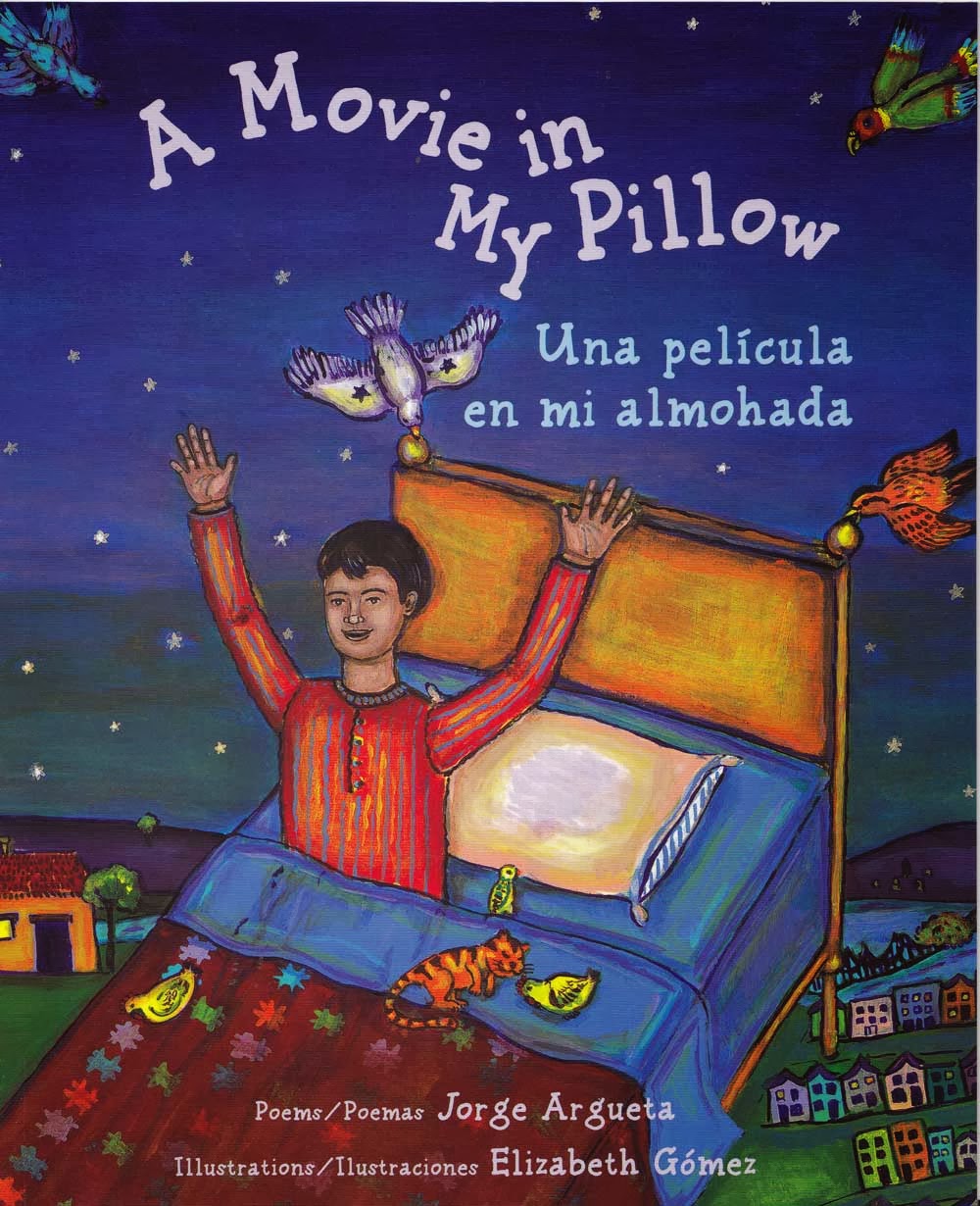
Movie in My Pillow / Una película en mi almohada


author: Jorge Tetl Argueta
translator: Jorge Tetl Argueta
illustrator: Elizabeth Gómez
Children’s Book Press / Lee & Low, 2001
grades 2-up
Pipíl, Salvadoran, Salvadoran American

During the bloody Salvadoran Civil War (1979-1992) between the military government representing the 12-family oligarchy of wealthy landowners, and leftist forces representing mostly impoverished peasants, US-supported government death squads terrorized, tortured, murdered and disappeared thousands of civilians, especially targeting students, intellectuals, and Indian people in the rural areas. By the time the UN-brokered peace agreement was signed, it’s estimated that more than 75,000 people had been killed and more than half a million refugees had fled to the US.

In this lovely bilingual collection of autobiographical poems, young Jorge tells the story of how he and his father, fleeing from the war, arrive in San Francisco. Eventually, the rest of the family will join them, but for now, father and son, leaving in the middle of the night—and without saying goodbye to anyone—must travel alone.

In an introductory note, Argueta writes about the beauty of his home country and the war that forced his family to leave. “These poems are my memories, my dreams,” he writes, “the movies in my pillow.” This brief history of his “transplantation” reminds me of the stories my grandmother told me about having to leave Mexico with her brother packed into a trunk so he would not be taken to become a soldier. Although my grandmother always longed for the homeland of her childhood, still she embraced this country for the safety it provided. Like my grandmother was, young Jorge is also resilient. While holding tight to the memories of his homeland, he is able to put down roots in San Francisco with its “sopa de lenguas en el viento / soup of languages in the wind.”

When his uncle sends him an audiotape of his grandma, talking and singing to him in Nahuatl and Spanish, we know that Jorge, wherever he is, will always remain connected to his culture and community:

Jorge, Jorge, maybe
you will never come back.
Remember when you sat
next to me on the river bank?
Jorge, Jorge, don’t forget
that in Nahuatl “tetl”
means “stone” and “niyollotl”
means “my heart.”

 Argueta’s writing—both in Spanish and English—are pure poetry, with brilliant metaphors that will resonate with young children. On one page, for instance, he is a yo-yo, and his poem is a long unpunctuated sentence: 

I have a yo-yo that makes me crazy but I can’t stop playing yo-yo in the mornings yo-yo in the middle of the day yo-yo in the afternoon yo-yo at night yo-yo yo-yo yo-yo I dream yo-yo I walk yo-yo I eat yo-yo I am a yo-yo.

Gómez’s brightly colored acrylics beautifully illustrate Argueta’s beautiful poems. She has a lot to work with: Here is Jorge, avoiding cobras on the sidewalk; riding a dragon dancing the cumbia; with his family flying like parakeets between San Francisco and El Salvador; and turning into a yo-yo. One of my favorites is the image of Jorge’s family members, embracing each other in a huge nest—“abrazando nos sentimos como un gran nido con todos los pájaros adentro.”

The Spanish is wonderful, depicting Jorge’s struggle and emotions of his abrupt immigration to San Francisco; the translation was most likely accomplished from Spanish to English. I especially like the way the Spanish and English versions alternate on each spread, with both languages presented as equal in importance.

In A Movie in My Pillow / Una película en mi almohada, Argueta gives young readers insight into the one of the most difficult experiences a child can have—being uprooted from your homeland and transplanted far away to a very different place. For young Jorge, landing in “la misión” provides him with a world of adventures and enough cultural connections to El Salvador to make his transition a little less traumatic than if he had landed somewhere else. This book is a welcome addition to a collection of stories about the immigrant experience and is highly recommended.

—María Cárdenas
(published 1/24/14)

Xochitl and the Flowers / Xóchitl, la Niña de las Flores


author: Jorge Tetl Argueta
translator: Jorge Tetl Argueta
illustrator: Carl Angel
Children’s Book Press / Lee & Low, 2003
kindergarten-up
Pipíl, Salvadoran, Salvadoran American

Newly transplanted from El Salvador to San Francisco, the hard-working Flores family struggles to transition from one culture to another and to adapt to a new urban environment. As in their homeland, Xóchitl and her mother decide to sell flowers in the city; and when her father locates an apartment to rent in a building with a garbage-laden vacant lot, the family and a few neighbors clear it and build a plant nursery. But, as an unfeeling landlord demands that it be shut down, the nursery’s fate is uncertain. How everyone comes together and softens the landlord’s heart is the crux of this tender story of family and community.

Argueta, a talented poet, infuses the story with the imagery of the immigrant experience: days going by slowly as turtles, ants circling their world of dwarf lemon trees in just a few minutes and snails carrying their little homes on their backs. The Spanish text reads beautifully and is particularly expressive; it seems likely that Argueta wrote it first and then translated it into English, which was then edited.

Here, for instance, Spanish-speaking children will easily identify with Xóchitl, as she practices English:

En la escuela, ya puedo decir varias oraciones en ingles. Cuando estoy sola las practico y parezco loquita diciendo: —How are you? My name is Xochitl. Do you like flowers?

But some of the English text will confuse Spanish-speaking children. Here, Xóchitl is telling, in English, how she practices some simple sentences in English:

In school, I can already say a few sentences in English. I practice them when I’m alone; I probably seem a little crazy when I ask myself, “How are you? My name is Xochitl. Do you like flowers?”

Angel's acrylic and colored-pencil illustrations of the characters seem flat, but his background images, including photo collages, are bright and vibrant and will hold the attention of the youngest readers.

The story’s conflict is too easily resolved; I would rather have had it more closely reflect the actual community struggle—as neighbors and local organizations came together to convince the City Planning Commission that the family’s nursery was an asset—as Argueta describes it in his endnote. Still, Xochitl and the Flowers / Xóchitl, la Niña de las Flores, is an evocative story of a hard-working immigrant family from Central America, and is highly recommended.

—Beverly Slapin
(published 11/3/13)