Showing posts with label Kokila Books. Show all posts

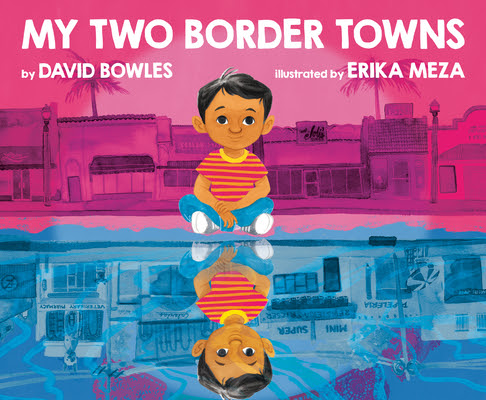
Mis Dos Pueblos Fronterizos // My Two Border Towns


David Bowles
Mis Dos Pueblos Fronterizos // My Two Border Towns 
illustrated by Erika Meza 
Kokila Books, 2021 
Mexican (preschool-grade 4)


Every other Saturday, a young child’s father wakes him up early. It’s time to go shopping, and then to el Otro Lado—the Other Side, across the U.S.-Mexican border. As they cross, the father reminds his son of the time when the Indigenous people—Coahuiltecans—once lived here, before both riverbanks were Mexico.


For the boy, their shopping trip is a large part of his education. On the way, the child’s dad quietly instills in his young son important values, such as respect for elders. As he holds out a dollar and calls to an elderly newspaper seller, “Aqui tiene, Don Memo. Thanks!”—his dad refers to him as “Don,” an honorific. Although the child appears to be unaware that he is learning something important, he is, in fact, learning. Later, he notices that his dad has tipped another elderly man, Don Chava, for washing his truck.


After breakfast at their favorite restaurán, father and son go shopping. They’ve done this often, and the child recites what’s on the list for their friends: medicine, T-shirts, chanclas, bottled water. And “cold, sweet Gansitos and lots of chewy Glorias, too.” And one last stop, for comics, notebooks, pencils, and game cartridges. “I add the things we bought today,” he tells young readers. “I hope all the kids will enjoy them.” 


His dad calls the child’s friends “refugees” …. “stuck between two countries. The U.S. says there’s no room, and Mexico says it can hardly look after their own gente.”


A line of people from the Caribbean and Central America camp along the edge of the bridge, waiting for their numbers to come up; and a border patrol cop, hanging on to his guard dog, suspiciously eyes father and son.


Dad pulls over, and the boy’s young friend, Élder—who lives on the bridge with his mom and siblings—runs to greet him. While he distributes the comics, games, snacks, bottled water and medicine that he and his dad had bought for them, a group of white tourists passes. They look straight ahead, as if the people sitting at the curb with their children and everything they own—hanging laundry, a blanket, a mattress—are invisible. Several women tightly clutch their purses.


The boy may not notice the white tourists who look away, pretending not to see the poverty right in front of them. But the boy’s father tells him and models for him this family’s duty to care for their gente. “I add the things we bought today,” he tells young readers. “I hope all the kids will enjoy them.” (They will. Among the games, snacks and bottles of water are great children’s books: They Call Me Güero and Gustavo, el Fantasmita Tímido.)


Neither Bowles’ Spanish version nor his English is a translation of the other. Rather, he tells the story in Spanish and in English, with each complementing the other. A piece in English reads, for instance, “This town’s a twin of the one where I live…,” and in Spanish reads, “El pueblo es como el nuestro en un espejo…” (“The town is like ours in a mirror…”)


Meza’s artwork—using gouache, soft watercolors, pencil illustrations and “digital gimmicks”—is rich in detail. The broad river does, indeed, resemble “a watery serpent that glints with the dawn.”


Young readers look intently at the cultural images and define them: In dad and son’s favorite restaurán, a string of delicate papel picado hangs overhead and an altar to the Virgen de Guadalupe and el Niño Dios contains a fresh flower in a glass of water as an offering. As an elder woman flips tortillas with her hands, a waiter carefully balances a large basket full of them and a bowl of salsa, and the boy uses a rolled-up tortilla to scoop up his food.


Other illustrations almost force young readers to notice things they otherwise might not. A white woman, for example, looks straight ahead and tightly clutches her purse in fear of the line of Mexican and Central American asylum seekers at the border.


The young boy’s empathy is real. This Mexican kid knows who he is and what he comes from because he absorbs his parents’ compassion—and because they teach him by word and example his responsibilities for his gente. This kind and generous child—of kind and generous parents—is learning that he is part of his gente and his gente are part of him. My Two Border Towns and Mis Dos Pueblos Fronterizos tell an important story. 


Compassionately written and beautifully illustrated, both Spanish and English versions are highly recommended for all home, classroom and library collections.


—Beverly Slapin

(published 9/12/2021)


*Highly recommended for all home, classroom and library collections.


Strange Birds: A Field Guide to Ruffling Feathers

author: Celia C. Pérez 
Kokila Books, 2019
grades 4-7

Some 150 years ago, wearable taxidermy—specifically, dead birds or bird parts affixed to women’s hats—were so popular among wealthy patrons of the high-end fashion industry, that they helped bring about the decline of several species, such as the snowy egret and the common tern. In the US, this problem was especially acute in Florida; and it took a particularly strong and vocal group of women to take a stand against this wholesale slaughter of the US wild bird populations. 

In 1886, American writer and poet Celia Laighton Thaxter penned an impassioned article that was later reprinted for the Audubon Society of the State of New York. Her piece, entitled, “Woman’s Heartlessness,” read, in part:

I would the birds could all emigrate to some friendlier planet peopled by a nobler race than ours, where they might live their sweet lives un molested, and be treated with the respect, the consideration, and the grateful love which are their due. For we have almost forfeited our right to the blessing of their presence.

But still we venture to hope for a better future, still the Audubon and other societies work with heart and soul, to protect and save them, and we trust yet to see the day when women, one and all, will look upon the wearing of birds in its proper light,—namely, as a sign of heartlessness and a mark of ignominy and reproach.(1)

In 1918, the struggles of these women activists bore fruit, and the Migratory Bird Treaty Act was signed into law. One of the first National Audubon Society’s victories, the MBTA has saved millions, and possibly billions, of wild birds. However, although it became illegal to hunt birds to feed the fashion industry, it was—and still is—legal to keep the “surviving” hats. 

Fast-forward to now. In the wealthy community of Sabel Palms, Florida, one of these hats—to wealthy white tradition-bearers, a symbol of the reverence for high fashion at any cost—becomes the focus of a new (or continuing) battle. A hundred years after the Migratory Bird Treaty Act became law, a Girl Scout troop called the Floras maintains a beauty pageant of sorts, in which the winner gets to wear the “Flora hat.”

During the summer before seventh grade, four girls—outraged at the notion that an antique woman’s hat, adorned with the bird feathers that symbolized and romanticized wealth and privilege in a bygone era, continues to be used as an icon in a beauty contest—learn about history, community involvement, activism, and social justice—and how their own stories connect with those of each other and with the community.

The girls, whose family histories are ethnically, culturally and economically disparate and yet whose realities are intertwined, see themselves as outsiders, “strange birds” who find each other and come together in this place and at this time in a quest for community change and social justice. And at the same time, the “Miss Floras Contest” and the “Floras hat” mean something different for each of them:

  • Budding investigative journalist Ofelia Castillo, whose parents are determined and proud OPCs (Over Protective Cubans), dreams of writing the exposé that will uncover the DiSanti family’s secrets and win her the Qwerty Sholes Journalism Contest. 
  • Rebel artist Lane DiSanti, whose millionaire grandmother insists on her joining the Floras, discovers that she must confront her own white and upper-class privilege in the struggle, while she tries to understand her parents’ impending divorce.
  • Innovative foodie Aster Douglas, the granddaughter of the first Black professor at Sabal Palms University and whose ancestors worked for Lane’s, mirrors her grandfather’s passion for social justice and researching the history of the Douglas family. 
  • Impassioned ornithologist and historian Catarina (Cat) García, a Floras defector whose discovery that the Floras hat is made of real bird feathers leads her to challenge her own privileged status and expose the violence of a beloved-by-some, innocent-appearing tradition. 

As the four girls, who call their secret group “An Ostentation of Outsiders and Others,” (2) come together in the struggle and take a look at themselves and how and where they’re positioned in their communities, they—and readers—soon realize that, in deciding to become visible activists, some are more at risk than others. And sometimes—as is common with institutional racism—it’s up to one of them to educate the others. Aster tells the others, for instance:

My grandpa says people find reasons and ways to oppress other people based on color and language and anything else that makes us different from one another. It’s how the rich and powerful stay that way, by dividing people.

And, part of being an activist is this: “Knowing when to stop depends on how much you’ve done, how much you care, and how much you’re willing to risk.” And later, he says, “Sometimes the desire for change is bigger than anything else. It has to be.”

In this fast-moving and satisfying adventure story in which plans sometimes go awry and chaos sometimes ensues, Pérez gives each girl her own character arc and friendships become strong. For middle readers, Strange Birds opens up an important and nuanced discussion of race and racism, class and classism, and a deeper understanding of the relationship between intersectionality and activism. And, no less important, as Pérez writes, it’s about “four individuals discovering truths about the world, about themselves, and about friendship.” 

*Highly recommended for all home, classroom and library collections. 

—Beverly Slapin
(published 9/21/19)

(1) http://www.seacoastnh.com/celia-thaxter-attacks-heartless-women-wearing-birds-as-fashion/

(2) In ornithology, a flock of peacocks, peahens and peachicks is collectively known as an ostentation.
.