Showing posts with label Raven Tree Press. Show all posts

Best Mariachi in the World // El Mejor Mariachi del Mundo // The Best Mariachi in the World / El mejor Mariachi del mundo

author: J.D. Smith
illustrator: Dani Jones 
translator: Eida de la Vega 
Raven Tree Press, 2008 
preschool-grade 2 
Mexican

This title was published in hardcover and paperback, in English-only, Spanish-only, and what the publisher labels “Bilingual—with mostly English and concept words in Spanish formats.” (For those who may not know—apparently including the publisher—a bilingual book contains the complete text in two languages.)

Summary: “Gustavo wants to be in the family mariachi band [sic], but he cannot play the violines [sic], trumpets or guitars. He finds his place in the band with his singing talent.” The book’s message is something about a little kid (literally) “finding his voice.”

This book seriously downplays the role of nurturing in a large extended family. Mariachi groups are often family-based, cousins, uncles, aunts, grandmothers, grandfathers, all training the future generation of musicians. Think of the Trio Los Panchos—they’ve been around for over 50 years and are now composed of grandsons of the original mariachis.[1] This takes work and dedication and teaching from an early age. None of this is shown in Best Mariachi, and that is its fatal flaw: it totally negates the role of family in Mexican culture.

The story begins on this depressing note: “Gustavo was the worst mariachi in the world.” In the first illustration, Gustavo—dressed in a green t-shirt and brown pants, hands in his pockets, eyes cast downward—stands sorrowfully in the middle of his (male) relatives who are dressed in mariachi outfits and happily playing mariachi instruments: violín, trompeta, and guitarrón. The only one who acknowledges Gustavo’s existence is the dog at his feet.


Although Gustavo dreams of becoming a great mariachi, recognized and applauded by everyone, young readers find out that Gustavo is the “worst mariachi” because none of his mariachi relatives—his father, his uncle, his brother, even his cousins—will let him as much as touch their instruments, so he cannot even learn to play.

Let’s stop here for a moment. This story stretches credulity and completely obscures the reality. Any Mexican or Mexican American mariachi family (or any musical family) would be delighted to encourage their children to learn the music—as well as traditional, historical and contemporary songs—and to learn to play whichever instruments suit them. There would be lots of hard work to accomplish the goal of becoming a mariachi: lots of learning and lots of practice, probably after school and homework; and maybe even working a part-time job to save money to purchase the instrument and fabric for the outfit. The whole thing might become a family or community project in which the child learns many things about history, music, study, work, and economics. That would make a good story.

But here, young, sad and alone, Gustavo goes out into the desert each night to sing. At first, he is hesitant, and then, little by little, he gets more confident and sings louder as “he sings all the songs that he knows as well as he knows his own name.” After a while, the townspeople hear his voice, loud and clear. They applaud. They say he is a “true mariachi—the best mariachi in the world.” His cousins carry “the best mariachi” home to an “enormous breakfast” consisting entirely of a huge plate of what appear to be plain tortillas. Served by someone wearing a chef’s outfit. Oh, well.

Jones’ gouache, oil, and colored-pencil illustrations complement the stereotypic story. With very small differences, all of her over-the-top cartoonish characters look alike—exaggerated, oversized heads and small bodies, dark complexions all the same shade of brown, expressions denoted by closed or bugged-out eyes and wide open or curved-downward mouths. As well, the limited palette of background colors—mostly bright turquoises and blues, browns, greens and purples—seems to be a weak, half-hearted attempt at Mexican sky, desert flora and fauna, and adobe.

Last year, I viewed an amazing 2013 performance by Mariachi los Tigres, students from Stephen F. Austin Middle School in San Antonio.[2] Here was a group of talented, disciplined, practiced, joyful young people, full of pride and community esteem, performing instrumental and vocal solos, revolutionary corridos and popular songs. Towards the middle of their performance, their teacher asked the parents and other adult community members to stand and receive applause for their hard work and dedication. Then all acknowledged the children for maintaining their grades and good citizenship before engaging in the “fun stuff” of playing mariachi music. Love spread all around. This is what community is about.

All of this is what’s missing from The Best Mariachi in the World // El Mejor Mariachi del Mundo. Mariachi family members who won’t let a child touch their instruments. A child left alone with no one to help him realize his dreams. So he accomplishes all this on his own. And becomes the best.

The “bilingual” version—from the title on (which, rather than “El Mejor Mariachi en Todo el Mundo, would correctly be, “El mariachi mejor en todo el mundo”)—is piled high with errors and inappropriate usage. Here are just two more examples:

            No one was there to play. But he had to stand up and sing. He had to cantar.[3]

Since “cantar,” above, is an infinitive, the (incorrect) English translation would be, “He had to to sing.”

“Hmm,” Gustavo thought, “I want to be in the band—in la banda mariachi. But what can I do?”

(1) The term, “mariachi,” is both singular and plural: A person who sings and plays mariachi music is called a “mariachi,” and the group is also called “mariachi.” (2) “Banda” refers to Mexican country dance music; it doesn’t mean “band,” as a synonym for a musical group. That word would be “grupo” or “conjunto,” followed by the name of the group. And finally: (3) Inserting Spanish words into an otherwise English text does not make a story bilingual. Mexican and other Spanish-speaking people do not talk this way. Mexican and other Spanish-speaking people do not even think this way.

Rather than reflecting Mexican children’s ways of speaking, ways of thinking, and ways of being in the world, the story is a deficit view of Mexican families, and the language is worse than stilted. Children who are hablantes or who are bilingual learn by working through meaning and concepts and nuance. But by using an English-dominant translation—using English as the literal point of transfer—the story obscures meaning, rather than bringing together two ways of meaning and two ways of seeing the world.

The Best Mariachi in the World / El Mejor Mariachi del Mundo is a culturally inappropriate story—about a young Mexican child who must, and does, go out alone to “find his voice” because his mariachi family doesn’t care enough about him to encourage his talent. The story contains inaccurate Spanish, amateurish and stereotyped pictures, and a fake “multicultural” overlay—all of which promotes a sort of  “bootstraps mythology” to be fed to innocent little kids. Despite its winning second place in the 2009 International Latino Book Awards for Best Children's Picture Book, The Best Mariachi in the World / El Mejor Mariachi del Mundo is not recommended.

—Beverly Slapin
(published 10/14/16)

Míl gracias to María Cárdenas, Judy Zalazar Drummond, Pat Enciso, Lyn Miller-Lachmann, and Ricardo Ramírez.


[1]Here they are, in a 20-minute compilation of six of their well-known songs: “Contigo,” “Si No Estás Conmigo,” “Flor de Azalea,” “Poquita Fe,” “Triunfamos,” and “Sabor a Mí.”
 https://www.youtube.com/watch?v=7Cp0tjTQv6M.

[2] Enjoy this wonderful community concert: https://www.youtube.com/watch?v=TavqBkUv-6M. The teacher is the guy in the back who’s playing the guitarrón and can’t stop smiling.

[3] In the book, the phrases in bold here are highlighted in red.

Soap, Soap, Soap / Jabón, Jabón, Jabón

author: Elizabeth O. Dulemba 
illustrator: Elizabeth O. Dulemba 
Raven Tree Press, 2009 
preschool-grade 3 
Mexican American


The illustrator of Paco y La Planta de Chile Gigante / Paco and the Giant Chile Plant is back now with her own work. With the same structure as Paco, Soap is a modernized version of the classic Appalachian Jack tale written in English with Spanish words peppered throughout and highlighted in red, and primarily featuring Latina/o characters. Also like Paco, Soap is marketed as bilingual, which, of course, its not.

Here, Hugos mother sends her forgetful child to the market to buy soap. Although the market is only a short walk from his house, he chooses a roundabout path through the playground, down the sidewalk, past a ditch, through the schoolyard into the market. Sort of like the comic strip, Family Circus. Along the way he encounters multiple obstacles, neighbors, and misunderstandings, which sometimes lead to violence. Each time, he forgets what he was supposed to buy, but is reminded by something someone says until his next encounter.

Hugo slips and falls into a puddle of mud, his friend also falls into the mud puddle, an elderly neighbor drops her groceries and grabs and scolds Hugo, and a bully hurls him into a ditch. Finally, Hugo gets to the market, purchases the soap, jumps back over the ditch, past his fuming neighborstill yelling about her groceriesand through the playground to his house. His mother, agape when she sees her stinky, filthy child, marches him to the tub to bathe himself with his newly purchased soap, soap, soap.

Dulembas acrylic paintings on a palette of bright oranges, yellows, greens and earthy browns, are inviting; and the storys premise is silly but appropriate for the age range for which it is intended. However, Soap, Soap, Soap is a tour de force of racial and ethnic stereotypes.

Hugos mother appears to be single. Certainly, single mothers exist in all cultures and ethnicities, but it is exasperating to see Latinas consistently cast as women who must raise their children alone. In addition, both women hereHugos mother and the elderly, hotheaded Latina who drops her groceries and remains incensed for what could be hoursare heavyset with prominent derrières. Hugos young friend, an African American child, is named Jellybean, which is a racial slur for Black people [1]. And, as with Paco, there is not one actual cultural marker in this story [2], and the highlighting of a few Spanish words in red sends a negative and confusing signal to Spanish-speaking children while teaching English-speaking children little of value.

And, although Dulembas bright images make it appear that Hugo lives in a cheerful and safe neighborhood, he experiences violence multiple times while trying to run a simple errand for his mother. This plays out like the lives of minority young people growing up in impoverished and violent neighborhoods where at any moment they can get hurt, or worse, just for being at the wrong place at the wrong time.

Soap, Soap, Soap / Jabón, Jabón, Jabón is not recommended.

Lisette Silva
(published 7/12/15)


[1] “Jellybean,” as a name for Black people, is a racial slur that means, “no one likes the black ones.” (Racial Slur Database, www.rsdb.org/slur/jellybean)

[2] The one Spanish expression used here, “Ay, caramba!” more likely befits “Pancho,” the not-so-bright sidekick of the 1950’s “Mexican” TV hero, “The Cisco Kid.” It was also the catch phrase of Bart Simpson.

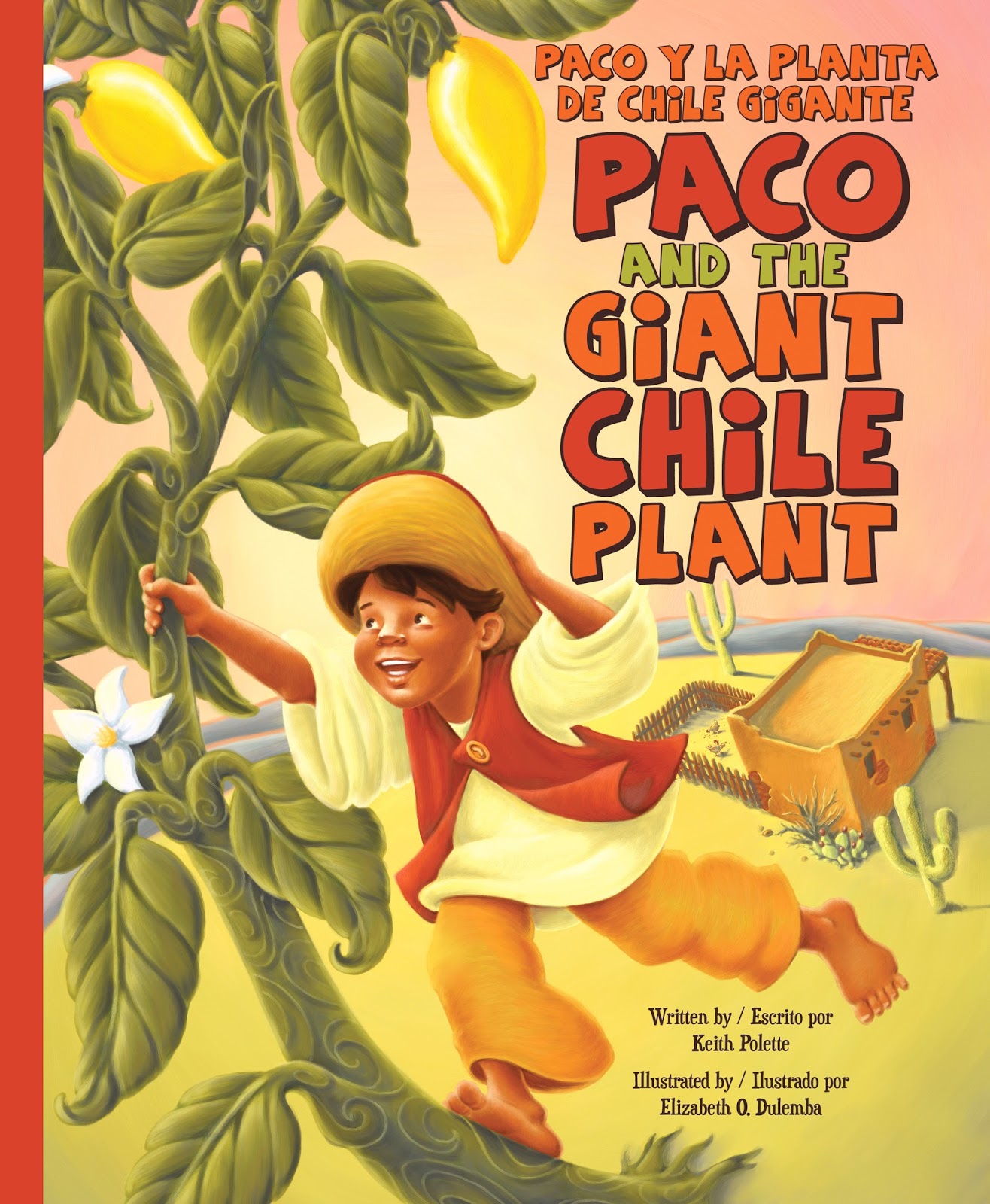
Paco y La Planta de Chile Gigante / Paco and the Giant Chile Plant

author: Keith Polette  
illustrator: Elizabeth O. Dulemba 
Raven Tree Press, 2008 
preschool-grade 3 
Mexican American


Set in the Southwestern United States, Paco y La Planta de Chile Gigante is a re-imagined version of Jack and the Beanstalk, the classic English tale of a poor widow and her son who sells their dairy cow for magic beans. Upon learning of her son’s action, the outraged mother throws the beans on the ground where, overnight, they grow into an enormous beanstalk. Looking for treasure, Jack climbs the beanstalk to find a horrible, nasty, greedy giant who attempts to eat him, but ultimately Jack prevails in stealing the giant’s gold and other stuff and the giant falls to his doom.


In Paco, the English boy and his family morph into Latinos. Here, a poor, presumably widowed, mother sends Paco off to town to sell their dairy cow—which he does, for magic chile seeds. But rather than proudly presenting the chile seeds to his mother as Jack did with his beans, Paco plants the seeds himself to see what happens. The chile plant quickly grows up to the sky and Paco climbs it, looking for treasures.

Upon reaching the top, Paco harvests the chile blooms, enters a house of enormous proportions and meets the giant himself. Like the original tale, the giant is terrifying and tries to eat Paco; but unlike the original, he sees Paco as the savory filling for a thin, flat Mexican pancake of masa or flour:

FEE-FI-FO-FUM, I SMELL THE BLOOD OF A HUMAN ONE. BE HE THIN OR BE HE FAT, FOR MY TORTILLA I’LL GRIND HIM FLAT.

In an attempt to save himself, Paco offers the giant his chiles de oro. The chiles burst in the giant’s strong grip and spray their juice all over his face. The juice is so hot that the giant begins to cry a river of tears. With each tear, he begins to shrink and shrink until he is the size of an average man. Once the crying and shrinking stuff stop, Paco recognizes the man as—his father! Yes, years before, the father-cum-giant-cum-father tells Paco, he had climbed a giant chile plant, also looking for treasures. When he got to the top, like his son, he found chiles de oro. But, rather than just picking them, he ate them—and turned into a terrible giant.

So Paco and his father clamber down the chile plant and chop it down as the mother comes out of their house to find her long lost husband with their son. And they live happily ever after.


Paco could be seen as a charming “Latino” rendition of the original, but the devil is in the details. Dulemba’s digitally rendered artwork—on a palette of mostly desert browns, yellows and greens—is designed to reflect a “beautiful desert setting in the American Southwest.” It does. But I couldn’t make sense of the time period(s) in which it’s supposed to be set. Paco and his father appear to be dressed as Mexican campesinos who look like they came out of an old Clint Eastwood movie set in the 1800s, while the mother’s clothing and hairstyle appear to be from the 1930s or 40s.

And Polette portrays his Mexican American characters (including the giant) stereotypically:

• A Latina mother who is single and abandoned rather than a widow

• A deceptive Latino child who plants the seeds himself, rather than an innocently precocious boy, who proudly shows his mother how he is “helping” her

• A Latino father who is a dimwitted dreamer looking for treasures in the clouds, who abandons his family, and who becomes a violent thug (before he changes back)

• And finally, Latina/os who eat hot chiles turn into monsters

Then there’s the language: Although there’s a vocabulary page in which each of the Spanish words is translated into English, Paco demonstrates the type of structure that is all too often falsely marketed as “bilingual,” as this one is. But it’s not a bilingual story. It’s not a story in Spanglish, either. Rather, it’s an English-language story with Spanish words casually tossed in throughout—and worse, each Spanish word is embedded in red type. This technique, according to the liner notes, aids in the fun and learning of both languages. But the reality is that it relegates the “other” language to second-class citizenry.

I don’t know what the purpose of Paco is. If it’s an attempt to teach Spanish to English-speaking children, it fails: A few words do not make a language. If it’s an attempt to teach English to hablantes, it fails as well. If it’s an attempt to change a well-known fairy tale into a “diverse” story, placing it in another time and locale and stereotyping the characters is exactly the opposite of what it purports to do.

Paco y La Planta de Chile Gigante / Paco and the Giant Chile Plant is not recommended.

—Lisette Silva
(published 7/7/15)