It was Spring 2012. My second book, Mexican Bestiary (an illustrated bilingual encyclopedia of creepy cucuys), had just been released by a small press, much like my previous collection of short stories, The Seed: Stories from the River’s Edge. Outside of the Río Grande Valley of South Texas, that stretch of borderland where my family has lived for generations, no one really knew who I was. But on the strength of a few school presentations, Pat Anderson of Overlooked Books—distributor of hard-to-find and little-known Texas titles to school libraries—had invited me to sign at his booth at the annual conference of the Texas Library Association (TLA).
As fate would have it, both of my signing slots put me at a table with two talented, more established authors, both of whom would become close friends: Jason Henderson, promoting his Alex Van Helsing series from HarperCollins, and Belpré Award-winning Guadalupe García McCall.
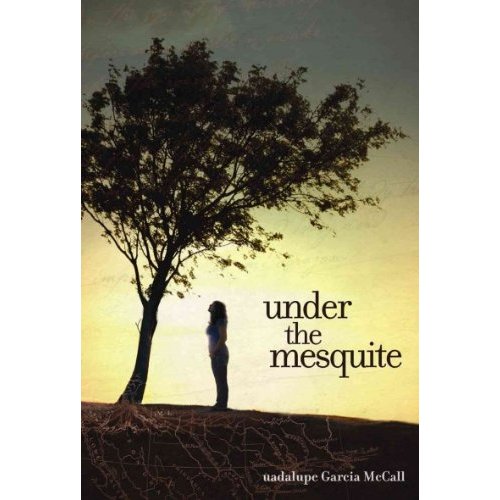
Loops (as I affectionately call her) was there for her second book, Summer of the Mariposas. She was generous with her time and advice, which I appreciated deeply, but perhaps more important was that sophomore publication itself. I read it that evening in my hotel room, awed by the beautiful prose and inspired by her deft integration of not only Mexican American legends into the narrative, but also Aztec mythology.
I had been toying with an idea. During my kids’ childhoods, I read all the major series with them: The Chronicles of Narnia, Harry Potter, Percy Jackson, Hunger Games, and others. We would often joke that it would be so nice to crack open a cover one day and find a Chicana battling cucuys and Mesoamerican deities (instead of the typical Chosen White Dude facing off against European monsters and gods, with an occasional Secondary Sidekick of Color). Our laughter would often fade to wistful looks, as it didn’t seem particularly plausible.
But after my first book was published, I began to dream about creating just such a series, centered on magical Mexican American kids whose abilities must be put to use to stop the forces of chaos from ending the world for a fifth time (as predicted by Mesoamerican sacred stories).
Speaking with Guadalupe García McCall, reading her work, I became convinced that this could actually happen. I gave the characters a family name from my dad’s side—Garza—that also served as a nod to Loops (the five sisters in Summer of the Mariposas, which I would go on to translate into Spanish, are also Garza: cousins of my protagonists, we have officially agreed).
By late 2013, I had written The Smoking Mirror, the story of Carol and Johnny Garza, 12-year-old twins whose lives in a small Texas town are forever changed by their mother’s unexplained disappearance. Shipped off to relatives in Mexico by their grieving father, the twins soon learn that their mother is a nagual, a shapeshifter, and that they have inherited her talent. But there’s more. Twin shapeshifters come along only once a millennium, capable of wielding savage magic, a power even the gods can’t control. In order to rescue their mother, the twins have to descend into the Aztec underworld and face the dangers that await them in each of its nine levels.
This was a quest story, which I infused with video-game logic and middle-school snark, with a thematic twist at the end: it isn’t the twins’ might that ultimately saves their mother, but their love for her and each other.
I began sending it to editors. Every single one of them rejected it. Nearly two dozen. Most expressed some variation of the following concerns:
- There are no white kids. Can’t the twins have a white sidekick they have to explain all the unusual cultural stuff to?
- There’s too much Spanish. Can’t you cut back on it? Readers will be confused or alienated.
- Aztec gods have hard names. Can’t you shorten them or something?
To which my responses were, over and over:
- No. Donna, Texas, has hardly any white people. It would feel forced.
- No. There’s not too much Spanish, to my mind. And who do you mean when you say “readers”? Do you think that Latino kids don’t read?
- No. Tezcatlipoca isn’t any harder than Hephaestus. You’re just used to the latter because we teach Greek gods in school.
Soon I started sending it to smaller presses that accepted un-agented manuscripts. Many gave me similar pushback. A couple of prominent publishers of Mexican American kid lit passed on the manuscript as well. One said, “We don’t publish fantasy.” The head editor of the other rejected the book five minutes after receiving the first chapters, citing excessive adverbs (there were three—I counted).
Finally, I saw an ad from IFWG Publishing, an Australian outfit that also distributed in Europe. They were looking to break into the US market and had put out a call for manuscripts. I submitted: editor Gerry Huntman loved the book (a big fan of Mexico, he really got what I was trying to do). Seeing that it was clearly the first volume in a series, he offered me a contract for all five books.
Small publishers had been good to me so far, so I agreed. When the cover illustrator dropped out, they took my advice and hired my then 18-year-old daughter Charlene, a great artist who had just begun her BFA. If you’re wondering about the benefits of publishing outside of the Big Five, those sorts of opportunities top the list.

The book was released in the spring of 2015, right before that year’s TLA conference. Pat Anderson of Overlooked Books sat down with me, and we came up with a strategy for promoting The Smoking Mirror. I bought 100 copies from IFWG, and Pat helped me to give them away to key librarians from all over Texas, with no strings attached beyond the hope that they would share the book with students at their schools, especially Mexican American kids. If they also wanted to give it a positive review with online booksellers, Goodreads, or their own blogs, that would be wonderful, too.
Ah, who can fathom fate? There’s no way of knowing what will grow from the seeds we plant. All we can do is our best, hearts full of good intentions, actions free of malice.
One of those librarians loved the book. She gave it to her friend, who was on the Pura Belpré committee, looking for titles by “a Latino/Latina writer and illustrator whose work best portrays, affirms, and celebrates the Latino cultural experience in an outstanding work of literature for children and youth.”
The committee member loved it, too. Shared it with the rest of the members. Advocated for it despite the small size and unusual situation of the publisher.
I was sitting at the dining room table with my wife that January afternoon when calls started coming in from Baltimore. Whom do I know in Baltimore? Probably a robocall or bill collector. Chale, not answering.
Then my editor messaged me. Answer your phone. It’s the American Library Association.
It was a good thing I was sitting down when they finally got through. It was one of the most unexpected, beautiful things to ever happen to me, listening to the committee congratulate me on the book’s being selected for one of the author honors.
Awards change things, for authors and publishers both. IFWG had to revamp its distribution model and retroactively put out a hard cover edition. I was interviewed again and again. Agents came out of the woodwork, trying to sign me.
I came away from la Celebración in Orlando with two new book deals with publishers who had (no hard feelings, folks) passed on The Smoking Mirror.
 At the same time that The Smoking Mirror was receiving all these accolades, the publication of its sequel, A Kingdom Beneath the Waves, went somewhat unnoticed. Set about six months after the first volume, this second installment finds the Garza family’s Christmas vacation in Mexico cut short by the appearance of Pingo, one of the elfish tzapame. The news is grim: a rogue prince from an ancient undersea kingdom is seeking the Shadow Stone, a device he could use to flood the world and wipe out humanity. Now Carol and Johnny must join a group of merfolk and travel into the deepest chasms of the Pacific Ocean to stop the prince and his monstrous army with their savage magic.
The book was structurally a departure from the first. Setting it in a fictional place of my own devising (rather than in an established region like the Aztec Underworld) gave me the freedom to raise the stakes considerably and craft an entire culture from a few throwaway lines about mermaids in an old Nahuatl text.
Speaking of being overshadowed, the third book in the series was released in 2018, sandwiched between the mythology collection Feathered Serpent, Dark Heart of Sky and the multiple-award-winning They Call Me Güero, my first novel in verse (see the De Colores review here). Around that same time, after a recommendation from Matt De La Peña, author Adam Gidwitz asked me to co-author the fourth book in his Unicorn Rescue Society series from Dutton Penguin. It was a wonderful, high-profile opportunity, and together we wrote The Chupacabras of the Río Grande (see the De Colores review here). As Penguin Random House prepped us for our tour, I could see Garza Twins #3 fading in the rearview mirror.
And, yikes! There’s the rub, the downside to being prolific, no matter the quality of one’s work: invariably some of it “hits” better than the rest, and there’s no way of predicting what project will. I try to make sure that when multiple books of mine are coming out the same year, none of them compete against the others for the same readers (each project should be intended for a different audience).
Still, The Hidden City just didn’t get the same love (from its author or its public) as my other work that year. The book is ambitious, opening up the twins’ adventures to conflicts not just with gods, but also with humans, setting up the endgame that will play out in books 4 and 5. When Carol and Johnny learn of the Ollamat—an ancient stone that can channel savage magic—they convince their parents to take them to the cloud forests of Oaxaca. With Pingo’s help, they search for the legendary city where it has been protected for a thousand years. But the twins aren’t the only ones hunting for the Ollamat. After it is stolen, they travel to the beautiful yet dangerous Tlalocan, the paradise of the rain god. To retrieve the stone, they face talking apes and forest elementals, rock wyrms and vicious elves, demons of lighting and something even more unexpected: the souls of people they have watched die. As always, they are aided by allies old and new, though nothing can quite prepare them for the biggest foe of all—a member of their very family.

Now here we are, two years later, and I’m working on book 4, Wings Above the Burning Earth. Racing against the clock and against the better judgment of their parents and allies, Carol and Johnny head for the Above, the heaven of the sun god, to retrieve the lost soul of their cousin Stephanie before she becomes a cihuateotl, a fearsome ghost that haunts the evening skies. Their desperate trek lands them in the midst of a massive civil war in heaven, as a former sun god leads rebels against Nanahuatzin Tonatiuh, trying to wrest away control of the sun so he can set the earth’s atmosphere on fire. The twins will have to forge a fast alliance among harpies, phantoms and ancient vampires if they’re going to stop the destruction of all they hold dear.
Publication is set for 2021, but Charlene has already completed the cover, and I wanted De Colores readers to be the first to lay eyes on that artwork.
For those of you who haven’t read the series or who stopped after The Smoking Mirror, now is the perfect time to get caught up. And if you prefer Spanish, Gemelos Garza (translations done by the amazing Libia Brenda) will start publishing this winter, beginning with El espejo humeante.
The Garza Twins will wrap up with book 5, The World Tree, in 2022, ten years after I started writing The Smoking Mirror.

The twins will be climbing the axis mundi to reach the highest heaven of all, Omeyocan, Place of Duality. What a fitting finale for a series that nearly didn’t see the light of day.
Ad astra per aspera, my friends. Much respect and love to all of you who struggle day and night along your own hard road to the heavens.
—David Bowles
(published 5/8/20)
(published 5/8/20)