Showing posts with label Chronicle Books. Show all posts

Lowriders to the Center of the Earth

author: Cathy Camper
illustrator: Raúl the Third (González)
Chronicle Books (2016) 
grades 4-up 
Mexican American

Take any of your favorite Rocky and Bullwinkle’s “Fractured Fairy Tales,” add some random Saturday morning cartoons and a scene or two from Charlie Chaplin’s “Modern Times,” and toss in some Cantínflas, a little “El Chavo del Ocho,” and a telenovela played at double-speed. What you get doesn’t even approximate Cathy Camper’s and Raúl the Third’s high-octane, hyperbolic, over-the-top punny graphic novel for children and everyone else, Lowriders to the Center of the Earth.

In Camper’s and González’s first collaboration, Lowriders in Space, our three amigos—Lupe Impala (ace mechanic extraordinaire), El Chavo Flapjack Octopus (the washcloth-wielding dynamo), and Elirio Malaría (the prime detailer with a bill as steady as a surgeon’s hand)—rebuilt their wreck of a Chevy (“so slow it didn’t even go”) into a lowrider (“the most mechanically inventive, exquisitely detailed car in the universe, with powers gleaned from the galaxy!”) and won the (literally) Universal Car Contest. With the prize money, they were able to buy their own garage, “Bajito y Suavecito,” and became independent from their tyrannical boss. But. At the end of this first volume, their beloved gatito, Genie, frightened by several earthquakes, has disappeared, and Flappy (and the rest of us) see another giant adventure on the horizon….

The three amigos’ adventures continue in Lowriders to the Center of the Earth, just after Genie has gone missing. Gone is Genie, who loved it when Flappy sang to him. Gone is Genie, who purred soniditos while Elirio painted. Gone is Genie, who kneaded tortillas on Lupe’s belly until she fell asleep. So the three amigos get into their retro-nuevo super-ranfla—bajito y suavecito—and, following the trail of gatito paw prints, embark on the mero-mero of all road trips.

Their first encounter is a bad-guy character based in contemporary reality. He is the amigos’ “guide,” the serape- and sombrero-wearing Coyote, who looks somewhat like the “Big Bad Wolf” of Saturday morning cartoons—and who confuses the amigos and leaves them stranded in the desert, as do many of the human smugglers (“coyotes”) hired by desperate people attempting to cross over from Mexico and Central America.

After having been deserted by Coyote, the amigos follow the lead of a colony of bats, journey through a gigantic maíz maze, cross the railroad tracks, traverse a field of boulders, and head into a huge volcano. They encounter, among others: the fearsome ghost, La Llorona (who, they say, wanders the Earth, crying, “¿Dónde están mis bebés?” and grabs up children to replace her own), whom Camper and González have morphed into a sad kitty-cat with great big anime eyes that rain great big blue tears all over her umbrella-patterned dress. And El Chupacabra, the dog-like monster who feeds mainly on the blood of goats and other livestock, appears to have a special taste for Lupe (who is, after all, a ruminant mammal).


But the main bad guy—even worse than Coyote—is Mictlantecuhtli, the hulking, spine-chilling Aztec god—who captures creatures in his great corn maze and forces them to inhabit Mictlan. Here, he becomes el mero-mero, the rudo of all rudos in the Realm of the Dead’s lucha libre ring, swiftly transforming all who dare challenge him into piles of skeletons and whose eyeballs he wears around his neck. In a super-bout that challenges the very lives of los téchnicos Lupe, Flappy and Elirio (not to mention Genie)—their combined technical skills and brainpower, deep affection for each other, and ability to work as a team make for the emotionally best, most satisfying (and kind of unexpected) lucha libre finale ever (followed by a huge Día de los Muertos pachanga, in which La Llorona sings the beautiful, heart-rending ballad, “Cielito Lindo”).

Written in English with over-the-top puns and other wordplays and illustrations that effortlessly and appropriately incorporate Spanish and Caló, both the first and second titles ingeniously hold the attention of adults and are way silly enough to attract reluctant readers.

A few from Lowriders to the Center of the Earth, including this “knock-knock” encuentro:

Lupe: “Have you seen our cat?”
Coyote: “Knock-knock.”
Lupe: “Who’s there?”
Coyote: “Señor.”
Lupe: “Señor who?”
Coyote: “Señor gato? I don’t think so.”

Then there are Flappy’s malapropisms; here, the names for rock formations—“big dumb ignoramus rocks,” “sedentary rocks…like napping at the beach,” and one of my favorites, and I hope one of yours, “metaphoric rocks, the building blocks of poets everywhere”—which are accompanied by depictions of their correct names (carved out of the giant rocks themselves) and ten-second (at most) geology lessons about weathering and the erosion of rock formations.

There are also short “units” about technology, such as the mechanics of a swamp cooler—“hecho en un pantano”—and the wonders of electromagnetic coils, which, when combined with hydraulics, become powerful enough to make the lowrider “hip and hop, dip and drop,” freeing up the tires so the amigos can escape from the worst monsters in the Underworld.

And, spoiler alert: Genie’s rescue is super-special.

González’s art, in traditional Chicana/o doodling form with the time-honored red, blue and black Bic® pens (this time adding green) on what appears to be brown paper grocery bags stained with coffee, uses cross-hatched, stamped and spiraled patterns mixed with papel picado and other designs as they happen to occur to him. A master doodler, González gives readers, in no particular order and for no discernable reason, a bunch of fun things to look at. Here, for instance, readers may find a hitchhiking Mexican Kilroy (yes, he was here), a jackalope, a gnome, cuddly bears, Olmec heads that appear to be rudos, Cheech and Chong, and a tiny raven among the crows (warning “nunca más”).

Although all of his flat-out silly illustrations will appeal to hablantes and English-speakers alike, González saves the most exciting, and by far, the most engaging ones for the mega-bust up on the last few pages, which readers of all ages will want to scrutinize over and over. González certainly ought to receive a Pura Belpré Prize for Traditional Mexican Illustration.

In Lowriders to the Center of the Earth, Camper and González ramp up their hyper-silliness to the level of a Roadrunner cartoon. Something goes wrong, the three amigos fall off a cliff, and the next thing is they’re having yet another adventure. I look forward to seeing the next in this series, maybe a prequel. Who are the three amigos and how did this inter-species trio get together? We know that Lupe, who runs the show, is an adult. And zoot-suit-wearing Elirio is probably a young man. Flappy, al otro mano, is less mature and the others look out for him. Is he a child or just childlike? Are they all roomies or is there a deeper relationship, sort of like with Bert and Ernie? Will we ever find out?

As in their first collaboration, Camper’s hilarious story and González’s ultra-detailed artwork encourage children to develop their imaginations and appropriate suspension of disbelief. Chicana/o children in particular, besides appreciating the cultural and linguistic references that are part of their everyday lives, may be encouraged to see Caló as poetic and beautiful as “regular” Spanish and that great Chicana/o art doesn’t need expensive stuff to produce. As well, children who are not Chicana/o (or who may not even speak or understand Spanish) will find a lot to learn about and enjoy, and unstated lessons both in the text and art. The story also works for teens and young adults as well, who will “get” some of the smart and funny references and nuanced word play on just about every page. For everyone, perhaps the most important thing they will find here is that community trumps individuality.

Pull-quote: “Lowriders to the Center of the Earth—a delightful, hilarious, exciting, culturally-driven collection of textual wordplay and artful doodles—is must reading for every age, ethnicity, gender and species! It’s the best hyperbole-driven graphic novel in the world!”

*Highly recommended for all home, classroom and library collections.


—Beverly Slapin
(published 2/7/17)


Lowriders in Space

author: Cathy Camper
illustrator: Raúl the Third (González) 
Chronicle Books (2014)
grades 4-up 
Mexican American
  
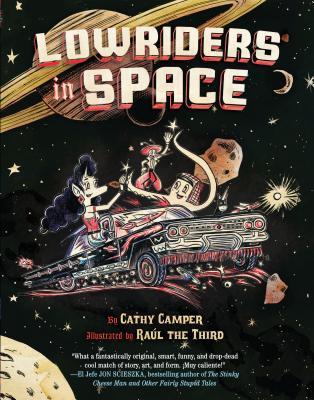
In Camper’s and González’s hilarious graphic novel, three amigos—a mammal, an insect and a cephalopod—embark on a loopy, out-of-this-world adventure in an all-encompassing display of friendship and species diversity in which everyone speaks Caló.

The three, who live together and work at a car dealership six days a week, are the protagonists in the fastest, wildest hyperbole-driven story in the world. “Mechanic extraordinaire” Lupe Impala is “the finest mechanic south of Vacaville.” Ace car polisher El Chavo Flapjack Octopus wields “the wettest washcloth north of the Salton Sea.” And “the best detail artist around” is a mosquito named Elirio Malaría (“Don’t be scared, eses! Only lady mosquitos bite vatos for food!”).

They don’t have a cent, but they have big hearts, big ambitions and big dreams. They dream of having their own garage where they could build their own car: a lowrider that hips and hops, dips and drops. A lowrider that is low and slow—bajito y suavecito. One day, they see an announcement about a (literally) “universal car competition,” in which the “most mechanically inventive, exquisitely detailed cosmic car wins!” First prize is a solid gold steering wheel and a carload of cash—more than enough to fulfill all their dreams! But all they have is “the start of a car, the shell of a car. It was already low and slow, so slow it didn’t even go.”

After an uproarious, fast-paced intergalactic adventure involving at least one fart joke, the three have built a lowrider extraordinaire—bajito y suavecito—adorned with rockets and planets and stars and a tiny “burro-corn” on the front. They “cruised back to earth (with cinto de Orion on the roof), the milky way coated their car, stars stuck to the paint job like glittering dandelion fluff, (and) the Big Dipper gleamed from their license plate.” Their lowrider is, as one of the judges exclaims, “retro-nuevo cool.”

A note about the illustrations: After studying traditional Chicana/o art for many years, graphic artist Raúl the Third took the leap and returned to his cultural roots. For Lowriders in Space, his media became the time-honored red, blue and black Bic® pens, on what appears to be used brown paper grocery bags but is actually paper stained with Nescafé Suave. In this complementary partnership between author and artist, crosshatched, stamped and spiraled patterns mix with papel picado, the characters change size and form according to the needs of the story, asteroids become pom-poms for the windshield, and the planet Pluto is transformed into a gearshift knob.

Teasing the reader, González’s dizzying graphic references fly by. Here is Flapjack, wearing a Chavo hat (of course), sitting in his bucket, blowing bubbles (as octopi do), except he’s blowing soap bubbles. Here, leaning against a wall in his super-cool posture, is Elirio, a Zoot suit-wearing mosquito with a Cantínflas mustache. Here are dust bunnies that are literally bunnies. Here are the Cartínflas garage and Sapo Bell taquería. Here—if you look really carefully—you’ll see Cheech and Chong. And here are our homies in the background careening down a hill on a handmade, fire-spewing, big-tired bike; while an aged, sombrero-wearing, serape-clad Pluto makes a token appearance. We see him sitting next to a nopal cactus, rather than leaning against it—as if to say, “adiós, tired old comic book stereotypes, y ¿qué tal? cool new graphic novel vatos.”

For children, Camper’s uproarious story and González’s over-the-top artwork together encourage development of imagination and appropriate suspension of disbelief. Chicana/o children in particular will appreciate the cultural and linguistic references that have deeper meanings for them. As well, children who are not Chicana/o (and even those who do not speak or understand Spanish) will enjoy the story’s fast pacing and great good humor, and may learn new things as well. The story also works for teens and adults, who will “get” some of the smart and funny references and nuanced word play on just about every page that younger readers might miss. (Such as the great Mexican comedian, Cantínflas, morphing into “Cartínflas,” the name of the garage; and the Mexican sitcom, “El Chavo del Ocho,” into “El Chavo Flapjack Octopus.”)

Camper’s glossary, explaining Spanish, Spanglish, Aztec and Caló references, words and phrases, along with technical and scientific info, is a hoot as well. Take, for instance, “holy mole*,” where the asterisk leads to a lengthy explanation of a “thick Mexican sauce for meat made of many ingredients, including peppers and chocolate.”

No less important is that an aspect of “diversity” modeled here—one that often escapes authors and publishers—is group, rather than individual, problem solving. No fake “multiculturalism” here. No tokenism. No ethnic overlays. Lowriders in Space is the real thing, and it’s hilarious. 

*Highly recommended for all home, classroom and library collections.


—Beverly Slapin
(published 11/22/16)

Just a Minute: A Trickster Tale and Counting Book


author: Yuyi Morales 
illustrator: Yuyi Morales
Chronicle Books, 2003, 
preschool-up 
Mexican

With his sugar-skull face and Día-de-los-Muertos outfit consisting of a bowler hat, wristwatch, and braces to hold his teeth in, Señor Calavera is polite yet insistent. It’s time, he says, for Grandma Beetle to come along with him. Pues, Señor Calavera will soon to find out that Grandma Beetle has other plans—she’s staying around for a while, and Mr. Death will just have to wait—“just a minute.”    

From the first double-page spread—in which a grinning Señor Calavera tips his hat to the left and Grandma Beetle, with a bemused expression on her face, nods to the right—young readers, especially Mexican and Mexican American children, will guess that something hilarious is about to happen. The scene is set: Señor Calavera’s not hiding who he is, and Grandma Beetle has no intention of going with him. The only one who seems frightened is a little black-and-white kitten, who runs away—or hides, or tries to appear large—on every spread.

And Señor Calavera, impatiently checking his watch, waits. He waits “just a minute,” while Grandma sweeps ONE (UNO) house, “just a minute,” while she boils TWO (DOS) pots of tea, “just a minute,” while she prepares THREE (TRES) stacks of tortillas, “just a minute,” while she slices FOUR (CUATRO) fruits, “just a minute,” while she melts FIVE (CINCO) cheeses, “just a minute,” while she cooks SIX (SEIS) pots of food, “just a minute,” while she fills SEVEN (SIETE) piñatas with candy, “just a minute,” while she arranges EIGHT (OCHO) platters of food on the table, and “just a minute,” while her NINE (NUEVE) beautiful grandchildren come through the door to celebrate her birthday. And when everyone is seated, Grandma pulls up a chair for—¿puedes adivinar quién?—guest number TEN (DIEZ), a very happy Señor Calavera himself, whose expression says he can’t believe he’s actually been welcomed to join the festivities.

Here, prestigious award-winner Yuyi Morales renders her beautiful, lively artwork in acrylics and mixed media on paper. In rich, warm colors and bold geometric shapes that bring to mind the bright Mexican murals, here is a working kitchen with chile peppers strung together, well-used ollas on the stove, a humongous cast-iron pot with stew bubbling over, baskets of corn and an old corn-grinder, hand-painted wooden chairs, and gorgeous piñatas, hanging from the ceiling.

And here is Grandma Beetle. She’s a strong, dark, round-cheeked, zaftig Indian woman with sparkles in her gray hair and in her eyes as well. She’s single-handedly enjoying her work: grinding corn, wielding a machete to slice a watermelon, filling piñatas, carrying the huge ollas to the table. And all the time, she’s laughing, laughing, laughing, and sometimes sneaking winks to her child audience. Her nine grandchildren—ethnically mixed, some with darker complexions and dark, straight hair; some with lighter complexions and curly hair; and two with red hair—are reflective of a large, loving Mexican family. And the expressions on Señor Calavera’s face (um, skull)—as he grows more and more impatient—are priceless. All of the artwork is warm and lovely, especially that of the grandchildren, surrounding Grandma with hugs as Señor Calavera makes his exit.

Just a Minute, which complements the celebrations of el Día de los Muertos—is way more than “just” a well-executed counting book—it’s a treasure that will charm readers, young and old alike, and is highly recommended.

—Beverly Slapin
(published 6/16/14)

Tortilla Sun


author: Jennifer Cervantes
Chronicle Books, 2010
grades 4-7 
Mexican American

When her single mother, a graduate student, signs on to a research project in Costa Rica, 12-year-old Izzy Roybal is sent to her grandmother’s house in a New Mexican village, even though Mom and Nana “don’t see eye to eye.” Mom is a footloose scientist while Nana has never strayed from her Mexican-American roots and community. Not only has Mom kept Izzy away from her cultural heritage for twelve years, but she has also kept the youngster away from any information about her Anglo father, who died before Izzy was born.

Before leaving California for New Mexico, Izzy finds her father’s baseball, on which is written, “because…magic,” with the words in between clearly missing. Izzy is eager to find the missing words and with them the truth about her father. Nana and Nana’s friends counsel patience. There are tortillas to prepare and decorations to put up for a birthday party. To pass the time, Izzy works on a story she is writing about a girl whose life parallels hers. Then she meets 13-year-old Mateo, a guitar-playing neighbor with an interest in finding buried treasure, and Maggie, a six-year-old orphan who is cared for by her grandmother Gip, Nana’s best friend. Mateo introduces Izzy to Socorro, the village healer, who offers more clues to Izzy’s past, but Izzy’s desire to discover everything at once puts others in danger.

Cervantes’s debut novel reveals the rich fabric of the community and a spunky and appealing protagonist. Izzy’s energy and impatience ring true, as well as her feeling of being out of sync with the village. This same feeling of being at odds with her surroundings helped to drive away Izzy’s mother, but the youngster’s desire to connect with her past bonds her to people with whom she otherwise has little in common. Cervantes uses elements of magic realism as markers of the characters’ emotional transformation in a way that is subtle and natural. Most compelling, though, is the connection between the athletic, tomboyish Izzy to the father she never knew, a promising baseball player until the tragedy that took his life. Recommended.

—Lyn Miller-Lachmann
(published 4/8/13)

Dream Carver


author: Diana Cohn
illustrator: Amy Córdova
Chronicle Books, 2002
grades 1-3 
Maya

Beginning with a quote from Johann Wolfgang Von Goethe about following one’s dream (the author probably couldn’t find anything by Octavio Paz), Cohen has envisioned a picture book about a little boy in a small Mexican village who—following his dream—defies his father and breaks with his family’s generations-old tradition of carving juguetes, tiny wood animals for sale. Instead, he secretly begins to create brightly painted wood figures carved from copal, using the natural shapes of the copal to inspire the carvings. Of course, these figures become a great hit at the fiesta that follows, and the boy wins over the entire village, including his father, who asks that the little boy teach him “a new way to carve!”

The idea for Dream Carver, Cohen writes, was inspired by Manuel Jiménez, who is said to have been the “inventor” of this art form. But, whether one artist or a handful of artists began this relatively new folk-art phenomenon, it was not begun by a Mexican child in defiance of his father. And Mexican fathers do not generally reprimand their young children for “foolish dreams.” This book is culturally dishonest. And, since the Mexican people regard the Zapotec and Mixtec structures in Oaxaca as sacred, the term “Zapotec ruins” is a misnomer.

Córdova’s intensely colored paintings, rendered in acrylic and colored pencil, situate both the family and their stylized carvings in a contemporary Mexican art form, whose borders beautifully complete each page. But her talent is not enough to save this poorly conceived and poorly written book. Dream Carver is not recommended.

—Beverly Slapin
(published 4/7/13)