Showing posts with label Mestizo. Show all posts

21 Cousins // 21 Primos


author: Diane de Anda

illustrator: Isabel Muñoz

Star Bright Books, 2021

Mexican, Mestizo

grades: preschool-up


Against a brightly colored background of blue sky, growing greens, and festive papel picado, the 21 cousins—with 21 hair textures, styles and colors; and 21 complexion tones ranging from chocolate to café con leche—sit, stand, wave, laugh, and make funny faces for the cover shoot. 


On the frontispiece, the young narrators—grade-schoolers Alejandro and Sofia—stand on a stairwell, talking with each other. They’re about to introduce readers to each of their 21 cousins. Young readers will see that this book is, in effect, a “photo” album, with one page for each member of this diverse, loving family. 


The first spread, which contains black-and-white wedding photos—of Abuelo Pedro and Abuela María in 1953; Abuelo Juan and Abuela Marta; and tías Rosa María and Juanita as teenagers—are together a testament to the family’s mestizaje. As with all mixed families, relatives “look different in many ways.”


Alejandro and Sofía invite young readers to meet their “primos and primas.” Some of them: Cousin Enrique (“Kiki”) is a football player who has “long, strong legs.” Cousin Elena, whose nickname is “Guera” (“Whitey”) because she is light-complected, wants to teach in English and Spanish. Twins Tony (who plays soccer) and Tonia (who plays basketball) are tall. Young Teresa, who’s called “Morena” because she has “milk-chocolate skin,” likes to jump rope. Baby Miguel has no hair yet, so his nickname is “Pelón (“Baldy”). Martina (“Teenie”) is a gymnast.


Some adult readers from outside the culture may find offense at some of the nicknames the relatives give each other. Don’t. Loving teasing among close friends and relatives is indigenous to Mexican culture and to other cultures as well.


Lesser authors would have called undue attention to some of the relatives for their disabilities or differences. Diane de Anda doesn’t. Rather, she sometimes mentions a disability as one element of a child’s life, and then lets it go. For instance:


Eight-year-old Beto “goes to a special class in school. He has Down syndrome. Sometimes he needs our help to do things.” Alejandro and Sofía make sure that readers also know that Beto has fun playing games with them and sharing their favorite flavor of ice cream, dulce de leche. Another page shows Maricela, who “can spell words in Spanish and English” and “won the third-grade spelling bee.” That Maricela uses a wheelchair is shown but not even mentioned. Rather, everyone “cheered when she rolled up the ramp to get her trophy.” 


In the final spread at the end of Alejandro and Sofía’s introduction to each family member, the two pose for a family portrait—in which they welcome cousin number 22, Baby Christina. 


Using a bright spectrum of colors, soft strokes, and a lot of background detail, Isabel Muñoz created her vibrant, expressive artwork on a digitally manipulated “canvas.”  


Writing and illustrating a children’s picture book that describes the lives of 21 individuals in a family—and holds the attention and imagination of very young children—is no easy task. But Diane de Anda and Isabel Muñoz have pulled it off, seemingly effortlessly.


Diane de Anda’s outstanding writing and Isabel Muñoz’s gorgeous artwork give new meaning to the term, “We are all related.” 


*Highly recommended for all home, classroom and library collections.


—Beverly Slapin

(published 7/27/2021)

Little Night / Nochecita

author: Yuyi Morales
illustrator: Yuyi Morales
translator: Yuyi Morales
Roaring Brook Press
2016
preschool-up 
Mestizo, Mexican

In this beautiful inverted go-to-bed story, full of magical realism and lots of love, Mamá Cielo (Mother Sky) convinces her young daughter, Nochecita (Little Night) to come out and darken the sky so that everyone can sleep. While Morales portrays Mamá Cielo as a beautiful, zaftig Mestiza with long braids flying, Nochecita is a chubby baby girl with glowing, dark, dark skin, happy and mischievous and adorable and well-loved. She is, after all, the night, so how could she be anything but dark?

This was Morales’s intention, she told me: to acknowledge and honor the beauty of brown skin by having a child represent the night. As such, while Little Night / Nochecita has the energy of a bedtime story, it’s as calming as the relationship between a loving mother and her child. And, as Morales told me, it celebrates her memories of her mother’s getting her and her sisters ready for bed, and how her sisters would run and hide in order to avoid going to sleep. 

Here, it’s time to come out—rather than time to go to bed—and Nochecita’s running around, one more time, trying to avoid darkening the sky because playing hide and seek is the fun thing to do. While Morales plays with this cosmic idea, Nochecita peeks from behind the hills, disappears into a bat cave, jumps into a rabbit hole, blends with the stripes of bees, vanishes into a blueberry field, and goes anywhere dark, as dark as she is. 

Morales produced her acrylic art on paper with very light brush strokes, thinly layered and without mixing of any of the colors. By drying each layer with a hair dryer before adding another, she told me, she was able to form her colors by creating a myriad of layers. The result is a richly dark palette—of mostly twilight colors of reds and pinks, blues and purples, with brown tones representing the Earth and, of course, Nochecita and Mamá—that literally glows, with the depth of the shine depending on the depth of the dark. And, as young readers turn the full-bleed spreads, they see the images and colors of the afternoon becoming night. 

Both Spanish and English are poetry, and neither is an exact translation of the other. They both hold the metaphors of the language and beautifully complement the artwork. For instance, as Mamá pours stars from the Milky Way from an enormous clay jug into a tiny cup for Nochecita, the English reads:

“I found you. I found my Little Night.” Creamy mustache, lips lick, stars dripping from the Milky Way to drink.

And the Spanish reads:

—Te encontré, encontré a mi Nochecita. Bigotes cremosos, labios relamidos, la Vía Láctea gotea sabrosas estrellas de leche para beber.
Finally, as the sun is setting and the last peekaboo for this day has occurred, Nochecita has quit her hiding game. She’s taken her bath in a tub of falling stars, she’s wearing her nightdress crocheted from clouds, she’s had her nighttime snack from the Milky Way, and she’s allowed Mamá to comb her hair with her braids kept in place by three hairpins—Venus está al Este, Mercurio, al Oeste, y Júpiter, arriba. And as the little children for whom this story was made are in bed, getting sleepy, Nochecita is taking her moon ball and bouncing it high into the air.

On every page, with every word, darkness is beauty and joy. Little Night / Nochecita—a loving, life-affirming story that celebrates children who see themselves in this little girl—is highly, highly recommended.

—Beverly Slapin
(published 9/22/17)

All Around Us

author: Xelena González
illustrator: Adriana M. Garcia 
Cinco Puntos Press, 2017 
grades 1-up 
Mestizo, Mexican American

Grandpa says circles are all around us. We just have to look for them. 

In this warm, gentle story that celebrates family, culture, community and the connectedness of all things, a young girl and her grandfather work side by side in their vegetable garden, hang out in their backyard, walk around their neighborhood—and find circles to see and contemplate. A rainbow, whose other half is down below the earth, “where water and light feed new life.” And stems, leaves, and seeds—veggie leftovers—“to bury back in the ground.” And round body parts, such as bellies and eyes, to laugh about. And bicycle wheels, and the sun and the moon, and gentle lessons about the cycles of birth and death. 

González’s and Garcia’s picture-book debut was informed by the author’s own experiences as a Mestiza child at school, and the characters were modeled after her daughter and father in their garden, backyard, and San Antonio neighborhood. In her author’s note, González explains the story behind this story. “When I was six,” she writes, 
I was given a class assignment to draw a timeline of my life. Birth was the beginning. First steps and first fallen tooth were milestones. I wondered aloud how my timeline would continue, and more importantly, how it would end. My father shook his head when he heard me. “People will tell you it’s a line, but we believe it’s a circle,” he said, gathering two imaginary points of a timeline and joining them midair to form a circle.

While “timelines” are typical first-grade assignments, they undermine Indigenous knowledges and nonlinear ways of visualizing time. All Around Us should have begun here, with an example of what Indian kids—such as the young Xelena—often encounter in school, and with the kind of loving affirmations that Indigenous family members—such as her grandfather—often give to their kids. 

Since all of her art depicts the outside, Garcia used a rich, textured earthy palette of mostly greens and browns, with brightly colored vegetables and some pinks and yellows as accents. She told me that she began this project with photos, which she digitized and collaged and used as a guide, and then added the background details. But rather than creating a photorealistic piece, her “imagination took over” as she redrew the images with digital paint, inserting mostly circular lines that both complement and transcend the story. I’m especially impressed by the differing skin tones between Grandpa and granddaughter, something that few picture-book illustrators get right. And, in many of the illustrations, lines almost blur as the two literally blend in with their environments. Where they’re digging in the garden, for instance, they appear to be dark brown on one spread and green on another; and where they’re sitting in sunlight, smiling at each other, they are yellow.

Just before sunset, Grandpa and granddaughter walk to the back of their yard, away from the house. There’s a fenced-in area with an arbor, a small bench, and a tall pecan tree, indicating that this area might be set aside as a family burial ground. Here, Grandpa and child sit on the bench, quietly, their eyes closed. Young Xelena says, “Grandpa seems sad when he sits here, because this is where we bury the ashes of our ancestors. I don’t remember them, but he does.” 

While González makes clear in her author’s note that it’s not her own family practice to bury their relatives’ ashes in this way, educators may want to use this passage in a class discussion—at another time, so as not to interrupt the story—of different practices associated with death and dying.

Finally, we walk to the front yard to water our smallest tree. Grandpa planted it for me on the day  I was born, and everything that fed me while I grew in my mother’s belly is buried at the roots. I love bringing water to the apple tree that is already taller than I am.
Here, young children who are literal thinkers might imagine their mothers’ bellies as filled with cereal and bananas to feed them as they grew inside; so there’s an opportunity to introduce the terms, “placenta” and “umbilical cord,” which are often buried at the roots of newly planted trees to connect newborns to the land.

As young Xelena waters her tree, she notices new growth, and Grandpa pats her head and says,“Do you see, my grandchild? We have new life with you.” “I am part of the circle too,” Xelena answers, “the part we can see…just like a rainbow!”

*Highly recommended for all home, classroom and library collections.


—Beverly Slapin
(published 9/12/17)


Note (7/4/19): Por todo nuestro alrededor—the author’s new Spanish translation of All Around Us—just out—honors all the hablantes who will now hold in their hands and hearts a beautiful story of life and love. In it, author Xelena González thanks the following people for helping with the translation: Amalia “Maya” Guirao, Rafael Juárez, Luis Humberto Crothswaite, Isabel Zepeda, and Jessica Chávez. 


Juanito Counts to Ten/ Johnny cuenta hasta diez


author: Lee Merrill Byrd
illustrator: Francisco Delgado
Cinco Puntos Press, 2010
preschool-up
Mestizo, Mexican American

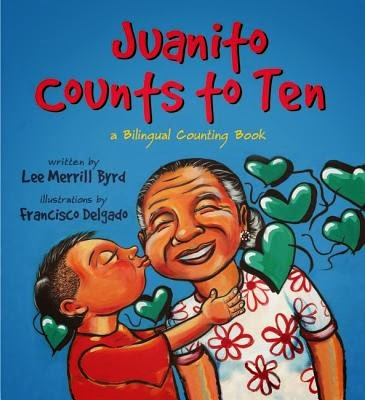
It’s so sweet to count kisses! Narrated by Juanito’s grandma, the simple little story is about who receives Juanito’s delicious kisses. Beginning with one little kiss for his big sister, two big kisses for his daddy, three wet ones for his momma, and, as he counts to nine, Abuelita’s worrying that he might have run out of kisses. But—of course not—he has ten delicious ones for her!

Who would think of a counting book that is so loving, so family-oriented, so delightful? Clearly, Juanito Counts to Ten is not just about counting. And, while “traditional” counting books usually count just the objects, this one actually describes each kiss. With appropriate idiomatic Spanish, Juanito Counts to Ten is language expansion at its best.

Delgado’s artwork, in rich, saturated oils, complements the loving, enthusiastic text and carries the emotions. Big sister is grossed out, Beatriz’s dog is jealous—and the cat’s not especially loving it, either. Here, he portrays Juanito’s family, friends and everyone else he kisses (but not girls outside of the family, whom he wants to but doesn’t) as real Mestizo people and community. And one of the messages—an important one—is that it’s totally OK for Latino boys to kiss their close friends and relatives. Highly recommended.

—María Cárdenas
(published 1/16/14)