Showing posts with label Salvadoran American. Show all posts

Little Doctor / El doctorcito


author: Juan J. Guerra
illustrator: Victoria Castillo 
translator: Gabriela Baeza Ventura 
Piñata Books / Arte Público Press
2017
kindergarten-grade 3 
Salvadoran American


Guerra, who is an ob-gyn physician in Oakland and co-founder of Salud en Español, a clinic for the Spanish-speaking community, conceived of and wrote this quasi-autobiographical story to encourage children who are bilingual to think about entering the medical profession. Unfortunately, The Little Doctor / El doctorcito is fractured and contrived, and does little to communicate this valuable message to young readers.

Ten-year-old Salvador has just earned an A+ on his fourth-grade science test, and rushes home to celebrate with his abuelita, who greets him with a request that he accompany her to the community clinic in order to help her “speak English” (translate for her). The child enthusiastically welcomes the chance to help his abuelita, telling her on the way that he wants to become a doctor.

At the community clinic, which has an inexplicably long line of people who are “coughing, moaning, and fussing,” several are crying and a woman is angrily shushing her screaming daughter. Salvador comforts a woman who is crying, and, when it’s finally their turn, he tells the health care worker at the desk that his grandmother is here for a checkup and asks for a doctor who speaks Spanish. There is none, and he realizes that “everything (is) now up to him.”

In the examining room, Abuelita is frightened (“Salvador, don’t leave me!”), insisting that her young grandson remain with her while she changes into a robe. And, as the door bangs open, in rushes a white, gray-haired, crazed-looking doctor, who not only appears rude, he’s downright mean. With papers flying all around, he barks at Salvador:

“Tell your grandmother her blood pressure is high. She needs to stop eating so much Mexican food and eat more fruits and vegetables. And she needs to take medicine.”

Then he storms out the door, slamming it behind him.


First, no responsible physician would instruct a young child to translate and explain a serious medical condition such as “high blood pressure” to a parent or grandparent; this is something the child might not understand and would probably not have the vocabulary to translate, not to mention explain. And second, this racist, reality-challenged doctor—who assumes that all Spanish-speaking people are Mexican, grandma doesn’t eat any fruits or vegetables but she eats too much Mexican food (all of which is unhealthful), nor does she take medicine—loudly instructs this child to disrespect his own grandmother.

Moreover, in Abuelita’s case, a doctor or nurse would be likely to find out why she has high blood pressure: Do other family members have high blood pressure? What’s her diet like? Is she taking other medications? Does she exercise? But the over-the-top behavior of this doctor is beyond the pale and confusing to young readers, especially to young Latinx readers.

While Salvador responds to the doctor’s assumption that the family is Mexican, he doesn’t question any of the other assumptions. Of course, as a young child, he wouldn’t; but again, the child reader will be confused. This failure, along with many others, is built into the story.

Depending on necessity and circumstance, people in El Salvador often see both physicians and curanderas. But readers at first learn that, whenever Abuela felt ill in El Salvador, she saw a curandera or drank herbal tea. And later, an upset Abuelita remembers, “Salvadoran doctors listen. They want to know about you and how your family is. In El Salvador, the doctors really care for their patients!” This “either-or” rather than “both” paradigm is confusing as well.

Salvador’s experience in this overcrowded clinic in which there are no Spanish-speakers is now convinced that he has found his life’s path. Abuelita’s young translator now assures her that he will never take her to see another abusive doctor like the one they’ve just encountered “ever again.” And his parents remind him that he’ll have to “work very hard” to bring his dream to reality.

And, that night, as he goes to sleep:

[He] imagined the amazing journey of becoming a doctor, wondering about mysterious and marvelous places like college and medical school.

He envisioned a world with doctors who looked like him and spoke English and Spanish.

Knowing that his magical adventure would begin the very next day, Salvador drifted off to asleep [sic].

Doctors practice all over the world, and in many places, people see both traditional healers and physicians. While years ago, medical translators were nonexistent or rare, most clinics now employ both medical professionals and translators who speak the languages of the communities. But there are some cases in which a translator may be unavailable, and this story could have been about not having enough Spanish-speaking doctors, but that’s way different than Salvador’s situation.

It's clear that Castillo is a talented illustrator and comic artist. In a different story, her vibrant, cartoonish art, in pen and ink and digital watercolor on a bright palette of mostly reds and oranges, would shine through and easily capture a young child's imagination. But here, they are discomfiting exaggerations of what might have been tender scenarios in which young Salvador is translating and being generally helpful. For instance, in a scene where he is helping a nurse who is assisting a patient in a wheelchair, the nurse is smiling at Salvador rather than looking where she is going, shielding her patient from the rain by holding an open umbrella under her left arm and struggling to steer the wheelchair with her left hand while also struggling to keep a heavy door open with her right hand. Salvador is opening the other heavy door for her. This kind of problem may have been typical more than 20 years ago, but today, most hospitals and clinics are equipped with wheelchair ramps and automatic doors.

There are many stories that could have been—and should be—written about real situations involving children’s translating or interpreting for family members. And there are many positive potential scenarios about children’s desires to become community physicians and how these desires might be encouraged. This could have been a story about something positive happening that convinces a child to want to become a doctor.

Finally, “doctorcito” is a Spanglish word, an endearing term for a child who may have demonstrated his skills of doctoring, such as taking care of a sick puppy or changing the dressing on a kitten’s paw, or even reminding his grandma to take her medicine on time. But here, our young protagonist is a translator, a helper—but not a “doctorcito.” 

Baeza Ventura’s excellent Spanish translation, in many cases, reads better than the English text. For instance, an English passage reads: “Salvador knew that everything was now up to him,” and Baeza Ventura’s translation reads: “Salvador sabía que todo estaba en sus manos.” But it’s not enough to save this story. Rather, The Little Doctor / El doctorcito is a stereotypic mishmash with lots of contradictions and distractions and little to recommend.

—María Cárdenas
(published 4/6/17; revised 4/10/17)

Mamá the Alien / Mamá la extraterrestre

author: René Colato Laínez 
translator: René Colato Laínez 
illustrator: Laura Lacámara 
Children’s Book Press / Lee & Low 
2016 
kindergarten-grade 3 
Salvadoran, Salvadoran American

In Mamá the Alien / Mamá la extraterrestre, young Sofía accidentally knocks over her mama’s purse, spilling out its contents. When a resident alien card drops out, the child discovers (she thinks) that mom must be an alien from outer space. Since her parents’ explanation doesn’t yield any usable information, the child does the research and the math and puts the puzzle together:

Mamá was an alien. Papá didn’t have a card, so he was not an alien. That meant I was half alien. I looked like a human girl, so my alien parts were hidden. But I needed to find out which half of me was hidden. Could I be alien from my head to my belly button? Or from my belly button to my feet? Could I be alien only on my right side or only on my left side?

It’s only after 23 pages that Sofía discovers the term “alien” has more than one meaning (“alguien de otro planeta o alguien de otro país”) and becoming a US citizen is easy and equally attainable by all. And that’s this story’s fatal flaw. While Colato Laínez’s writing is humorous and endearing, his Spanish translation is very good, and Lacámara’s bright, acrylic-and-collage artwork is appealing, the story ignores the inequities and dangers that immigrant and refugee children and their families must endure, and glosses over the issues of who gets to become a citizen and who doesn’t.

Mamá the Alien is sure to resonate with well-meaning teachers and librarians looking for picture books that are relevant to contemporary issues. And Mamá the Alien will surely be a hit as a read-aloud in bilingual early childhood classrooms. No doubt, refugee children will sit, heads down, confused and shamed and not understanding why.

We are living in a scary, dangerous time. Especially for undocumented children and their families, this fact cannot be disputed. Confused, scared, unaccompanied children who are running for their lives—to get to the “safety” of El Norte—more often than not find themselves in detention centers, waiting for strangers to decide their fates. And others may hide for years—sometimes with extended family members who live in the US—in fear of being caught and sent back. Their lives must be kept secret, even from their classmates and friends. The same issues come back again and again and again and again.

Immigrants with papers, on the years-long road to US citizenship, don’t have it easy either. Job and housing discrimination, and verbal and physical attacks by xenophobes, are common. Both documented and undocumented individuals and families are often insulted as “aliens,” and even, “illegal aliens.”

Children who are not enmeshed in this difficult life, whose citizenship has never been questioned, need to be taught to challenge these inequities. They need to be taught to recognize the pain and call out those who demonize immigrants and refugees, and to become allies in what might seem to be an impossible struggle. The conversation is necessary. It’s beyond excuses.

The publisher’s note enthuses, “The book’s bilingual text makes it an especially good fit for English language learners who may struggle to find books that reflect their experiences,” and Mamá the Alien has garnered raves from the major review journals. As the Booklist reviewer wrote, “[this] heartfelt and humorous story is perfect for primary-school readers, as well as a useful way for parents or educators to introduce the topic of immigration.” And the Kirkus reviewer called it “a delightful, original, clever, purposeful, multicultural alien tale.” Unfortunately, all are missing the point.

While I do not doubt the good intentions of the author and illustrator, both of whom are immigrants, Mamá the Alien / Mamá la extraterrestre trivializes the pain that so many children and their families undergo and makes light of migration issues that have yet to be resolved in this country. It cannot be recommended.

—Beverly Slapin
(published 7/21/16; revised 12/15/16)

Míl grácias a mi colega, Oralia Garza de Cortés.

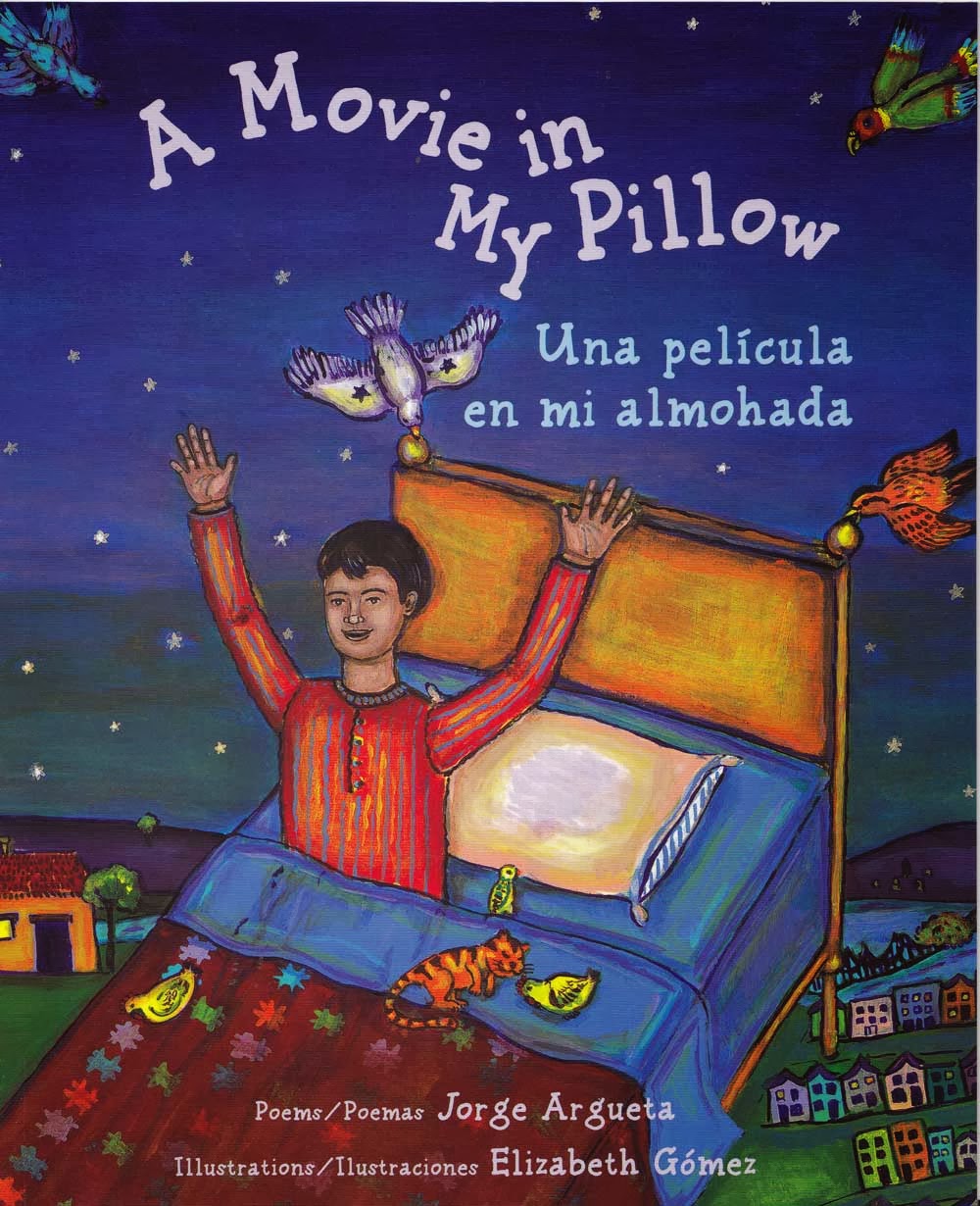
Movie in My Pillow / Una película en mi almohada


author: Jorge Tetl Argueta
translator: Jorge Tetl Argueta
illustrator: Elizabeth Gómez
Children’s Book Press / Lee & Low, 2001
grades 2-up
Pipíl, Salvadoran, Salvadoran American

During the bloody Salvadoran Civil War (1979-1992) between the military government representing the 12-family oligarchy of wealthy landowners, and leftist forces representing mostly impoverished peasants, US-supported government death squads terrorized, tortured, murdered and disappeared thousands of civilians, especially targeting students, intellectuals, and Indian people in the rural areas. By the time the UN-brokered peace agreement was signed, it’s estimated that more than 75,000 people had been killed and more than half a million refugees had fled to the US.

In this lovely bilingual collection of autobiographical poems, young Jorge tells the story of how he and his father, fleeing from the war, arrive in San Francisco. Eventually, the rest of the family will join them, but for now, father and son, leaving in the middle of the night—and without saying goodbye to anyone—must travel alone.

In an introductory note, Argueta writes about the beauty of his home country and the war that forced his family to leave. “These poems are my memories, my dreams,” he writes, “the movies in my pillow.” This brief history of his “transplantation” reminds me of the stories my grandmother told me about having to leave Mexico with her brother packed into a trunk so he would not be taken to become a soldier. Although my grandmother always longed for the homeland of her childhood, still she embraced this country for the safety it provided. Like my grandmother was, young Jorge is also resilient. While holding tight to the memories of his homeland, he is able to put down roots in San Francisco with its “sopa de lenguas en el viento / soup of languages in the wind.”

When his uncle sends him an audiotape of his grandma, talking and singing to him in Nahuatl and Spanish, we know that Jorge, wherever he is, will always remain connected to his culture and community:

Jorge, Jorge, maybe
you will never come back.
Remember when you sat
next to me on the river bank?
Jorge, Jorge, don’t forget
that in Nahuatl “tetl”
means “stone” and “niyollotl”
means “my heart.”

 Argueta’s writing—both in Spanish and English—are pure poetry, with brilliant metaphors that will resonate with young children. On one page, for instance, he is a yo-yo, and his poem is a long unpunctuated sentence: 

I have a yo-yo that makes me crazy but I can’t stop playing yo-yo in the mornings yo-yo in the middle of the day yo-yo in the afternoon yo-yo at night yo-yo yo-yo yo-yo I dream yo-yo I walk yo-yo I eat yo-yo I am a yo-yo.

Gómez’s brightly colored acrylics beautifully illustrate Argueta’s beautiful poems. She has a lot to work with: Here is Jorge, avoiding cobras on the sidewalk; riding a dragon dancing the cumbia; with his family flying like parakeets between San Francisco and El Salvador; and turning into a yo-yo. One of my favorites is the image of Jorge’s family members, embracing each other in a huge nest—“abrazando nos sentimos como un gran nido con todos los pájaros adentro.”

The Spanish is wonderful, depicting Jorge’s struggle and emotions of his abrupt immigration to San Francisco; the translation was most likely accomplished from Spanish to English. I especially like the way the Spanish and English versions alternate on each spread, with both languages presented as equal in importance.

In A Movie in My Pillow / Una película en mi almohada, Argueta gives young readers insight into the one of the most difficult experiences a child can have—being uprooted from your homeland and transplanted far away to a very different place. For young Jorge, landing in “la misión” provides him with a world of adventures and enough cultural connections to El Salvador to make his transition a little less traumatic than if he had landed somewhere else. This book is a welcome addition to a collection of stories about the immigrant experience and is highly recommended.

—María Cárdenas
(published 1/24/14)

Xochitl and the Flowers / Xóchitl, la Niña de las Flores


author: Jorge Tetl Argueta
translator: Jorge Tetl Argueta
illustrator: Carl Angel
Children’s Book Press / Lee & Low, 2003
kindergarten-up
Pipíl, Salvadoran, Salvadoran American

Newly transplanted from El Salvador to San Francisco, the hard-working Flores family struggles to transition from one culture to another and to adapt to a new urban environment. As in their homeland, Xóchitl and her mother decide to sell flowers in the city; and when her father locates an apartment to rent in a building with a garbage-laden vacant lot, the family and a few neighbors clear it and build a plant nursery. But, as an unfeeling landlord demands that it be shut down, the nursery’s fate is uncertain. How everyone comes together and softens the landlord’s heart is the crux of this tender story of family and community.

Argueta, a talented poet, infuses the story with the imagery of the immigrant experience: days going by slowly as turtles, ants circling their world of dwarf lemon trees in just a few minutes and snails carrying their little homes on their backs. The Spanish text reads beautifully and is particularly expressive; it seems likely that Argueta wrote it first and then translated it into English, which was then edited.

Here, for instance, Spanish-speaking children will easily identify with Xóchitl, as she practices English:

En la escuela, ya puedo decir varias oraciones en ingles. Cuando estoy sola las practico y parezco loquita diciendo: —How are you? My name is Xochitl. Do you like flowers?

But some of the English text will confuse Spanish-speaking children. Here, Xóchitl is telling, in English, how she practices some simple sentences in English:

In school, I can already say a few sentences in English. I practice them when I’m alone; I probably seem a little crazy when I ask myself, “How are you? My name is Xochitl. Do you like flowers?”

Angel's acrylic and colored-pencil illustrations of the characters seem flat, but his background images, including photo collages, are bright and vibrant and will hold the attention of the youngest readers.

The story’s conflict is too easily resolved; I would rather have had it more closely reflect the actual community struggle—as neighbors and local organizations came together to convince the City Planning Commission that the family’s nursery was an asset—as Argueta describes it in his endnote. Still, Xochitl and the Flowers / Xóchitl, la Niña de las Flores, is an evocative story of a hard-working immigrant family from Central America, and is highly recommended.

—Beverly Slapin
(published 11/3/13)

Knife and the Butterfly


author: Ashley Hope Pérez 
Lerner, 2012
grades 7-up 
Salvadoran American

In 2011, I spoke on a panel with four other authors, on the topic of children’s literature and war. My part on children as combatants included G. Neri and Randy DuBurke’s graphic novel Yummy: The Last Days of a Southside Shorty, about an 11-year-old Chicago boy executed by gang members after he had shot a 14-year-old neighbor to prove himself to the gang.

This theme of gang warfare and the trauma experienced by young combatants in inner cities in the United States appears in Ashley Hope Pérez’s second young adult novel, The Knife and the Butterfly. Fifteen-year-old Azael Arevalo wakes up in an institution following a drug-fueled gang battle near his Houston, Texas, neighborhood. He doesn’t remember how he got there, but he fears he has killed someone and is back in prison. This, however, is an unusual prison, because his only activity appears to be watching a 17-year-old Anglo girl, Lexi Allen, as she writes in her diary and meets with her therapist, her grandmother, and her attorney.

In chapters from the past that alternate with Azael’s present, the reader learns that his mother has died and his alcoholic father has been deported to El Salvador, leaving him and his older brother to fend for themselves. Though he aspires to be an artist, Azael is the tougher and more violent of the two brothers; in fact, he brought his older brother into the notorious MS-13 gang.

A brief digression into the history of MS-13. The gang, originally known as Mara Salvatrucha, formed in Los Angeles in the 1980s with Salvadoran refugees who sought to protect themselves from Mexican-American gangs. The young refugees had fled a bloody civil war in their country between leftist guerrillas and right-wing government and paramilitary forces that enjoyed the support of the US government despite highly publicized human rights abuses such as the assassination of the Archbishop of San Salvador, Oscar Romero, and the killing or disappearance of thousands of clergy, teachers, intellectuals, and others.

In all, more than 70,000 Salvadorans died in the fighting that lasted for two decades until a peace treaty in 1992. Many of the refugees who became gang members were deported following the end of the war, and they established MS-13 in El Salvador; since then, the gang has recruited members throughout Central America and Mexico as well as in the United States. The trauma of one war has given way to the trauma of another.

Pérez’s novel moves into the supernatural as Azael reflects on his violent life. Unable to communicate directly with the mysterious Lexi, he reads her diary and draws her face and surroundings. He establishes a connection to her that moves her to take responsibility for her own role in the gang battle. Pérez has written a fascinating story that explores why young people join gangs and portrays the emotional trauma of taking part in these wars at home. Although Azael has suffered much and taken a dangerous path, readers will ache for his desire to leave some beauty in the world through his art, a goal he clings to even when everything he creates seems to be marred or erased. Recommended.

—Lyn Miller-Lachmann
(published 4/7/13)

I am René, the Boy/ Soy René, el Niño


author: René Colato Laínez
illustrator: Fabiola Graullera Ramírez
Piñata Books / Arte Público Press, 2005
grades 1-3 
Salvadoran American

A youngster from El Salvador whose name is René—“René el valiente, René el fuerte y René el chistoso”—to his horror, finds out in his new school in the US that Renee, the homophone of his name, is a girl’s name! So he goes off to the library and researches his name. When an essay contest gives René the opportunity to write up his research, he wows everyone and wins two pizzas, which he, of course, shares with his class.

Ramírez’s cartoon illustrations are bright and detailed, and will grab young readers. Although this story is based on the author’s experiences, the story seems contrived, especially in the level of research (René Descartes the philosopher, René Magrite the artist) this young child is able to accomplish. Marginally recommended.

—Beverly Slapin
(published 4/7/13)