Movie in My Pillow / Una película en mi almohada


author: Jorge Tetl Argueta
translator: Jorge Tetl Argueta
illustrator: Elizabeth Gómez
Children’s Book Press / Lee & Low, 2001
grades 2-up
Pipíl, Salvadoran, Salvadoran American

During the bloody Salvadoran Civil War (1979-1992) between the military government representing the 12-family oligarchy of wealthy landowners, and leftist forces representing mostly impoverished peasants, US-supported government death squads terrorized, tortured, murdered and disappeared thousands of civilians, especially targeting students, intellectuals, and Indian people in the rural areas. By the time the UN-brokered peace agreement was signed, it’s estimated that more than 75,000 people had been killed and more than half a million refugees had fled to the US.

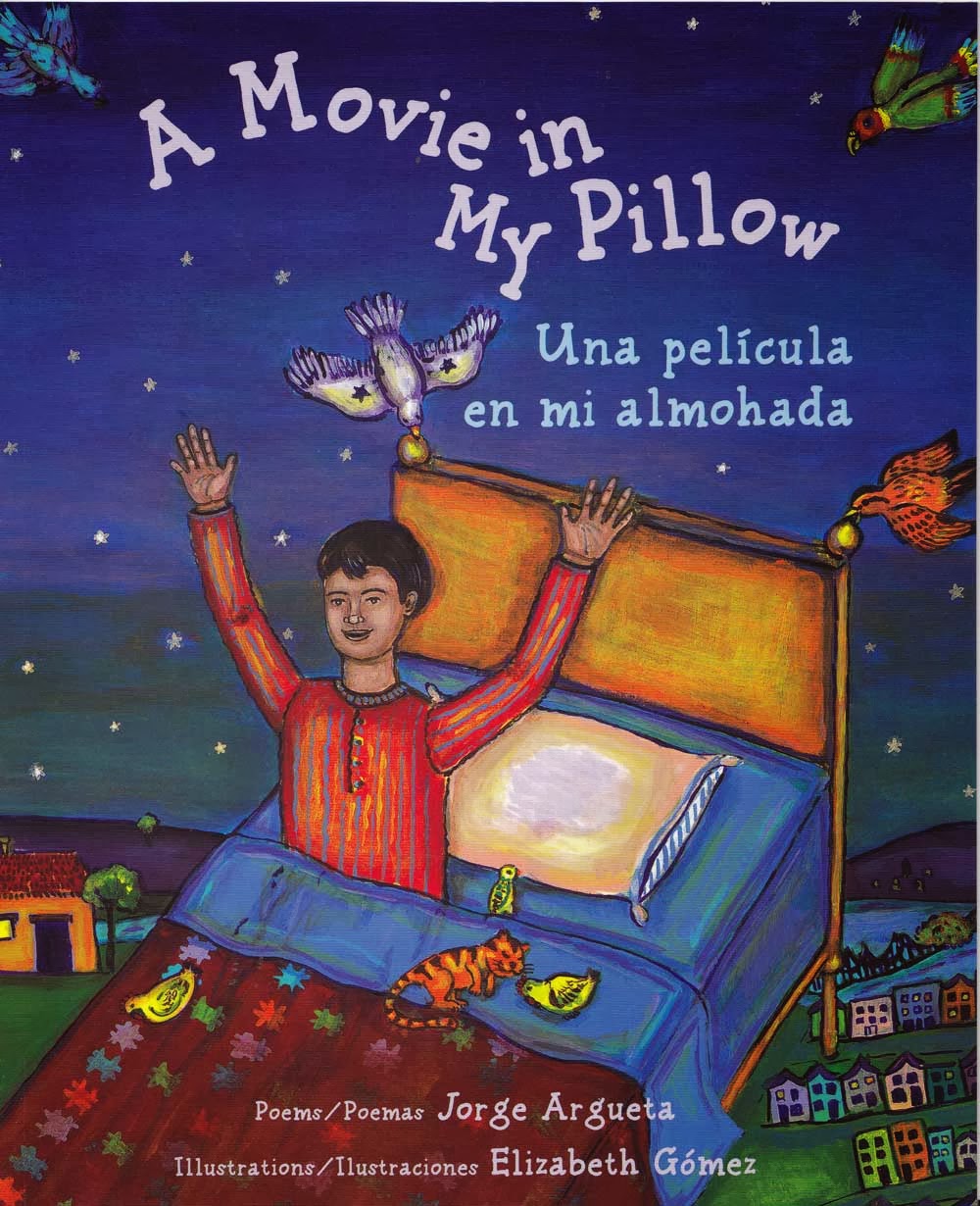
In this lovely bilingual collection of autobiographical poems, young Jorge tells the story of how he and his father, fleeing from the war, arrive in San Francisco. Eventually, the rest of the family will join them, but for now, father and son, leaving in the middle of the night—and without saying goodbye to anyone—must travel alone.

In an introductory note, Argueta writes about the beauty of his home country and the war that forced his family to leave. “These poems are my memories, my dreams,” he writes, “the movies in my pillow.” This brief history of his “transplantation” reminds me of the stories my grandmother told me about having to leave Mexico with her brother packed into a trunk so he would not be taken to become a soldier. Although my grandmother always longed for the homeland of her childhood, still she embraced this country for the safety it provided. Like my grandmother was, young Jorge is also resilient. While holding tight to the memories of his homeland, he is able to put down roots in San Francisco with its “sopa de lenguas en el viento / soup of languages in the wind.”

When his uncle sends him an audiotape of his grandma, talking and singing to him in Nahuatl and Spanish, we know that Jorge, wherever he is, will always remain connected to his culture and community:

Jorge, Jorge, maybe
you will never come back.
Remember when you sat
next to me on the river bank?
Jorge, Jorge, don’t forget
that in Nahuatl “tetl”
means “stone” and “niyollotl”
means “my heart.”

 Argueta’s writing—both in Spanish and English—are pure poetry, with brilliant metaphors that will resonate with young children. On one page, for instance, he is a yo-yo, and his poem is a long unpunctuated sentence: 

I have a yo-yo that makes me crazy but I can’t stop playing yo-yo in the mornings yo-yo in the middle of the day yo-yo in the afternoon yo-yo at night yo-yo yo-yo yo-yo I dream yo-yo I walk yo-yo I eat yo-yo I am a yo-yo.

Gómez’s brightly colored acrylics beautifully illustrate Argueta’s beautiful poems. She has a lot to work with: Here is Jorge, avoiding cobras on the sidewalk; riding a dragon dancing the cumbia; with his family flying like parakeets between San Francisco and El Salvador; and turning into a yo-yo. One of my favorites is the image of Jorge’s family members, embracing each other in a huge nest—“abrazando nos sentimos como un gran nido con todos los pájaros adentro.”

The Spanish is wonderful, depicting Jorge’s struggle and emotions of his abrupt immigration to San Francisco; the translation was most likely accomplished from Spanish to English. I especially like the way the Spanish and English versions alternate on each spread, with both languages presented as equal in importance.

In A Movie in My Pillow / Una película en mi almohada, Argueta gives young readers insight into the one of the most difficult experiences a child can have—being uprooted from your homeland and transplanted far away to a very different place. For young Jorge, landing in “la misión” provides him with a world of adventures and enough cultural connections to El Salvador to make his transition a little less traumatic than if he had landed somewhere else. This book is a welcome addition to a collection of stories about the immigrant experience and is highly recommended.

—María Cárdenas
(published 1/24/14)

Juanito Counts to Ten/ Johnny cuenta hasta diez


author: Lee Merrill Byrd
illustrator: Francisco Delgado
Cinco Puntos Press, 2010
preschool-up
Mestizo, Mexican American

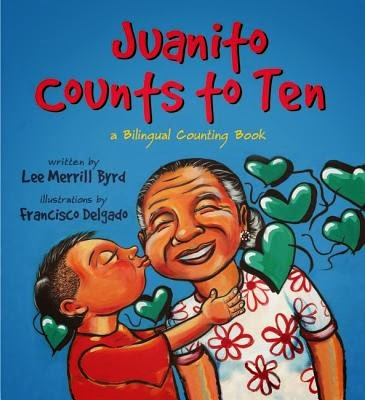
It’s so sweet to count kisses! Narrated by Juanito’s grandma, the simple little story is about who receives Juanito’s delicious kisses. Beginning with one little kiss for his big sister, two big kisses for his daddy, three wet ones for his momma, and, as he counts to nine, Abuelita’s worrying that he might have run out of kisses. But—of course not—he has ten delicious ones for her!

Who would think of a counting book that is so loving, so family-oriented, so delightful? Clearly, Juanito Counts to Ten is not just about counting. And, while “traditional” counting books usually count just the objects, this one actually describes each kiss. With appropriate idiomatic Spanish, Juanito Counts to Ten is language expansion at its best.

Delgado’s artwork, in rich, saturated oils, complements the loving, enthusiastic text and carries the emotions. Big sister is grossed out, Beatriz’s dog is jealous—and the cat’s not especially loving it, either. Here, he portrays Juanito’s family, friends and everyone else he kisses (but not girls outside of the family, whom he wants to but doesn’t) as real Mestizo people and community. And one of the messages—an important one—is that it’s totally OK for Latino boys to kiss their close friends and relatives. Highly recommended.

—María Cárdenas
(published 1/16/14)


New Sun / Un Nuevo Sol


authors: Max Benavidez and Katherine Del Monte
illustrator: José Ramírez
Latino Literacy Press, 2002
grades unknown
Mexican

 A New Sun / Un Nuevo Sol appears to have been written for hablantes who are learning English. Here, the narrator, newly arrived from Mexico, is struggling with the differences between the familiar culture he left and the strange new culture he encounters. Ultimately, he finds that people everywhere want “to have hope and make their dreams a reality.” This sparse prose-poem (I came with a dream, / Yo vine con un sueño, / with so many hopes. / con tantas esperanzas. / I was looking for a new life. / Buscaba una nueva vida.) has no story—it’s just phrases on a page with no real connection to the immigrant experience.

The melting-pot ending—(Yet, no matter how different we are / Sin embargo, no importa cuán diferentes somos / we have the same hopes. / tenemos la misma esperanza. / We share the same dream of a better tomorrow. / Compartimos el mismo sueño de un major futuro.)—is the most annoying part, implying that, while we all have some differences, we are really all the same. The reality, of course, is that, while we all may dream of a better tomorrow, our dreams aren’t the same. In truth, some of us dream about staying alive, about being where the bombs aren’t falling. Some of us dream about having enough food to eat, about drinking clean water. Some of us dream about going home, about reuniting with our families.

Ramírez’s art, in highly saturated oils on a dark, morose palette, does not reflect what little message of hope there may be. The people’s faces are distorted and unhappy-looking and most of them appear to be wearing masks. On close inspection, one might find La Virgen de la Guadalupe and a few calaveras.

What’s apparently being taught here is basic translation, grammatical sentence structure and working with antonyms. The text is flat; here’s no passion or even emotion. There is just not enough content to be meaningful—to anyone. A New Sun / Un Nuevo Sol is not recommended.

—María Cárdenas
(published 1/16/14)

Gift from Papá Diego / Un regalo de Papá Diego


author: Benjamin Alire Sáenz
illustrator: Geronimo García
Cinco Puntos Press, 2010
grades 3-up
Mexican, Mexican American

Dieguito is missing his Papá Diego a lot. He wants to see his grandfather and he doesn’t understand the concept of far away—“if I could see my Papá Diego every day, …then every day would be as perfect as a sky full of summer clouds.” Dieguito’s father tells him that Mexico is far away, that it’s Papá Diego’s home and that he wouldn’t be happy in El Paso.

When, for his birthday, Dieguito receives the Superman suit he had wanted, he finds that he is unable to fly to see his Papá Diego. Upset, he refuses dinner, including champurado, which, he is told, helps him speak Spanish and feel warm inside. When he finally comes down—to his surprise and joy—Papá Diego has arrived!

García’s molded clay art, in muted, natural colors, is gorgeous; with brightly colored backgrounds that enhance, rather than obfuscate, the clay figures. Here is Dieguito, excitedly watching his mother in the kitchen, fixing chiles relleños. Here is Dieguito’s sister, taunting him. Here is Dieguito’s father, telling Dieguito the story of the day he was born.

The Spanish text, which I read first, is idiomatic and wonderful. For example, Papá Diego tells Dieguito (in English), “Tonight Chihuahua is not so far, and I do not feel so old, and it was very easy to cross the border. The border is nothing for people who love.” And in Spanish, “Esta noche Chihuahua no está tan lejos y no me siento tan viejo y no fué tan difícil cruzar la frontera. Una frontera no es nada para los que se aman.”

In this story, Mexico is about where Papá Diego’s home is, but El Paso is Dieguito’s immediate family’s home as well.

When we think of borders, we generally think of physical lines, but the reality is that they are often political and economic borders that divide families. In reality, many, many children are taken from their parents and parents are taken from their children. Children—born here or there—feel the loss of their relatives on the other side, and fear the breakup of their families.

We don’t know why part of Dieguito’s family members came to the US and some stayed in Mexico; it seems to have been an economic decision. We also don’t know whether or not the family has documents. Nevertheless, this story lends itself to a rich discussion of the migrant and immigrant experiences of separated families, and can be supplemented by other stories, such as Jorje Argueta’s beautiful Alfredito Flies Home. A Gift from Papá Diego / Un regalo de Papá Diego is highly recommended.

—María Cárdenas
(published 1/16/14)

Harvest Birds / los pájaros de la cosecha


author: Blanca López de Mariscal
illustrator: Enrique Flores
Children’s Book Press / Lee & Low, 1995
grades 2-up
Mexican

Allegedly based on a folktale from Oaxaca, The Harvest Birds / los pájaros de la cosecha tells the story of a young man named Juan. We don’t know his last name. People call him “Juan Zanate” (not in quotes in the story) because he has a special relationship with zanates (grackles), who “consider him their friend.” He daydreams a lot about having his own land. He also works for the town shopkeepers, yet they mock him because he doesn’t “know anything about making things grow.” So the young man makes a sharecropping deal with an elderly landowner, and a shopkeeper provides him with leftover miscellaneous seeds:

“Juan, sweep up the corn, the beans and the squash seeds from my floor and take them to my pigs. Then, if you wish, you can take some seeds for yourself.”

One of the birds, whom Juan calls “Grajo,” is Juan’s special friend: “There was one bird in particular who cared very much for Juan and wanted him to find his way in life.” The birds, in unison, advise Juan to “plant weeds on the borders” of the land, but Juan’s planting corn, beans and squash together appears to be an accident.

OK, let’s stop here. In Indigenous traditions, wisdom can come to someone in many forms. Sometimes an elder provides wisdom. Sometimes an animal provides wisdom. Sometimes dreams provide wisdom. But here, the birds themselves provide agency for the poor guy by actually telling him what to do. This is not the way traditional oral stories go. It just isn’t.

And, the story of the Three Sisters—corn, beans and squash—is told in many ways, to provide actual ecological and scientific knowledge, which this story, of course, doesn’t. Rather, this heavy-handed moral from Juan:

“The zanates taught me that all plants are like brothers and sisters… If you separate them, they become sad and won’t grow. But if you respect them and leave them together, they will grow happily and be content.”

Actually, all plants do not grow well together; some plants overwhelm others. People need to know which plants grow successfully together and why. In oral stories, seeds would not be planted together so that the plants could be happy—“happiness” is not a characteristic given to plants.  

The Spanish pretty much follows the English, but it’s not as poorly written. For example, unlike the English, “Old people know many things because they’ve lived longer,” the Spanish, “Los viejos, porque han vivido más, saben mucho” (“Old people, because they’ve lived more, know much”) reads like a traditional dicho.

The art, probably rendered in watercolor and ink on a brightly colored palette, is unappealing. The characters’ faces are often expressionless and inconsistent—sometimes Juan appears to be a young man and sometimes he appears much older.

Had it been written in the form of an oral story, with lessons hinted at but unstated, The Harvest Birds would have been richer and more exciting.  As it stands, it’s didactic and boring and not recommended.

—María Cárdenas
(published 1/16/14)

César Chávez: the Struggle for Justice / La lucha por la justicia


author:  Richard Griswold del Castillo
translator: José Juan Colín
illustrator: Anthony Accardo
Piñata Books / Arte Público Press, 2008
grades 3-up
Mexican American


It was 1969, and I remember marching with César Chávez in Delano and in front of the Berkeley Safeway. Everyone was shouting, “¡Huelga! Don’t buy poison grapes!” César was a small man, and sometimes you could hardly hear him. Yet he spoke with such great passion and presence. His power came from within and inspired us and ignited our spirits. Even though grapes were one of my favorite fruits, I did not eat them for years. We were there to support César and the agricultural workers and our movement was exciting and purposeful. For Chicana/o students like me, it was more than the struggle for one group of workers—it was also our struggle to grow our identities and cultural connections.

In simple words and almost-photographic watercolor illustrations, this large, bilingual picture-book biography introduces young readers to the humble migrant farm worker who led the labor struggle that became known as the “fight in the fields”—to secure better pay and working conditions for Raza and other agricultural workers. The design is striking—on each double page spread, the large well-spaced text appears on the left, with full-page paintings on the right. The English and Spanish texts are separated—and yet connected—by a repeating banner of black UFW eagles on a red background.

When I look at Accardo’s boldly colored illustrations, they give me chills. They remind me of those exciting days and of the passion, struggles and triumphs of my people. Here is his mother comforting young César, after he’s learned the harsh lessons of discrimination at school. Here is an older Chávez, studying a book about Gandhi, and leading people on a march, and speaking at a rally, and breaking a fast by accepting a small piece of bread from Robert Kennedy. And here is a depiction of Chávez’s funeral. At the center is a plain pine coffin carried by farm workers. In front is a little girl, sitting on her father’s shoulders. And all around are people and flags—of La Vírgen de Guadalupe, and the UFW eagles, and the American flag. What is especially moving is that, in those paintings where Chávez is leading a march or speaking with farm workers, he is indeed one of them, not separated in any way. This is exactly what our students need to understand—Chávez’s strong connection to the people.

Unfortunately, the narrative (along with the literal Spanish translation) is a historical walk-through; it’s flat and passionless. The sentences are short and choppy, more a recitation of facts than a story. 

For example, here is the first paragraph:


César Chávez was a very important Mexican American leader in the United States. He was a man who improved the lives of poor farm workers. He fought to help them get better wages and working conditions. He helped them gain more respect and end discrimination against them. César Chávez organized the United Farm Workers Union to do this. He gave the poor hope that life could be better.
 
Here, in Griswold del Castillo’s presentation of César Chávez as a larger-than-life leader who “improved” the lives of farm workers and “gave them hope,” the agricultural workers themselves have no agency—no capacity to make their own choices. In reality, César Chávez was a leader of the people. As César organized and encouraged the poorest workers in the country, they took their own power and were able to make significant changes in their lives and the lives of their families.

And in some instances in the narrative—“Working and moving from place to place, Cesar learned how poor the farm workers were”—Griswold del Castillo makes it appear that Chávez is outside looking in rather than acknowledging the first hand experience of his own family as migrant agricultural workers. As it is, the narrative loses the opportunity to tell a rich story.

Nevertheless, César Chávez: The Struggle for Justice / La lucha por la justicia can be used alongside Carmen Bernier-Grand’s César: ¡Sí, se puede! Yes, we can! and Kathleen Krull’s Harvesting Hope: the Story of Cesar Chavez and is recommended.

—María Cárdenas
(published 1/9/14)

César Chávez: A Hero for Everyone


author: Gary Soto
illustrator: Lori Lohstoeter
Aladdin, 2003
grades 3-up
Mexican American

Soto’s narrative begins in 1962, as young organizer César Chávez and other recruiters walk from house to house in Corcoran, California, explaining to Mexican-American agricultural workers about a new union that would help them in their desperate need for justice. As a farm worker himself, Chávez knows that Corcoran is a dangerous place for seasonal workers—he knows that contractors often steal their hard-earned money, and he knows that “strikers had been beaten and shot and sometimes killed by armed farmers.”

The narrative then turns back to the beginnings of Chávez’s early life on his grandparents’ large homesteaded farm, where the whole family works together in tough Depression-era times. And school is far from welcoming for Spanish-speaking children—“all Cesar would remember of school was the whistling of the ruler as it came down on his wrist or knuckles.” Indeed, during his years as a young farm worker, Chávez’s experiences with poverty, injustice and racism are what shape him into the organizer he later becomes.

When the family, hungry and broke, is forced to leave their farm, young readers will see what young César and the other migrant agricultural workers have to endure; and as the narrative progresses, Chávez’s development as an organizer:

[The farm workers] had to wake up before dawn. They had to work stooped over for ten hours. They had to breathe in pesticides that stayed on leaves. There were no toilets. There was no clean water to drink. There were no rest breaks. Their whole day was just hard labor.

As Soto describes how César Chávez develops from inexperienced organizer of local Chicano workers to leader of the fledgling National Farm Workers Association, to joining with the Filipino compañeros of the Agricultural Workers Organizing Committee, to convincing the workers to adopt a tactic of nonviolence while engaging in the “fights in the fields,” to leading the 300-mile peregrinación from Delano to Sacramento, to the shouts of “¡Que viva la huelga!” and “¡Sí, se puede!” that were heard around the world, young readers will come to understand the life and work of a man of courage, humility and strength who fought for the rights of some of the most exploited workers in the US.

As a child, Soto worked the fields of the San Joaquin Valley; and currently serves as a Young People’s Ambassador for California Rural Legal Assistance and the United Farm Workers of America. He’s a brilliant and prolific storyteller whose knowledge and experience shine in this small biography of “a hero for everyone.”

Although this series, called “Milestone Books,” is designed for easy reading, the vocabulary is not oversimplified and the text does not condescend. Unfortunately, the book is printed on cheap “mass-market” paper and Lohstoeter’s black-and-white illustrations are less than engaging. Nevertheless, Soto’s evocative book can be paired with Carmen Bernier-Grand’s César: ¡Sí, Se puede! Yes, We Can! and Kathleen Krull’s Harvesting Hope: The Story of Cesar Chavez. All three are highly recommended.

—Beverly Slapin
(published 12/27/13)

Children's Books about César Chávez: Telling or Showing?


Many reviewers of books for young readers give a free pass to the often-oversimplified narratives and illustrations that constitute pictorial biographies. I have seen and heard, more often than not, comments to the effect that these are “just” for children and therefore, should not contain more than brief chronologies of events. It is my firm belief, however, that young children who are challenged to think deeply are capable of understanding complex issues and responding positively. Values such as “empathy,” “honesty,” “kindness,” “respect” and “fairness,” among others, can be encouraged early on if they are modeled in life—and shown in picture books.

I use the word “shown” because one of my other firm beliefs is that children shown how to think are more likely—than are those who are “told” only what to think—to develop into critical readers and thinkers, children who will apply what they have learned to their lives.

To illustrate how some picture books “show” and others “tell,” let’s look at a pair of excerpts, each from the introduction to a picture book about César Chávez. Following the excerpts are my comments.

Excerpt 1:  

As a child, Cesar Chavez traveled with his family from one farm to the next to pick beans, broccoli, lettuce, and other crops. After a day in the fields, his back often ached. His hands were sore. Yet Chavez and others who helped put food on Americans’ tables often had no tables of their own, no real homes. Later, Cesar Chavez would lead the fight for better pay, working conditions, and health care for families such as his.[1]

Excerpt 2:

¡Híjole!
Who could tell?

Who could tell
that Cesario Estrada Chávez,
the shy American
wearing a checkered shirt,
walking with a cane to ease his back
from the burden of the fields,
could organize so many people
to march for La Causa, The Cause!

Who could tell
that he with a soft pan dulce voice,
hair the color of mesquite,
and downcast, Aztec eyes,
would have the courage to speak up
for the campesinos
to get better pay,
better housing,
better health?

¡Híjole!
Who could tell?[2]

Comments: While Excerpt 1 implies that César Chávez was born poor, that he had no real home, and that he was not American, Excerpt 2 makes no such implications.[3] While Excerpt 1 dispassionately tells young readers that “after a day in the fields, his back often ached” and “his hands were sore,” Excerpt 2 shows them the effects of a lifetime of difficult labor: “walking with a cane to ease his back/ from the burden of the fields.” While Excerpt 2 shows young readers how César Chávez belonged to the land and the culture (“shy American,” “hair the color of mesquite,” “soft pan dulce voice,” and “downcast Aztec eyes”), Excerpt 1 does not.

Now, here are some more excerpts from picture books about César Chávez, including the ones we’ve already examined. Each excerpt below either “shows” or “tells” about an aspect of his life. In each category: Which ones carry stated or unstated assumptions that “tell” children what to think? Which ones “show” or gently lead children into understanding? Which ones are more likely to engage child readers? Which ones are more likely to encourage empathy in child readers?


Early Childhood

Facts: As a young child, Cesario Chávez lived with his large extended family on an 80-acre ranch, where the family produced all that they needed, not only for a comfortable life, but also to stock their grocery store and feed homeless people who happened by. Cesario and his siblings were raised on the dichos of their mother, the examples of their father, and the stories of their grandparents—and lots of love. He later wrote, “I had more happy moments as a child than unhappy moments.”


Cesar Chavez was born in 1927 near Yuma, Arizona. His family had a grocery store and a farm. Cesar was born in a little room over the grocery store.[4]

Everyone in the Chavez family worked on their farm. Cesar’s father planted seeds in the dirt. He hoed away the weeds. He dug ditches to bring water from the river to the farm. Without water, the crops could not grow. Cesar and Richard fed the horses, cows, and chickens. They gathered eggs. Rita washed clothes by hand. Juana made tortillas from ground corn. Their family was poor.[5]

Cesar woke up early each morning and did the usual farm chores. He carried water from the nearby canal, fed the animals, and gathered eggs. Then he went to school.[6]

Until Cesar Chavez was ten, every summer night was like a fiesta. Relatives swarmed onto the ranch for barbeques with watermelon, lemonade, and fresh corn. Cesar and his brothers, sisters, and cousins settled down to sleep outside, under netting to keep mosquitoes out. But who could sleep—with uncles and aunts singing, spinning ghost stories, and telling magical tales of life back in Mexico? Cesar thought the whole world belonged to his family. The eighty acres of their ranch were an island in the shimmering Arizona desert, and the starry skies were all their own.[7] 


Family

Facts: Cesario’s extended family was huge: Besides grandparents, parents, sisters and brothers, there were aunts, uncles and cousins. These loving role models were always around. From his father, he learned the value of honest work, however hard—and the inequities of the farm labor system. From his mother, he learned the value of compassion and the importance of caring for poor and homeless people. From his grandparents, aunts and uncles, he learned about faith, the history of his people, and how to read in Spanish.

Cesar’s father was often too busy to spend time with his family. It was Cesar’s mom who kept them together. She told her children stories. She taught them values and many proverbs, such as “What you do to others, others do to you.”[8]

At night, Cesar watched his father make toy cars from tin cans and small pieces of wood. Cesar and his brothers played with their cars on the floor. At bedtime, their grandmother listened to the children’s prayers.[9]

(Librado) taught César
how to make cars
out of sardine cans
and tractors
out of spools of thread….
Tugged at César’s ears
and patted his head….
(Juana) often spoke to César in dichos,
taught him from the Bible.
“What does the Lord require of you,
but to do justice,
to love kindness,
and to walk humbly with your God?”
Hated violence.
“God gave you senses,
like your eyes, and mind, and tongue
and you can get out of everything.”
Gave César manzanilla tea,
and hugged him tight.[10]

Until Cesar Chavez was ten, every summer night was like a fiesta. Relatives swarmed onto the ranch for barbeques with watermelon, lemonade, and fresh corn. Cesar and his brothers, sisters, and cousins settled down to sleep outside, under netting to keep mosquitoes out. But who could sleep—with uncles and aunts singing, spinning ghost stories, and telling magical tales of life back in Mexico?[11] 

César learned from his parents. His mother told him many stories that taught about the importance of helping the poor and not being violent. César’s grandmother also taught him how to believe in God and the teachings of the Catholic Church. César’s uncle taught him to read in Spanish.[12]


School

Facts: School was a horrible time for young Cesario. Here is where his name was changed to “Cesar,” and he was taught that all that he learned from his family was worthless; that he was “less than” because he spoke, read and wrote in Spanish. The usual punishment for young César and his Spanish-speaking friends was humiliation—and to have the Spanish beaten out of them. Needless to say, he hated school. But he remained, learning to speak, read and write English, and learning the other skills that would serve him later in life. César was the first in his family to graduate from eighth grade.

The teacher told the children to speak English. Speaking English was hard. Everyone spoke Spanish at home. Many times, Cesar forgot to speak English. Then the teachers hit his fingers with a ruler.[13]

The Chavez family spoke Spanish at home; but in school, whenever Cesar spoke Spanish, his teacher hit him. “It’s a terrible thing,” he later said, “when you have your own language and customs, and those are shattered.”[14]

School was an unwelcoming place. He wasn’t allowed to speak Spanish, the family’s household language. In fact speaking it brought on punishment. All Cesar would remember of school was the whistling of the ruler as it came down on his wrist or knuckles.[15]

Once, after Cesar broke the rule about speaking English at all times, a teacher hung a sign on him that read, I AM A CLOWN. I SPEAK SPANISH. He came to hate school because of the conflicts, though he liked to learn.[16]

One word in Spanish,
 just one word,
and ¡Fuii! whistled the ruler
across César’s knuckles
its edge cutting sharply.
The teacher hung a sign
around his neck:
“I am a clown.
I speak Spanish.”
“If you’re an American,”
 she said,
“speak only in English.
If you want to speak in Spanish,
go back to Mexico.”[17]

In 1992, I worked with an ad hoc group of Bay Area parents, students, school workers and community activists. Together, we gave our skills and life experiences to a project that evaluated a set of history and social studies textbooks with a collective eye on giving our diverse community’s children what they needed to survive and thrive.[18] The insidious message with the focus of these textbooks, as we stated, was this: “In order for some children to be proud of their histories, other children must be made ashamed of theirs.” We went on to say, “We have to teach (all our children) who they are, where they came from, and how they can change the world.”

It’s not enough for children to be told the facts. Children need to be shown to see the colors, hear the music, sniff the air, taste the food, touch the trees and feel the emotions. ¡Sí, se puede!

—Beverly Slapin
(published 12/8/13)


[1] David A. Adler and Michael S. Adler, A Picture Book of Cesar Chavez, illustrated by Marie Olofsdotter. Holiday House, 2010.

[2] Carmen T. Bernier-Grand, César: ¡Sí, Se puede! Yes, We Can!, illustrated by David Diaz. Marshall Cavendish, 2004.

[3] In fact, young César and his family lived in a spacious adobe house that his grandfather had built many years earlier. As Kathleen Krul writes, “Cesar thought the whole world belonged to his family. The eighty acres of their ranch were an island in the shimmering Arizona desert, and the starry skies were all their own.” It wasn’t until César was ten years old, when the Great Depression hit, that the Chávez family joined hundreds of thousands fleeing to California to seek itinerant work.

[4] Susan Eddy, Cesar Chavez. Children’s Press, 2003.

[5] Ginger Wadsworth, Cesar Chavez, illustrated by Mark Schroder. Lerner, 2004.

[6] Adler, op. cit.

[7] Kathleen Krull, Harvesting Hope: The Story of Cesar Chavez, illustrated by Yuyi Morales. Harcourt, 2003.

[8] Adler, op. cit.

[9] Wadsworth, op. cit.

[10] Bernier-Grand, op. cit.

[11] Krull, op. cit.

[12] Richard Griswold del Castillo, César Chávez: The Struggle for Justice / La lucha por la justicia, illustrated by Anthony Accardo. Piñata Books, 2002.
[13] Wadsworth, op. cit.

[14] Adler, op. cit.

[15] Gary Soto, Cesar Chavez: A Hero for Everyone, illustrated by Lori Lohstoeter. Aladdin, 2003.

[16] Krull, op. cit.

[17] Bernier-Grand, op. cit.

[18] Our evaluation, which we distributed widely, was entitled, Communities United against Racism in Education: CURE Analysis, Houghton Mifflin History/Social Science Series, 1991.