Calling the Doves / El canto de las palomas


author: Juan Felipe Herrera
translator: Juan Felipe Herrera
illustrator: Elly Simmons
Children’s Book Press / Lee & Low, 1995
kindergarten-up
Mexican American

Calling the Doves is a prime example of two of the qualities that draw me to Juan Felipe Herrera’s work again and again: the richness of his poetic language and his fluent writing in both Spanish and English. While some of Herrera’s books (like Featherless / Desplumado and Super Cilantro Girl / La superniña de cilantro) embrace broad social-justice themes like US immigration policy and the experiences of children with disabilities in school, Calling the Doves is profoundly personal. It describes Herrera’s childhood with his migrant farm worker parents in a way that leaves me in awe of its richness. In metaphor and simile, he paints the California mountains and valleys in gorgeous colors; his relationship with the land is deeply personal. The sky is his blue spoon, the “wavy clay of the land” is his plate. His dirt patio is “a sand-colored theater where I learned to sing.” The tarp that makes the family tent is a “giant tortilla dipped in green tomato sauce.”

Even more powerful than his description of the land that he grew up in is the way he evokes his parents and their family life. When his father builds them a one-room house on top of an abandoned car, he tells us the house was “a short loaf of bread on wheels. Inside it was a warm cave of conversations. Mexican songs and auctions blared from a box radio on the wall.” The wonderful artwork on this page makes you feel like you are nestled in that cave listening to the music and family chatter. His mother and his father are both full of wonder—his father knows birdcalls that bring the doves to him, and his mother recites poetry over dinner and heals injured sparrows and the neighborhood children.

In contrast to books that paint migrant workers as both materially and culturally impoverished (and sometimes evenly morally bereft), Calling the Doves never sees the people and lands of the author’s childhood as “less than.” There is a sense of both excitement and loss when, at the end of the book, the family decides to settle in one place so that Juanito can go to school. Even as Juanito envisions a new life for himself, he imagines it as part of his parents’ legacy: “As the cities came into view, I knew one day I would follow my own road. I would let my voice fly the way my mother recited poems, the way my father called the doves.”

Simmons’ artwork is beautiful; she uses colored pencils, casein, and acrylic paints on rag paper to render the soft, vibrant, colorful land of Herrera’s childhood. The characters have expressive, human faces that make them compelling and relatable. These are bold, often whimsical paintings that would look just as stunning hanging on a wall as they do in the pages of a children’s book. I would certainly love to have one in my own living room!

Calling the Doves reads well in both Spanish and English, something I have come to think of as one of the hallmarks of Herrera’s work. There are ways in which the languages interweave. In Spanish, there is the distinct mark of English in terms like “troca del Army” (Army truck) and “trailas” (trailers), which helps set the book in California. Spanish words, like carpa, plantillas, campesinos, and fiesta, also work their way into the English text. There are a few awkward moments, especially when it comes to the long translations of food names. For instance, “huevos de papas o huevos revueltos becomes “huevos revueltos—scrambled eggs or fried eggs with potatoes.” But ultimately I appreciate that the Spanish and English versions seem interdependent. For anyone growing up speaking Spanish in California, the two languages are interwoven, and this is true in Herrera’s writing as well.

Calling the Doves could be read to children as young as Kindergarten, but could also be used with much older children to study metaphor and simile. The best part is that, if your students are curious about what happens to Juanito once he goes to school, you can pick up Upside Down Boy / El niño de cabeza—an equally beautiful sequel. Calling the Doves / El canto de las palomas is highly recommended.

—Grace Cornell Gonzales
(published 2/28/14)

*Highly recommended for all home, classroom and library collections.


Soledad Sigh-Sighs/ Soledad suspiros

author: Rigoberto González
translator: Jorge Tetl Argueta
illustrator: Rosa Ibarra
Children’s Book Press / Lee & Low, 2003
grades 1-up 
Puerto Rican

Soledad is lonely; she comes home from school to an empty house, does her homework alone, and puts herself to bed. Her parents and aunt all work late, and, though a next-door neighbor checks in on her, she is mostly on her own. Envious of her friend Nedelsey, who has a younger sister to keep her company, Soledad invents a little sister of her own. She and “Felicidad” play together at the park until Nedelsey and Jahniza come along and ask her whom she’s talking to. Embarrassed, she tells them, and they decide to come home with her to brighten her afternoon. The girls find a lot of things to do together—they read, they draw, they watch the clouds—and Nedelsey confides that she wishes she could have a quiet space for herself the way that Soledad does. They agree that when it’s too crazy at Nedelsey’s house, she will come over to play and they will be “alone together.”

Soledad Sigh-Sighs draws on experiences shared by many children—coming home alone, creating imaginary friends, and the benefits and disadvantages of being an only child. The rich Puerto Rican backdrop—the food, the decorations in Soledad’s home, the Spanish terms that the girls sprinkle into their English, their joy in drawing the Puerto Rican flag—add depth to a story that all children can relate to. As an elementary school teacher, I also like reading books about children from diverse cultural and linguistic backgrounds that don’t dwell exclusively on language and culture—Soledad is a little girl struggling with a common childhood problem, and she just happens to be Puerto Rican. It’s also refreshing that Soledad’s family—despite their absence from this story—is portrayed as deeply caring. So many children grapple with having parents whose work means they can’t always be there. Stories like this give kids a reassuring and relatable parallel.

Ibarra’s pastel and colored pencil illustrations, on a palette of mostly oranges and blues, are both bright and warm. The dominance of primary colors—from the children’s clothing to the buildings—subtly reflect a warmth that evinces both Soledad’s loneliness when she’s by herself and her joys when she’s with her friends.

In English, the use of onomatopoeias—Soledad’s sigh-sighs, the broom’s sweep-sweep, the swing’s screech-screech—gives the story a simple and compelling rhythm. Unfortunately, while the Spanish translation generally reads well, this pattern is lost. Soledad’s sigh-sighs become alternately “Soledad suspira que te suspira” or “Soledad suspiros,” and similar things happen with some of the other onomatopoeias. The girls’ dialogue in the English version reads realistically as mostly English with some code switching into Spanish, which helps flesh out the girls’ characters as Puerto Ricans living in New York and validates the ways that many Latinos in the US mix languages at home. However, in the Spanish version, this is also lost.

I like that the poetry in the play on words of Soledad (“loneliness”) and her imaginary sister Felicidad (“happiness”) works in both languages. There are some odd copyediting problems, though (hecha una carrera instead of echa una carrera).

Soledad Sigh-sighs / Soledad suspiros is fertile ground for classroom discussions. There’s plenty to talk about—great dialogue, multiple characters with subtle distinguishing traits, realistic feelings, longings, and confusions. For kids facing some of the same issues as Soledad, this book could offer a comforting connection, and, for all students, it’s a window into the life of a young girl who just might remind them of someone they know. Highly recommended.

—Grace Cornell Gonzales
(published 2/28/14)

Birthday Swap


author: Loretta Lopez
illustrator: Loretta Lopez
Lee & Low, 1999
kindergarten-grade 3
Mexican American

In this sweet autobiographical story, six-year-old Lori, who lives with her family in a town on the US side of the border with Mexico, wants to find the perfect birthday gift for her teenage sister, Cookie. On the day before the annual family reunion that marks Cookie’s birthday, Lori and her mother go shopping at a mercado on the Mexico side. Although Lori finds things she would like for herself—such as a donkey piñata or a puppy—she just doesn’t find anything she thinks her sister would like. When they arrive home, the whole family’s involved in preparation for the party; and the next day, Lori, whose birthday is in December, finds that Cookie has “swapped” birthdays so that Lori could have a huge summer party, too. And, there’s the donkey piñata she had seen at the mercado and, best of all—the puppy.

The text is in English with a smattering of Spanish terms, mostly family words and endearing phrases; this is very common with families who’ve been in the US for several generations.

Lopez’s illustrations, rendered in gouache and colored pencils on watercolor paper, are warm and bright and inviting. The text is attractively bordered with pictures of objects commonly sold in mercados, so different from supermarkets here. And I especially appreciate that Lopez has portrayed Lori and her relatives—actually, Lopez’s own relatives—as real people, clearly Latino, without exaggerated features, with varying skin tones. It’s unfortunate that this is not the case in many, if not most, picture books in today’s “multicultural” market.

Based on the author’s own surprise birthday party, Birthday Swap realistically depicts an event in the life of a Mexican family residing in a border town, easily moving back and forth between the US and Mexico to visit, shop and run errands. Although it was disappointing that Lori did not wind up finding or making a gift for her older sister, Birthday Swap is a good addition to a collection about Latino families, and is recommended.

—María Cárdenas
(published 2/21/14)

Descubriendo el magíco mundo de Frida


author: Maria J. Jorda
Texturas Ediciones, 2005
grades 4-up
Mexican


Written in narrative form and entirely in Spanish, Descubriendo el magíco mundo de Frida relates the major events in Frida Kahlo’s life. The book is attractively designed, with text in a cursive font, and each period of Frida’s life illustrated by one of her paintings. As well, there are questions that point out details of the paintings, activities, and curiosidades—more rhetorical than inquisitive (—¿Sabes que de joven quería ser médico? ¿Y que me casé dos veces con la misma persona?—).

The Spanish, although impeccable, is Peninsular, not commonly used in contemporary Mexico. For instance, the second-person plural familiar pronoun, “vosotros,” in the Americas, would be “ustedes.”

Although it doesn’t ring true as Frida’s actual voice (—Lee este libro y descubrirás cómo me convertí en una gran pintora: ¡un montón de historias y anécdotas te esperan!—) the book is well researched and useful as a basic reference, to be read to or by students to start off a study of the great artist. Recommended.

—María Cárdenas
(published 2/21/14)

Secret Side of Empty


author: Maria E. Andreu
Running Press, 2014
grades 9-up 
Argentinian

As happened at the turn of the previous century, the new century has seen a massive migration of people from one country to another. Escaping oppression and war, the effects of climate change, or the lack of economic opportunity, the new migrants have often found themselves in places where they are not wanted. Called “illegals,” living in the shadows and unable to work at jobs that utilize their full abilities, undocumented immigrants and their families struggle with feelings of disillusionment, hopelessness, and fear.

Maria E. Andreu captures these feelings in her soon-to-be-released debut novel The Secret Side of Empty, from Running Press. The story is based on her own experience of growing up as an undocumented immigrant from Spain, unable to see a future for herself as her classmates talked about college and careers. While she gained legal status and a path to citizenship through the 1986 Immigration Control and Reform Act, today’s teens, who were born in another country and entered the US illegally, are hoping that the DREAM Act will give them the same chances that Andreu had.

Andreu’s protagonist, M.T. (Monserrat Thalia) was born in Argentina and arrived in the US with her parents, both high school dropouts, at the age of five as a result of that country’s economic crisis (a topic well-covered in Sarah Darer Littman’s 2010 YA novel Life, After). Now 17 years old and an academically gifted senior at a Catholic girls’ school, she cannot make plans for college like her best friend Chelsea and her other friends because she has no birth certificate, no Social Security number, no papers at all. She is also on track to be valedictorian, making her circumstances a colossal waste of drive and talent. Beneath her cheerful, competent façade are some serious problems—a frustrated, paranoid father who has turned abusive in the wake of personal disappointments and his belief that M.T. no longer respects him, financial difficulties that may get her excluded from school, a romance with an otherwise charming and kind boy who doesn’t want baggage, a bullying classmate whose brother’s suicide sends M.T’s thoughts to dark places. One of the many strengths of his novel is a cast of characters who are complex—not simply heroes and villains but flawed people trying to do the best they can in their myriad of difficult circumstances.

As M.T.’s world crumbles around her, the story pulls readers in and gives them much to think about. As an undocumented teen, Andreu herself considered suicide because she saw her life after high school as a dead end. Her honest, authentic treatment of this plot thread will push readers to think about the human consequences of otherwise remote laws and policies. This intimate portrait of an undocumented family’s life, from one who’s been there, reveals both the challenges faced by and, ultimately, the resilience of people who travel to remote, unfamiliar, and often unwelcoming lands in search of a better life. Highly recommended.

—Lyn Miller-Lachmann
(published 2/18/14)

This review first appeared on The Pirate Tree, www.thepiratetree.com, 2/17/14. We thank The Pirate Tree for permission.

Amelia’s Road // Lights on the River


author: Linda Jacobs Altman
illustrator: Enrique O. Sanchez
Lee & Low, 1993
kindergarten-grade 3
Mexican American


author: Jane Resh Thomas
illustrator: Michael Dooling
Hyperion, 1994
grades 2-4 
Mexican, Mexican American

Since 1960, the terrible conditions of migrant agricultural workers in this country have been public knowledge.[1] Today, hundreds of thousands of children in the US work in agriculture[2] and, since César Chávez and Dolores Huerta founded the United Farm Workers in 1962, the organization has exposed and campaigned against the dangers of agricultural labor, particularly to child workers.

It’s not required for a picture book about a tough subject to overwhelm young readers. But children are capable of complex thinking, and empathy comes from understanding one’s own life and the lives and struggles of others. There are wonderful picture books, for instance, about the struggles of agricultural workers for human rights.[3] It can be done.

The story of families who are migrant farm workers is the focus of two children’s picture books, both published in the early 1990s. But Amelia’s Road and Lights on the River are very different from each other in the ways that each author relates the issues. One encourages empathy and discussion; the other encourages only pity.

Every time Amelia Luisa Martinez’s father picks up a map, it means the family has to move again, to follow the ripening crops. The child longs for a place she can call home, where the teacher knows her name, where she has friends, where her family doesn’t have to “mark all the important occasions of life by the never-ending rhythms of harvest.” One day after her morning’s work, Amelia hurries off to school. Here, she meets Mrs. Ramos, who introduces her to the other children and, when Amelia draws a picture of a house with a large tree in the yard, gives her a red star. When Amelia takes a different road back from school, she sees a large tree just like the one she has drawn, and feels connected to this tree and this place. Although Amelia and her family have to move on, she gives the tree a gift that ensures that she will return. Amelia has set down roots; for now, this is her road, this is her place. Sanchez’s acrylic-on-canvas paintings, on a palette of rich, bright, colors, show a loving family, working hard and being together. Amelia’s Road will resonate with young readers, especially those who work in the fields. Highly recommended.

In Lights on the River, young Teresa doesn’t work and doesn’t go to school—her only job is to take care of the younger children while her family toils among the cucumber vines nearby. Here, under a shade tree, she cuddles her doll and dreams of the happy times, spending Christmas Eve with her grandmother in “Mexico, far away,” where there is family, music and plenty to eat. Moving from camp to camp, Teresa and her family are alternately exhausted, sad, miserable, humiliated, enraged, and resigned to their pitiful existence. “We carry our house on our backs,” Teresa’s mother sighs.

At one farm, Teresa’s family is forced to live in a chicken coop with two dirty mattresses, an outside pump and a filthy outhouse. When she accepts a chocolate-chip cookie from the “woman farmer” and sees the contrast between her life and that of the farmer’s family, “her throat was so full of anger that the cookie stuck.” For Teresa, this contrast drives home the hopelessness of the Mexican family’s lives, and fuels both her mother’s silent rage and Teresa’s impossible dreams.


Papi and Gabriel had planted an orchard of their own. Mami ran a café with screened doors and curtains at the windows, where Teresa served beans and chicken and chocolate-chip cookies….Nobody’s stomach growled with hunger. And every night Teresa rested in Abuela’s dooryard with the people she loved, listening to Papi’s guitar.

As Teresa’s mother lights the luminaria candle, a present from her grandmother—“Abuela gave us the sand and the light to keep the village alive in our hearts,” Teresa “listened to Papi’s song as Mami pulled her into her lap, the place that was always home.”

In stark contrast to Sanchez’s artwork in Amelia’s Road, Dooling’s dreary oil paintings, on a palette of mostly dark browns and greens, complement the dreary text of Lights on the River. 

Thomas’ writing is superficial and trite, and full of cultural errors. According to her author’s note, she “wrote this story more than forty years after seeing several migrant farm workers standing at the doorstep of the chicken coop where they were housed on a Michigan farm. The people I saw as a child were Mexican.” It wouldn’t be a stretch to opine that the pity she felt as a child remained when she wrote Lights on the River. Mexican children of migrant agricultural workers deserve much more than this. Not recommended.

—Beverly Slapin
(published 2/17/14)


[1] On the day after Thanksgiving in 1960, “CBS Reports” aired a documentary presented by broadcast journalist Edward R. Murrow. Called “Harvest of Shame,” it brought public attention to the horrible conditions of migrant agricultural workers in the US.

[2] See, for instance, Human Rights Watch, “Labor Department Abandons Child Farm Workers” (http://www.hrw.org/news/2012/05/07/labor-department-abandons-child-farmworkers).

[3] See, for instance, the reviews of César: ¡Sí, Se Puede! Yes, We Can! by Carmen T. Bernier-Grand, Gathering the Sun: An Alphabet in Spanish and English, by Alma Flor Ada and Rosa Zubizarreta, and Harvesting Hope: The Story of César Chávez by Kathleen Krull.

¡Sí, Se Puede! Yes, We Can! Janitor Strike in L.A.


author: Diana Cohn
translator: Sharon Franco
illustrator: Francisco Delgado
Cinco Puntos Press, 2002
grades 3-up
Mexican, Mexican American

Through the eyes of a janitorial worker’s young son, readers come to know the conditions that united some 8,000 workers in the Justice for Janitors campaign in Los Angeles in April of 2000.

Carlitos’ mother is a present-day hero, struggling to support her family. She works nights as a full-time janitor, and cleans houses and takes in laundry on weekends. Still, she is not paid enough to afford the medication that his grandmother needs. Mamá explains to Carlitos that she and the other workers will have to go on strike for higher wages and a better life, including more time to spend with their families. As Mamá tucks her young son into bed, Carlitos wonders how he can help.

The answer comes when he shows newspaper photos of the striking workers and supporters to his classmates, and finds out that some of their parents are on also on strike. His teacher, whose grandfather was part of the farm worker struggle, tells the children, “When many people join together, they can make a strong force.” Together, the children make signs for the marchers and, with their teacher, join the three-week strike, which is ultimately successful. After, Carlitos takes his sign and marches with his mother, who, as an organizer, is off to assist the hotel workers:

 “I took down my sign from the living room wall and walked out with her,” Carlitos says. “That afternoon, we joined the workers and marched up and down in front of the hotel. Mamá and I met lots of new friends. And together we shouted, ‘¡Sí, Se Puede!’”

Cohn’s writing is straightforward, political and evocative, with stories from this and other strikes and struggles woven into the text. The book ends with a two-page essay by acclaimed author, poet, and union organizer, Luis J. Rodríguez, who profiles union organizer Dolores Sánchez, “a woman of struggle, a woman of hope.” And on the final page, an amazing poem that ends: “The truly human who now step into the streets, into our tomorrows,/ And declare: Basta! Enough! What we clean, we also make sacred.”

Franco’s Spanish translation, for the most part, rarely goes beyond the English text. In a few places, though, it sings. When Miss Lopez tells her young class about her grandfather’s struggle together with other immigrant farm workers, Carlos asks if they won, and Miss Lopez answers with real passion: “¡Claro que sí! Cuando mucha gente se junta, puede tener mucho poder.”

Delgado’s illustrations, in colored pencil and pastels, are strong and bright, reminiscent of the mural paintings of José Clemente Orozco. Here is Mamá, her forearm muscles bulging, pushing her mop across an office floor. Here is Miss Lopez, talking with her children about the importance of this struggle. Here are the strikers, silently standing together, holding candles, the “glowing light of our strength.” Here, on another day, is a striker, playing a trashcan like a big steel drum; and other strikers, shaking maracas made of soda cans filled with beans. Here is Carlitos’ mother, standing on a podium, taking a strike vote, with hundreds of janitors shouting, “¡Sí, se puede!” Here are the children, waving their handmade placards in the air. Here are thousands and thousands of people, all of them strong and resolute, “a celebration of courage.”

For Raza children, ¡Sí, Se Puede! Yes, We Can! is a gift, a rare connection with their own families’ lives and struggles. For all children, it’s one of the few picture books that celebrate the power of people uniting for a cause, and that invite discussion of contemporary issues of social justice, of exploitation, of migration and immigration, of the struggle for a living wage, of the need for strong unions, of modern-day heroes, and of women as leaders. Highly recommended.

—María Cárdenas
(published 2/14/14)

Dog Who Loved Tortillas/ La perrita que le encantaba las tortillas


author: Benjamin Alire Sáenz
illustrator: Geronimo García
Cinco Puntos Press, 2009
grades 2-up
Mexican, Mexican American

When Dieguito and his older sister, Gabriela, each see a dog and its owner having a good time, both decide they really, really want a dog. The sibling rivalry begins when Dieguito goes to his parents to ask for a puppy. Gabriela hears him and flies out of her room shouting, “No fair! I want a dog, too!” After listening to the children arguing about why one should have a dog and not the other, their parents decide that the two can have one dog—to share. When the rival siblings realize it’s one dog or no dogs they agree; but each thinks that the new dog will be more his or hers anyway.

The family visits the Humane Society, where both children decide they want a white puppy with brown spots. When Gabriela chooses a cute girl puppy, Dieguito, who originally wanted a boy puppy, falls in love with her and names her Sofie. 

They take Sofie home, where Dieguito and Gabriela learn to care for her and train her, using pieces of warm tortilla, which she loves. One day, Sofie gets very, very ill and, as the children sleep by her side—and comfort each other—they realize that Sophie is “our dog.”

García’s molded clay art, in muted, natural colors—and bright backgrounds that enhance, rather than obfuscate the clay figures—is gorgeous; I especially love the picture where Gabriela and Dieguito are sleeping with Sofie between them. The Spanish text is idiomatic and excellent, and Spanish words within the English are realistically presented. For example, when Gabriela encounters the shelter dogs, she says, “Pobrecitos…I feel sorry for them.”

I’m pleased that the family adopts their puppy from a shelter, rather than purchasing one from a pet store or breeder. As such, this is a wonderful story to use in a classroom discussion about adopting and caring for pets, relationships with pets, and, of course, sibling rivalry.

However, as a parent and an advocate for animals, I would like to have seen a family discussion—before adoption—about the responsibility required to care for a pet. Here, Dieguito and Gabriela successfully learn about caring for Sofie after they adopt her and, unfortunately, this is not often the case. Many animals are purchased or adopted impulsively and soon returned or abandoned because their new owners haven’t thought through the kind of work involved in bringing in a new family member.

Nevertheless, The Dog Who Loved Tortillas / La perrita que le encantaba las tortillas can be supplemented with non-fiction books about the care of pets and the commitment one must make before getting a pet, and is highly recommended.

—María Cárdenas
(published 2/11/14)

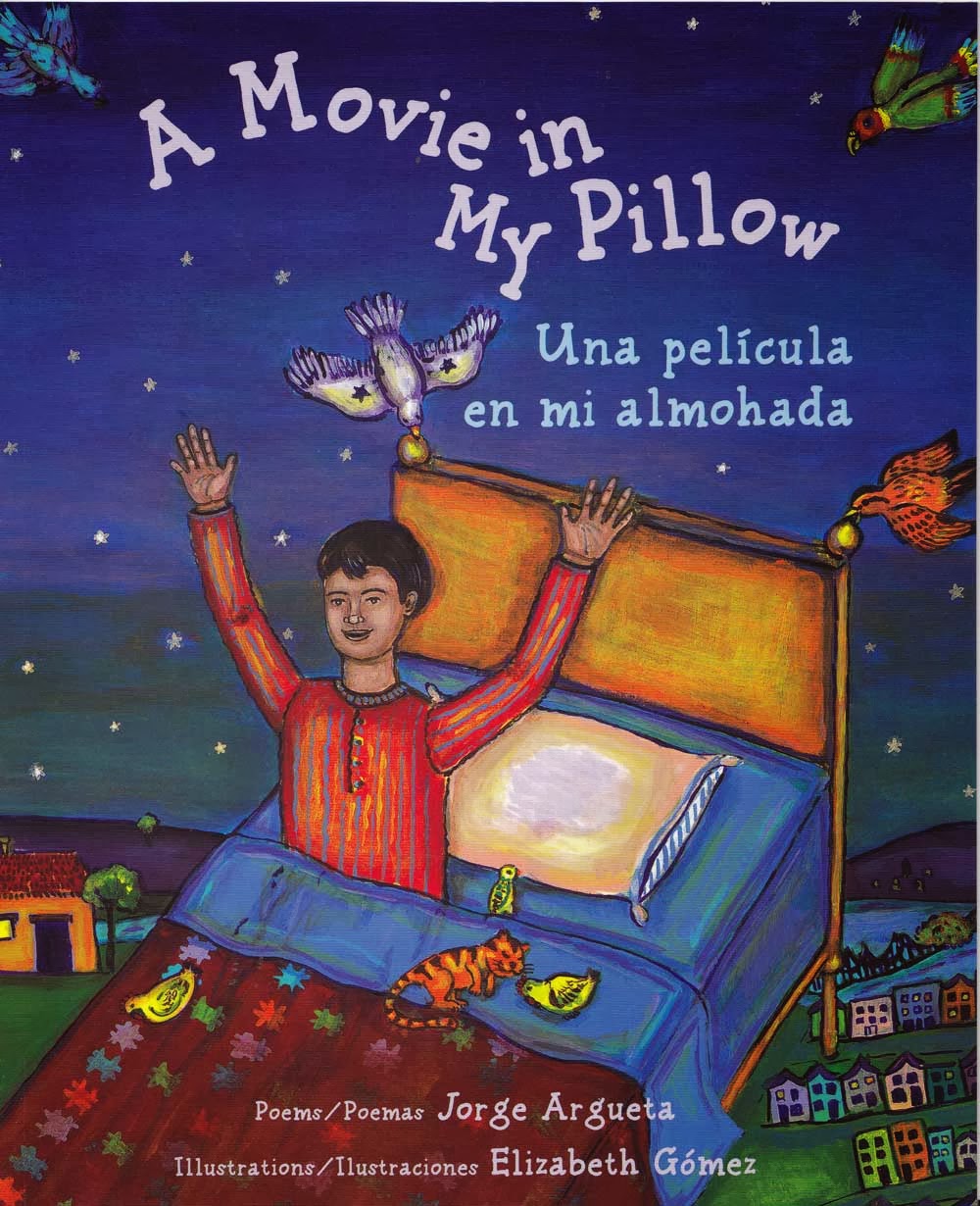
Movie in My Pillow / Una película en mi almohada


author: Jorge Tetl Argueta
translator: Jorge Tetl Argueta
illustrator: Elizabeth Gómez
Children’s Book Press / Lee & Low, 2001
grades 2-up
Pipíl, Salvadoran, Salvadoran American

During the bloody Salvadoran Civil War (1979-1992) between the military government representing the 12-family oligarchy of wealthy landowners, and leftist forces representing mostly impoverished peasants, US-supported government death squads terrorized, tortured, murdered and disappeared thousands of civilians, especially targeting students, intellectuals, and Indian people in the rural areas. By the time the UN-brokered peace agreement was signed, it’s estimated that more than 75,000 people had been killed and more than half a million refugees had fled to the US.

In this lovely bilingual collection of autobiographical poems, young Jorge tells the story of how he and his father, fleeing from the war, arrive in San Francisco. Eventually, the rest of the family will join them, but for now, father and son, leaving in the middle of the night—and without saying goodbye to anyone—must travel alone.

In an introductory note, Argueta writes about the beauty of his home country and the war that forced his family to leave. “These poems are my memories, my dreams,” he writes, “the movies in my pillow.” This brief history of his “transplantation” reminds me of the stories my grandmother told me about having to leave Mexico with her brother packed into a trunk so he would not be taken to become a soldier. Although my grandmother always longed for the homeland of her childhood, still she embraced this country for the safety it provided. Like my grandmother was, young Jorge is also resilient. While holding tight to the memories of his homeland, he is able to put down roots in San Francisco with its “sopa de lenguas en el viento / soup of languages in the wind.”

When his uncle sends him an audiotape of his grandma, talking and singing to him in Nahuatl and Spanish, we know that Jorge, wherever he is, will always remain connected to his culture and community:

Jorge, Jorge, maybe
you will never come back.
Remember when you sat
next to me on the river bank?
Jorge, Jorge, don’t forget
that in Nahuatl “tetl”
means “stone” and “niyollotl”
means “my heart.”

 Argueta’s writing—both in Spanish and English—are pure poetry, with brilliant metaphors that will resonate with young children. On one page, for instance, he is a yo-yo, and his poem is a long unpunctuated sentence: 

I have a yo-yo that makes me crazy but I can’t stop playing yo-yo in the mornings yo-yo in the middle of the day yo-yo in the afternoon yo-yo at night yo-yo yo-yo yo-yo I dream yo-yo I walk yo-yo I eat yo-yo I am a yo-yo.

Gómez’s brightly colored acrylics beautifully illustrate Argueta’s beautiful poems. She has a lot to work with: Here is Jorge, avoiding cobras on the sidewalk; riding a dragon dancing the cumbia; with his family flying like parakeets between San Francisco and El Salvador; and turning into a yo-yo. One of my favorites is the image of Jorge’s family members, embracing each other in a huge nest—“abrazando nos sentimos como un gran nido con todos los pájaros adentro.”

The Spanish is wonderful, depicting Jorge’s struggle and emotions of his abrupt immigration to San Francisco; the translation was most likely accomplished from Spanish to English. I especially like the way the Spanish and English versions alternate on each spread, with both languages presented as equal in importance.

In A Movie in My Pillow / Una película en mi almohada, Argueta gives young readers insight into the one of the most difficult experiences a child can have—being uprooted from your homeland and transplanted far away to a very different place. For young Jorge, landing in “la misión” provides him with a world of adventures and enough cultural connections to El Salvador to make his transition a little less traumatic than if he had landed somewhere else. This book is a welcome addition to a collection of stories about the immigrant experience and is highly recommended.

—María Cárdenas
(published 1/24/14)

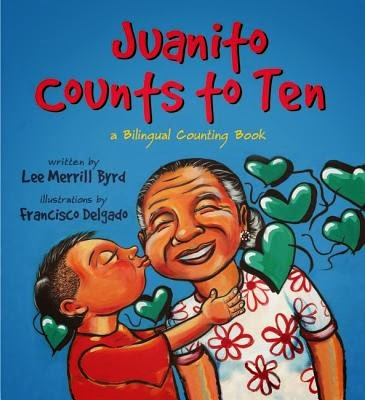
Juanito Counts to Ten/ Johnny cuenta hasta diez


author: Lee Merrill Byrd
illustrator: Francisco Delgado
Cinco Puntos Press, 2010
preschool-up
Mestizo, Mexican American

It’s so sweet to count kisses! Narrated by Juanito’s grandma, the simple little story is about who receives Juanito’s delicious kisses. Beginning with one little kiss for his big sister, two big kisses for his daddy, three wet ones for his momma, and, as he counts to nine, Abuelita’s worrying that he might have run out of kisses. But—of course not—he has ten delicious ones for her!

Who would think of a counting book that is so loving, so family-oriented, so delightful? Clearly, Juanito Counts to Ten is not just about counting. And, while “traditional” counting books usually count just the objects, this one actually describes each kiss. With appropriate idiomatic Spanish, Juanito Counts to Ten is language expansion at its best.

Delgado’s artwork, in rich, saturated oils, complements the loving, enthusiastic text and carries the emotions. Big sister is grossed out, Beatriz’s dog is jealous—and the cat’s not especially loving it, either. Here, he portrays Juanito’s family, friends and everyone else he kisses (but not girls outside of the family, whom he wants to but doesn’t) as real Mestizo people and community. And one of the messages—an important one—is that it’s totally OK for Latino boys to kiss their close friends and relatives. Highly recommended.

—María Cárdenas
(published 1/16/14)


New Sun / Un Nuevo Sol


authors: Max Benavidez and Katherine Del Monte
illustrator: José Ramírez
Latino Literacy Press, 2002
grades unknown
Mexican

 A New Sun / Un Nuevo Sol appears to have been written for hablantes who are learning English. Here, the narrator, newly arrived from Mexico, is struggling with the differences between the familiar culture he left and the strange new culture he encounters. Ultimately, he finds that people everywhere want “to have hope and make their dreams a reality.” This sparse prose-poem (I came with a dream, / Yo vine con un sueño, / with so many hopes. / con tantas esperanzas. / I was looking for a new life. / Buscaba una nueva vida.) has no story—it’s just phrases on a page with no real connection to the immigrant experience.

The melting-pot ending—(Yet, no matter how different we are / Sin embargo, no importa cuán diferentes somos / we have the same hopes. / tenemos la misma esperanza. / We share the same dream of a better tomorrow. / Compartimos el mismo sueño de un major futuro.)—is the most annoying part, implying that, while we all have some differences, we are really all the same. The reality, of course, is that, while we all may dream of a better tomorrow, our dreams aren’t the same. In truth, some of us dream about staying alive, about being where the bombs aren’t falling. Some of us dream about having enough food to eat, about drinking clean water. Some of us dream about going home, about reuniting with our families.

Ramírez’s art, in highly saturated oils on a dark, morose palette, does not reflect what little message of hope there may be. The people’s faces are distorted and unhappy-looking and most of them appear to be wearing masks. On close inspection, one might find La Virgen de la Guadalupe and a few calaveras.

What’s apparently being taught here is basic translation, grammatical sentence structure and working with antonyms. The text is flat; here’s no passion or even emotion. There is just not enough content to be meaningful—to anyone. A New Sun / Un Nuevo Sol is not recommended.

—María Cárdenas
(published 1/16/14)

Gift from Papá Diego / Un regalo de Papá Diego


author: Benjamin Alire Sáenz
illustrator: Geronimo García
Cinco Puntos Press, 2010
grades 3-up
Mexican, Mexican American

Dieguito is missing his Papá Diego a lot. He wants to see his grandfather and he doesn’t understand the concept of far away—“if I could see my Papá Diego every day, …then every day would be as perfect as a sky full of summer clouds.” Dieguito’s father tells him that Mexico is far away, that it’s Papá Diego’s home and that he wouldn’t be happy in El Paso.

When, for his birthday, Dieguito receives the Superman suit he had wanted, he finds that he is unable to fly to see his Papá Diego. Upset, he refuses dinner, including champurado, which, he is told, helps him speak Spanish and feel warm inside. When he finally comes down—to his surprise and joy—Papá Diego has arrived!

García’s molded clay art, in muted, natural colors, is gorgeous; with brightly colored backgrounds that enhance, rather than obfuscate, the clay figures. Here is Dieguito, excitedly watching his mother in the kitchen, fixing chiles relleños. Here is Dieguito’s sister, taunting him. Here is Dieguito’s father, telling Dieguito the story of the day he was born.

The Spanish text, which I read first, is idiomatic and wonderful. For example, Papá Diego tells Dieguito (in English), “Tonight Chihuahua is not so far, and I do not feel so old, and it was very easy to cross the border. The border is nothing for people who love.” And in Spanish, “Esta noche Chihuahua no está tan lejos y no me siento tan viejo y no fué tan difícil cruzar la frontera. Una frontera no es nada para los que se aman.”

In this story, Mexico is about where Papá Diego’s home is, but El Paso is Dieguito’s immediate family’s home as well.

When we think of borders, we generally think of physical lines, but the reality is that they are often political and economic borders that divide families. In reality, many, many children are taken from their parents and parents are taken from their children. Children—born here or there—feel the loss of their relatives on the other side, and fear the breakup of their families.

We don’t know why part of Dieguito’s family members came to the US and some stayed in Mexico; it seems to have been an economic decision. We also don’t know whether or not the family has documents. Nevertheless, this story lends itself to a rich discussion of the migrant and immigrant experiences of separated families, and can be supplemented by other stories, such as Jorje Argueta’s beautiful Alfredito Flies Home. A Gift from Papá Diego / Un regalo de Papá Diego is highly recommended.

—María Cárdenas
(published 1/16/14)