Zombies Don’t Eat Veggies! // ¡Los zombis no comen verduras!


author: Megan Lacera
illustrator: Jorge Lacera 
translator (Spanish): Yanitzia Canetti 
Lee & Low, 2019
kindergarten-grade 3 
Zombie

In the latest series of Kraft Foods TV commercials, non-Zombie parents who insist that their children eat nutritious foods chase them around the room or verbally battle with them—until discovering that offering them macaroni and cheese solves everyone’s problem. 

Ineffectual parenting
notwithstanding, the point is that just about all families want their children to be healthy. Although their definitions of “healthy” might be different from those of the rest of ours, Zombie families want the best for their kids, too. 

In Zombies Don’t Eat Veggies! and its Spanish version, ¡Los zombis no comen verduras!, young Zombie Mauricio (“Mo”) Romero cannot and will not abide his parents’ cultural food preferences. Among them are—yum!—arroz con spleens, chili con ojo, dori-toes, and arm-panadas. No, Mo is different. He has a secret, “deep, dark, dreadful, devious” craving for something “absolutely despicable”—horrors!—vegetables. Vegetables of all kinds! 

Mo earnestly attempts to convince his parents to integrate vegetables into their Zombie culinary world. First, he presents them with the stomach-churning (to them) book, Eating Vegetables by "Jonathan Saffron Gore," a Zombie tongue-in-cheek reference to Eating Animals, in which author Jonathan Safran Foer challenges readers to examine their eating habits.

When that argument fails, what Mo secretly concocts for his parents—with ingredients from his hidden veggie garden and prepared in his secret kitchen—is too good to divulge. (OK, it’s a delicious vegetarian gazpacho disguised as a delicious bloody mess, which he calls “blood bile bisque.”) Although Mo’s ploy is a bust—his Zombie parents hate the gazpacho—they know they must support their young Zombie son because they are a Zombie family and they love him beyond death.

Megan Lacera fills her tale with hilariously exaggerated puns (Mo’s mom offers him a bowl of delicious “finger foods,” and Mo begs his parents to “give peas a chance”), which Jorge Lacera complements with over-the-top cartoon images on a Zombie-centric palette of mostly darkened browns and greens. Here, for instance, young readers will see Mo and Mom proudly gazing at Dad, who displays his first-place trophy in the much-(Zombie)-coveted “competitive brain-eating contest.”

Lacera’s digitally rendered illustrations, in which the individuals in this Zombie family have varying complexions—Dad is brown, Mom is dark green, and Mo is light green—authentically reflect the multiethnic reality of the Zombie community. Plus, they’re very, very funny.

While the English version contains appropriate conversational code-switching, super-talented translator Yanitzia Canetti’s Spanish version not only reflects the cultural nuances of the spoken language, but effortlessly blends in spot-on Zombiana, which she has apparently studied. While Mom hopefully presents Mo with a bowl full of (literal) “finger foods,” the Spanish might be “comida de dedos.” But Canetti refers to it as “deditos en salsa” (literally, “little fingers in sauce”). She also adds or subtracts words or word parts to Zombify the Spanish, creating delightful names for the foods to reflect an unmistakable Zombie-centric flavor. For instance, she uses a hyphen to morph “patatas” (potatoes) into “pata-tas,” with “pata,” of course, meaning “foot.” As well, she employs Espanglish phrases in a way that will have young hablantes giggling. For instance, when Mo’s parents hesitantly agree to try his vegetarian dishes, an illustration shows them grimacing and taking (in English) “only a teeny tiny bit,” while in Espanglish, it’s “una probadita rechiquitita” (“a tiny retch-inducing taste”).

Hablantes and English-speakers—Zombies and non-Zombies alike—will love this well-done and totally silly story of the meaning of family, yearning to belong and daring to be different. And non-Zombie kids will see connections to their own lives as well. 

*Highly recommended for home, classroom and library collections. 

—Beverly Slapin
(published 7/18/19)


Muchísimas gracias a mis amigas Zombistas, Judy Zalazar Drummond y Lyn Miller-Lachmann.

My Friend / Mi amiga


author: Elisa Amado
illustrator: Alfonso Ruano 
Groundwood Books / House of Anansi Press, 2019 
grades 1-4 
Indigenous, Mexican, Guatemalan

What does it mean to be alone and lonely in a strange place? What might it mean to feel safe? To be loved and accepted? To have a friend you can rely on? And what does it mean when that relationship becomes strained and possibly disrupted? 

In this intimate, heart-wrenching second-person narrative, a newly arrived refugee girl relates the story of her tenuous and emotional relationship with a white girl. In a sense, this narrative style invites young readers into the young girl’s life and challenges them to be like her friend. 

On the cover, the young narrator wears a red-and-white striped polo shirt and her dark hair is neatly braided and pulled into traditional Indigenous chongos. She faces a white girl in denim overalls, whose blond hair is casually pulled back into a loose ponytail. In the background are the Brooklyn Bridge and the East River. 

Amado frames this young girl’s story between two versions of a song written in 1915 by José López Alavés, an Indigenous man from Oaxaca, after he had migrated to northern Mexico. The first, in Spanish—entitled “Canción Mixteca—My Father’s Version”—appears on a front end page. The second, in English—entitled “Mixteca Song—My Translation” is on a back end page. Both languages portray the song as a lonely, mournful yearning for home. In a brief note, Amado informs the reader that her translated version is what she thinks her “favorite family song sounds like in English.” 

“For us, in Spanish,” she writes, “it’s exactly how we feel about living so far from the home that we left behind, that we miss.”

Told from her perspective to her white friend, My Friend is a poignant chapter in a young girl’s refugee story. The second-person narration throughout—without identifying the young girl by name or her family’s specific ethnicity, while inclusively incorporating the various heritages and pan-Indigenous images from the southern Mexico-Guatemala region—transports young readers directly into the story and heightens its intimacy. 

Amado hints at the backstory, so readers will learn from the song—and from a few words from the girl’s father—that this family has survived tough times, has limited choices, and, for better or worse, is settling into a community of strangers. And, for this story, that may be enough. There’s no further explanation because none is necessary.

Soon after the narrator and her family arrive in Brooklyn, she forms a fast friendship with a white classmate; the two are always there for each other. “I knew you would be my best friend the day I came to school the first time,” she says. “I know you and you know me. That is why we are best friends forever.” 

But when she invites her new friend over for a special dinner with her family, things appear to go awry. The girl’s best friend does not seem to like the food. Or the loud music, a song “that makes us remember where we were before we came here and what it was like.” Or the shouting and arguing. “That was so weird!” she says, and decides to go home early.

The narrator is bereft; she’s internalizing the horrible thought that her best friend doesn’t like her anymore. Echoing the song, she says she “feels like dying.” This is not hyperbole; it’s her pain, the loss and betrayal that wrap around her.

“I want to go home,” she cries. “I hate it here!” But for this refugee family, as for so many others forced to come here, returning to their homes and communities is not an option. Her family’s loneliness and sorrow are palpable. “We can’t go back,” her father tells her. “We have no choice. Just be glad you are safe…”

That night, she plays the sad song over and over. “I know you and I thought you knew me…. But you don’t know anything about me!…I was so mad at you that I never wanted to see you again.” On her way to school the next morning, she worries. She’s lost so much and now she’s lost her best friend as well. But as she reaches school and sees the girl, she remembers, among other situations, when her best friend challenged the mean kids who were bullying her: “Drop dead! She’s way cooler than you!

And when her white friend thanks her for dinner and says that she “really had fun,” the two walk in the door together. Best friends.

Ruano’s art, rendered in watercolor on paper, effectively complements this refugee family’s realities, emotions and dreams. In one particular full-bleed double page spread, for instance, while the self-conscious white girl sits on the family’s couch, the young narrator and her father—their exuberance demonstrated by the rainbow colors that pass through them and the Indigenous art that frames them—belt out the song from their homeland and their hearts.


Elisa Amado was born in Guatemala, and it appears that My Friend might be part of her story as well. While the family sings this mournful song of loneliness and despair, the father is enraged at a situation he can’t control—they must stay here. For refugees desperately fleeing to the US—“into the mouth of the shark,” so to speak—this story couldn’t have been published at a better time. 

My Friend will resonate with youngsters who are immigrants, migrants or refugees everywhere. Amado is an amazing translator as well, and I look forward to seeing her Spanish version. Highly recommended. 

—Beverly Slapin
(published 7/11/19)

Muchísimas gracias a mis amigas y colegas, Rachel Byington y Lyn Miller-Lachmann. 


author: Elisa Amado
translator (Spanish): Elena Iribarren
illustrator: Alfonso Ruano 
Groundwood Books / House of Anansi Press, 2019 
grades 1-4 
Indigenous, Mexican, Guatemalan

Elisa Amado is a wonderful writer and an excellent translator. Although Elena Iribarren’s Spanish translation here is adequate, it doesn’t reflect the nuances of the story—especially the child narrator’s own voice and her sense of self. 

Central to the story is “Canción Mixteca,” a song of loneliness and despair and wanting desperately to go home. It’s this refugee family’s favorite song, and the child narrator deeply feels the song’s refrain, “quisiera llorar, quisiera morir” (“I would like to cry, I would like to die”).

Most of the problems children have to deal with in middle school include being dissed and not having friends. For newly arrived immigrant or refugee children, their troubles and anxieties may be multiplied. Both the English and Spanish versions deal with this anxiety; however, Amado’s English version appears more realistic than Iribarren’s Spanish, which is stilted and sometimes misleading.

When kids at school mock the young newcomer as “weird,” her friend immediately shuts them down: “Who cares? We’re best friends. Is that a problem?” In the Spanish version, however, her friend’s words appear self-conscious: “A mí no parece rara. Es mi mejor amiga. ¿Cuál es el problema?” (“She’s not weird to me. She’s my best friend. What’s the problem?”) Today’s tweens don’t talk like that—they’re more confrontational when a friend is dissed. Like, “¿Qué les importa?” (“What do you care?”)

After a special dinner that the new child’s refugee family has prepared, her friend laughs and remarks: “That was so weird!” The child is bereft: “I felt like dying.” 

But the reason for her deep hurt in the English version is not reflected in the Spanish. In that version, her friend says, “Sabes que? Nunca he estado en una cena como esta!” which can be interpreted as curiosity about or enthusiasm for the meal rather than disdain (“You know what? I’ve never been to a dinner like this!”). Yet the protagonist is heartbroken, thinking, “Yo me quería morir” (“I wanted to die”), an emotional disconnect resulting from an awkward translation.

The refugee child is miserable. She doesn’t know how she will exist without a best friend. But then she remembers her friend’s confrontation with the kids who had made fun of her clothes: “Drop dead! She’s way cooler than you.” In the Spanish, however, her friend says, “Callate. Ella es míl veces más interesante que tú.” (“Shut up. She’s a thousand times more interesting than you.”) 

While “callate” would be appropriate here—unless you really wanted a person to die, in which case you’d say, “muerate”—the rest doesn’t even come close to a rejoinder to kids who are trying to embarrass your friend. Rather, you’d probably say “¡Callate—Ella es mucho más chida que tú!” (Shut up! She’s way cooler than you!”)

In comparison to the vividness and specifics of Amado’s English version, Iribarren’s Spanish feels flattened and generic. It doesn’t reflect how tweens express themselves; it fails to convey the passion of a child in pain or the validation she feels when her best friend defends her. While My Friend is *highly recommended for all home, library and classroom collections, Mi amiga is not.

—Beverly Slapin
(published 12/16/19)
Muchísimas gracias a mis amigas y colegas María Cárdenas, Amy Costales, y Lyn Miller-Lachmann.


Illustrations copyright © 2019 by Alfonso Ruano. Reproduced by permission of the publisher, Groundwood Books (www.groundwoodbooks.com).


¿Qué estás haciendo? // What Are You Doing?

author: Elisa Amado 
illustrator: Manuel Monroy 
translator (Spanish): Luis Barbeytia
(Spanish edition, CIDCLI /Brincacharcos, 2011 // English edition, Groundwood, 2011)
kindergarten-grade 2 
Mexican

When his mother reminds young Chepito that today is his first day of school, the child informs her that he doesn’t want to go, and runs outdoors instead. As he traverses his community, Chepito meets a variety of people, each of whom he asks, “¿Qué estás haciendo?” (“What are you doing?”). Everyone’s engaged with a variety of reading materials, and Chepito sings, “¿Por qué? ¿por qué? ¿por qué?” (“Why, why, why?”) A man looks for stats to see who won the game, a girl enjoys a funny comic book, tourists consult a guide because they’re lost, a mechanic pores through an auto repair manual, a young woman scans a magazine for hairstyle ideas, and an archeologist studies hieroglyphics on a stela.

At school, Chepito is attracted by a shelf full of books, and when his teacher lets him borrow one, he runs home and begins to read. (Of course, our young emergent reader is decoding the pictures rather than reading the words, the first step in literacy learning and appreciating the written word.) Soon, he’s asking his younger sister, Rosita, if he can read her the book, and, bringing the story full circle, she sings, “Why, why, why?” 

“Because it’s fun,” Chepito begins to say, but Rosita interrupts him: “Yes. Read it to me.”

Monroy’s characters have varied skin tones and facial features; and his softly-colored pencil, watercolor and digital illustrations, on a limited palette of mostly tans, browns, and greens, complement Amado’s rhythmic and pleasing economy of words. With just the right amount of repetition and humor, ¿Qué estás haciendo? and What Are You Doing? are perfect for emergent readers.

*Highly recommended for all home, classroom and library collections.

—Beverly Slapin
(published 7/6/19)

¡Vamos! Let’s Go to the Market

author: Raúl the Third 
illustrator: Raúl the Third
colorist: Elaine Bay 
Versify / Houghton Mifflin, 2019 
all grades 
Mexican

After many years of immersing himself in the traditional Chicano art of doodling with Bic® pens on Nescafé®-stained grocery bags, the third Raúl in his family has taken the plunge. 

In ¡Vamos! Let’s Go to the Market, Raúl the Third (also known as Raúl Gonzalez) takes his readers on a totally trippy, frantically-paced journey through an enormous Mexican market whose inspiration was the Mercado Cuauhtémoc in Juárez. 

Raúl the Third’s artwork, rendered in ink on smooth plate Bristol board; and Elaine Bay’s digital dry-color palette and photo collage, feature lots of desert tones and complement the brightness of the market as well. 

Sharp-eyed older readers will see a combination of history and modern times, the silliness of El Chavo del Ocho and MAD Magazine, the speed of Monty Python’s Flying Circus, and the mayhem of a telenovela. Meanwhile, children (both hablantes and English-speakers) will follow the frenetic action while they learn new words and phrases, and reveal to each other the many visual jokes and punchlines. They will also count the appearances of favorite characters: “Where’s Waldo” fans, for instance, will love “¿Dónde está Coco Rocho?” (the tiny, winged, four-armed, two-legged, cape-wearing cucaracha in the white hat).

After being awakened by Kooky Dooky the rooster (who happens to be wearing a large sunrise belt buckle to remind him of his job), Little Lobo and his dog, Bernabé, and their tiny friend, Coco Rocho, eat a desayuno of huevos rancheros con tortillas de maíz and wash it down with warm milk. The huevos could not be fresher—a happy-to-please hen is nesting next to the oven, keeping her eggs warm.

Now, it’s time to load up their wagon to deliver supplies to the market. Everything is neatly labeled in Spanish with its English translation right below: Little Lobo’s house reads “mi casa,” the wooden box on which Coco Rocho sits is marked, “caja,” and a carton of miscellaneous stuff is tagged “cosas.” And the fun begins!

As Little Lobo, Bernabé and Coco Rocho navigate the double-page full-bleed spreads on their way to the market and inside, adults will also find not-so-hidden gems of word-plays and visual details. In one, for instance, next to a truck depicting workers unloading cases of buñuelos, the three encounter a poster for the film, “Un Perro Andaluz” playing at the Buñuel Cinema. 


Meanwhile, la Chida rolls by “El Mejor cortes de pelo,” whose logo is the helmet of Spanish conquistador Hernán Cortés; a group of palomitas wait to be seated at Palomita’s restaurant (on the roof of the theater), where they will dine on (of course) popcorn; and the iconic Sapo Bell in the Lowriders series has morphed into Sapo the trucker, taking his lunch break while reading “Sapo at Work.” 

Young readers who don’t already know will find that the worst thing that could possibly happen to a luchador (who must never show his face) is to lose his mask. It’s so tragic that the headline, “el TORO loses mask!” makes the front page of the Daily Chisme. Here, youngsters will see Little Lobo’s hero with a paper bag on his head, riding a motorcycle, walking around the plaza, bending a steel pipe with his bare hands, and finally, procuring a brand-new mask so he can fight again! ¡Guau!

In the plaza and inside the market—¡Guau!—everyone is busy! The Mercado is a virtual maze of pathways, shops and booths. There are mariachis, bailadores folklóricos, and everything anyone could possibly want: herbs, medicines and candles; delicious foods and snacks; comic books, magazines and sombreros; hand-made piñatas and hand-carved masks (including one of our little friend, Coco Rocho); black velvet paintings of Emiliano Zapata, Tweety Bird, La Catrina, Elvis and the ever-popular touristy “Aztec sacrifice”; marionettes of Frida Kahlo, Diego Rivera and Cantinflas; Día de los Muertos papel picado, and a line of tourists waiting to take a photo on “Chiva’s Zonkey,” a donkey she’s painted with zebra stripes. Saving the best for last, Little Lobo visits his favorite shop: Lucha Libre masks, posters and toys, and a revista that shows El Toro in his full glory, ready to get back in the ring. Here, Little Lobo delivers golden laces to tie onto El Toro’s new mask! And meets the great El Toro himself! And gives him a ride home! ¡Guau!

In ¡Vamos! Let’s Go to the Market, Raúl the Third, who won the Pura Belpré award in 2017 for illustrating Lowriders to the Center of the Earth (written by Cathy Camper), infuses his hilarious stream-of-consciousness doodling with virtually hundreds of little details (such as an anthropomorphic spider catching flies with a spiderweb fishnet). 

The Spanish and English words and phrases complement each other. Although an appended glossary translates most of the Spanish words into English, youngsters will easily be able to decode from context what they don’t already know. This peek into Mexican culture is rich with beautifully laid-out detail and the kind of humor that will appeal to both the youngest hablantes and English-speakers—and to adult readers as well. 

Pull-quote: “Gripping! Powerful! Inspiring! ¡Guau!”

—Beverly Slapin
(published 7/4/19)

(Note 8/18/19: Míl gracias a Raúl for the image of the two-page spread.)

(Note 8/24/19):

One of my favorite illustrations is the Piñatas Caminos section, in which Little Lobo delivers the tissue paper that Corrina Caminos needs to finish her piñatas. Her selection of piñatas for sale includes a giant El Monstruo and El Toro, a taxicab with driver (“La Ruta”), and (readers will remember from the Lowriders books) an El Sapo (the icon from Sapo Bell), an El Chavo del Ocho and a Flapjack Octopus.

Hey, wait! Is that a piñata of “our” orange-faced, Mexican-hating Donald J. Trump, glaring at a piñata of Cantinflas, the goofy-but-sly Mexican character who always manages to bamboozle the rich and powerful? Why, yes, yes it is.

¡Ay, que guau!

*Highly recommended for all home, classroom and library collections.


It Doesn’t Have To Be This Way: A Barrio Story / No tiene que ser así: Una historia del barrio

author: Luis J. Rodríguez 
illustrator: Daniel Galvez
translator: Francisco X. Alarcón
Children’s Book Press / Lee & Low, 1999 
grades 4-up 
Mexican American


Poet, novelist, educator, and activist, Luis J. Rodríguez, has been writing from his own experiences for more than 30 years. His beautiful picture book, La llaman América // América Is Her Name (Curbstone, 1997) was one of the first to focus on racism, immigration and migration from the voices and hearts of the people themselves.

It Doesn’t Have To Be This Way: A Barrio Story / No tiene que ser así: Una historia del barrio is narrated by 10-year-old Monchi, who’s being recruited by a local gang. Monchi becomes enamored of Clever, who is both engaging and intimidating. Both Monchi’s insightful and supportive uncle, Rogelio, and the child’s slightly older cousin, Dreamer, advise him not to take this road, but Clever’s pull is stronger. 

Rodríguez knows firsthand why young people join gangs: “to belong, to be cared for, and to be embraced.” In an introduction that includes a photo of himself as a gang member at age 11, he writes,“I hope we can create a community that fulfills these longings, so young people won’t have to sacrifice their lives to be loved and valued in this world.”

It Doesn’t Have To Be This Way is Rodriguez’s envisioning of what his own childhood could have been had he not been seduced into becoming part of this dysfunctional, violent world.

Renowned mural artist Daniel Galvez’s compelling watercolor paintings, on a palette of vibrant floral colors and tones, beautifully express the East LA barrio and the people who live there. On the copyright page, Galvez thanks the adults and fifth-grade students who appear as characters in this story. Tío Rojelio is iconic artist Juan Fuentes, who has a gallery named after him at Acción Latina on 24th Street in the Mission District of San Francisco. The character who buys the bike that Monchi has stolen is René Yañez, who recently passed away. He was one of the founders of the Galería de la Raza and himself a Mission icon. 

Leading with the Spanish text on some pages and the English on others—along with some phrases in Mexican street Spanish woven into both the Spanish and English—reveals the community’s bilingualism.

Alarcón’s Spanish version is filled with his usual strong images and deep magical symbolism, as does Galvez’s art. 

Clever, the gang recruiter, brings to mind Edward James Olmos’ character, “El Pachuco,” in Luis Valdez’s Zoot Suit. He is omnipresent, often lurking in the background. He is the evil who is there but not there, the one who follows the neighborhood, whispering in everyone’s ear. His presence is always there because he permeates the barrio, foreshadowing evil: watching Monchi from afar, giving him bad advice, inviting him to a jump-in, showing him how a gangsta dresses, encouraging him to steal a bike, noting his reaction to his cousin’s being shot, and observing his encounter with a cop. Practically the only scenes here that do not include Clever are when Monchi is with his family, especially with his uncle. The message is strong: Kids who live in the barrio must understand that they have to learn to be careful.

Monchi’s slightly older cousin, Dreamer, is Clever’s counterpoint—she’s the angel on Monchi’s shoulder. When we meet her, she’s fixing a loose board on the porch, and, mocking him as “medio tonto” after he’s tripped over a rock, pretends to hit her own head with the hammer. Although she appears to be joking with Monchi, she’s implying that he has the capacity to make the right choices, but he will still make mistakes along the way. Later, despite her being dissed by Clever, Dreamer tries to convince Monchi not to join the gang. When that doesn’t work, she takes a bullet for him. Kids who live in the barrio must understand that they have to learn to be careful.

Rodríguez’s story of the barrio brings in the same Chicano subtext that Luis Valdez captured in Zoot Suit—the strong history of rural East LA of the 1960s that goes back to Sleepy Lagoon and the so-called “Zoot Suit Riots” in 1943 which spawned the movie—to incorporate the neighborhood and the gangs.

Young Monchi is the poet Luis J. Rodríguez and, ultimately, his story is about resisting the strong pull of the gangs. In a particular illustration, Clever confronts Monchi, who is holding a notebook in which he’s been writing his poems. And Monchi, terrified, nonetheless is meeting Clever’s eyes. 

The rich symbolism continues throughout. In Monchi’s encounter with a cop after Dreamer has been shot, for instance, the illustration indicates that he is answering the cop’s questions reluctantly if at all. Readers see the policeman looming from behind, his arm close to the gun at his waist. Monchi, his arms at his side, looks directly up at him—while Clever stands a few feet away, but nobody sees him.

In another illustration, after Monchi has stolen and sold a bike, he purchases a knife. This knife comes from the outside world, and Monchi brings it inside and puts it on the table where Dreamer can see it. Mom is preparing food in the kitchen, her back turned to them, but her worried expression says that she, like everyone else, knows what’s going on. 

Ultimately, it’s the violent event that almost takes Dreamer’s life—rather than anyone’s pleading with him—that convinces Monchi to get out before it’s too late. 

In the hospital, Monchi is filled with grief and guilt, And the boy’s uncle is there to support him: “Esto no tiene que ser así, m’ijo,” he says. “Sé que quieres ser un hombre, pero tienes que decidir qué clase de hombre quieres ser.” (“It doesn’t have to be this way, my son. I know you want to be a man, but you have to decide what kind of man you want to be.”)

Rogelio is proud of Monchi's decision, and tells him that “nosotros podemos mejorar las cosas, m’ijo, si todos trabajamos juntos” (“we can make things better, my son, if we all work together”).

My comadre, Judy Zalazar Drummond, told me that she used Monchi’s story in San Francisco middle schools for many years in discussions about making positive and negative choices. It Doesn’t Have To Be This Way: A Barrio Story / No tiene que ser así: Una historia del barrio is *highly recommended for all home, library and classroom collections.

—Beverly Slapin

*Highly recommended for all home, classroom and library collections.

Gracias a mis colegas for their helpful input: David Bowles, María Cárdenas, Judy Zalazar Drummond, Juan Camilo Prado, Noam Szoke, and Lila Quintero Weaver.


NOTE

Although this story is highly recommended, the Spanish text is more nuanced and subtly different from the English. The result is, that in English, it tends to diminish Monchi’s autonomy and sense of self. I suspect that this flattening in the English language was an editorial choice, and I’d like to see an updated edition with the subtlety and message of the language restored.

A few examples:

• Describing an encounter with Clever, Monchi tells readers (in English) “I tried to sound cool, but I was scared.” And in Spanish, Monchi says that he was “trying to look calm, but the truth is that this vato scared me.” In the English, Monchi is blaming himself for being scared, while in the Spanish, he acknowledges the source of his fear.

• After Dreamer’s near encounter with death, Monchi tells his tío that he has decided not to join the gang. Rogelio responds: “Ésa fue uno decisión valiente…. Y te respeto mucho por eso.” Monchi’s uncle uses the empowering term, “decisión,” acknowledging both the decision itself and that the youngster is learning to make positive choices. In the English text, however, Rogelio tells Monchi that he did “a brave thing,” which implies that it may have been something he was compelled to do, rather than his choice. Here, the use of the word “thing” rather than “decision” deemphasizes Monchi’s developing self-awareness.

• In the end, Rogelio tells Monchi that: “Nosotros podemos mejorar las cosas, m’ijo, si todos trabajamos juntos.” (
“We can make things better, my son, if we all work together.”) Spanish readers see advice that comes from Rogelio’s experience and strugglewhile English readers see Rogelio telling Monchi that “we can make good things happen, m’ijo, if we all work together.” Using the passive term here—“happen”—minimizes the community’s task ahead and Monchi’s role in it. 

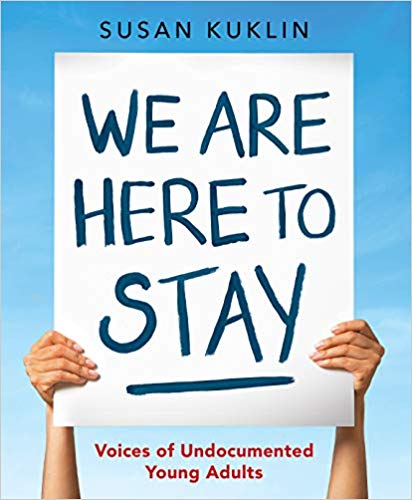
We Are Here to Stay: Voices of Undocumented Young Adults

Author / Photographer: Susan Kuklin
Candlewick Press, 2019 
grades 5-up 
Colombian, Mexican, Ghanaian, South Korean, Samoan

The original title of Kuklin’s book of interviews with undocumented young people was to be Out of the Shadows: Voices of Undocumented Young Adults. This was during the time of the Obama administration’s DACA (Deferred Action for Childhood Arrivals) program, which allowed individuals who were brought to the US as babies or children without documentation—US passports, green cards, or visas—to receive renewable two-year periods of deferred action from deportation and become eligible for Social Security, work permits, driver’s licenses and other necessary documentation. The book was to feature Kuklin’s stunning portraits of the young tellers who were, indeed, out of the shadows. 

However, after the book was imagined and planned and accepted by Candlewick Press for a 2017 release, the interviews accomplished, the portraiture shot and developed, and the book laid out and ready to go to print—the incoming Trump administration moved to repeal DACA, spreading hateful, divisive messages about immigrants, migrants, and refugee and asylum seekers. And the young people, among some 700,000, were forced back into the shadows.

A painful decision had to be made, and everyone decided to stop the presses. But after some two years, during which this volume of young people’s important, truth-telling stories sat in a drawer somewhere, all agreed—Kuklin, Candlewick, and the courageous young people themselves—to bring the book into publication. This was too important, they all said in their own ways, to leave it unpublished. At the same time, it was decided that changes had to be made for the protection of these young people. Here, they are referred to only by their first initials, empty frames replace their portraits, and all other identifying information has been redacted. As Kuklin told me (see interview below), their safety was everyone’s first priority.

In We Are Here to Stay: Voices of Undocumented Young Adults, nine young people from Colombia, Mexico, Ghana, Independent Samoa, and South Korea—now living under the constant threat of deportation to their countries of birth—narrate their “American” lives and, for those who remember, what their lives were like in their countries of birth and what circumstances brought them here. Each chapter is narrated by one or more of the young people. Their narrations are raw and honest. 

Kuklin’s stark, black-and-white photos in Chapter 3 are foreboding images that complement the young people’s stories. They include a sign that warns travelers about encountering “smuggling and illegal immigration,” a heavily-armed Border Patrol officer, a barbed-wire-topped enclosure, surveillance towers, footprints and empty water jugs. 

From G—, who came here from Mexico:

When I say good morning to my parents, I’m never sure that I will be able to say good night to them. I’m afraid to go to school, because it could be the last time I see them for a while. My dad’s got to go to work. He’s got to drive to get there. Because he does not have a US license, if a police officer pulls him over, he could end up in jail. Once he’s in jail, he could go through deportation proceedings. It’s happened to some of my friends—their parents get deported, and they are left alone.

And from Y—, who arrived from Colombia:

A lot of people grow up with shame and anxiety about being undocumented. It’s not something you want to share with people. On the news you hear about “the illegals,” and about all the resources they take from Americans. I don’t think people have a particularly nice image of us. So when I say, “I’m undocumented,” it’s hard to tell how people are going to react….

Maybe next time they hear someone railing about how terrible immigrants are, they’ll think about me. I’m a real person. I go to school with their kids. I have a wonderful family. Maybe after listening to me they will feel differently about immigrants.

Rather than being told (and interpreted) by outsiders, the voices in We Are Here to Stay: Voices of Young Undocumented Adults are authentic and impassioned and moving. This volume is *highly recommended for all home, classroom and library collections; and I look forward to holding an edition in which readers can feel the voices and see the faces of these courageous young people.

—Beverly Slapin
(published 5/1/19; revised 5/2/19, last sentence above.)

*Highly recommended for all home, classroom and library collections.


Note: Susan Kuklin is an award-winning author and photographer whose main interest in her more than 30 books for children and young adults is to address important social issues. Her photographs have been shown in the Museum of the City of New York and in documentary films, as well as published in Time magazine, Newsweek, and the New York Times. She cares very much about young people and getting the story right and, as I found out, she is generous with her time as well. 


INTERVIEW WITH SUSAN KUKLIN


Beverly Slapin: How did you originally envision this book? How has this project evolved? How and why have you and the young people you interviewed had to change your plans since the election of Trump?

Susan Kuklin: The book depended upon who came forward and volunteered to do an interview. One person led to another person. For example, Y told me that she felt really safe in New York but had she lived in Arizona, she probably would not have felt safe. P, a young woman from Mexico, really wanted her story to be in the book, but she was shy. Very, very shy. We met four or five times, but I was unable to get the details and introspection necessary for a narrative. Oh, how she wanted to do this. At one point in between our interviews, I went to Arizona, into the desert, and took photographs for an essay that appears in the book. When I returned, P— and I attempted another interview. I just happened to show her the photographs. “That’s exactly where I was!!!” All of a sudden, her experiences came rushing out. It was a magical moment. And by the way, she’s not shy any more. In fact, P’s arms are on the cover of the book and in the video on my Website.

So these interviews are organic—they’re flashes of memories, with one memory opening to another deeper memory.

How have the young people you interviewed reacted to Trump’s election? How have their lives changed since the election?

Their emotions range from scared to angry to defiant. And those emotions changed from day to day—from hour to hour. Can you imagine what it’s like to wake up one morning and learn that all your documentation—all your hopes and dreams—are down the drain? And also a new government hostile to immigrants has your address and telephone number and all your personal information?

The election was scary for me, so I can only imagine how it was for them. But still, the participants wanted the book to come out.

I felt responsible for their safety and well-being. I didn’t want to do anything to put them in jeopardy. I also realized that I was in effect sending them back into the shadows, the very shadows we saw the book as obliterating. They were much braver than I was. They kept texting me to stop worrying so much!

How has the book been received? How have the tours been received?

Very, very positively. People have been so compassionate about these kids and want to know how they’re doing now. Since the book came out, I’ve gone to border states and have met a number of DREAMers there who appreciate that the book was published.

The full-page frames with no photos in them are jarring; especially since they are all captioned as if they in fact contain portraits. They remind me of so many of the “disappeared” in countries such as Argentina, Chile, Guatemala and other fascist regimes of the time, whose families and communities still struggle to obtain the remains of their “disappeared” relatives. Who arrived at this decision to focus on the young people by “disappearing” their faces and names? Was it a collaborative decision? What do the young people think of it now?

Although it was not my intention to write a political book, the young people’s stories make a statement about what is going on now. 

For the year-and-a-half the manuscript and photos were in a drawer somewhere, I thought the book would never be published. But the participants had made it clear that they wanted their stories told, and those stories needed to be told. I gave them options to help me make the final decision: publish the book as is, publish it using names but not photographs, publish it using photographs but not names, or publish it without names or photographs. They also had the option of dropping out of the project. Everybody had a different idea of what they wanted to do. I decided—based on their views and based on their safety—that we should omit both the photos and names. I told them that I wanted to protect the most vulnerable people in the book. Basically, everyone agreed to protect each other.

I see these empty frames as telling people who look at them that we live in an unfree country and that many people who live here are in real danger. 

Yes, this is our reality. 

Despite the fact that these are all narratives, the book reads like an authentic collaboration. None of the young people who entrusted you with their stories have been named. How were they involved in the editing process? How were they involved in the decision-making process? 

While I was working with my editor, the young people had the opportunity to read the drafts for accuracy, authenticity, and voice. It was back and forth almost until the book went to print. Everything is in their voices, their syntaxes, their rhythms. Their stories are intimate. It was a true collaboration. 

Where are they now?

On one hand, they are in limbo and, on the other hand, their lives go on. Five have graduated from college, four are in graduate school, two are teachers, one’s becoming a journalist, one’s married, another has been able to bring his whole family here. They were raised as typical American kids. They know how to organize. They don’t take fools lightly. At the book launch that most of the New York participants attended, they immediately felt comfortable with each other——it was like they’d been friends forever.

All the participants are looking forward to the time when we can republish the book with their names and photographs—when they can actually come out of the shadows.