On the Hook


author: Francisco X. Stork
publisher: Scholastic Press, 2001

grades 6-up

(Mexican American)


Francisco X. Stork is an acclaimed author of eight novels for young readers. His most recent novel, On the Hook, is a reimagining of his debut YA novel, Behind the Eyes, which was published in 2006. We’re fortunate to have this second-chance book out in the world.


On the Hook is full of ethical dilemmas with characters about whom we deeply care. Sixteen-year-old Hector Robles is a chess enthusiast, an honor student, and devoted to his family, aware of his responsibilities ever since the death of his father from cancer several years earlier. He and his classmate Azi, an immigrant from Iran, are becoming close, and he ponders what it means to have a girlfriend and to be a good boyfriend. He wants to stay out of trouble, but in the projects of El Paso, Texas, trouble seems to follow him in the form of drug dealer Chavo—whose  one-time girlfriend is now engaged to Hector’s older brothe—and Chavo’s drug-addicted younger brother Joey. At least Hector’s older brother has turned his life around and is planning to move the family out of the projects and to safety once he fixes up a house belonging to his boss.


In one violent night, Chavo and Joey wipe out Hector and his family’s future. Hector and Joey are on their way to a military-style therapeutic boys’ school together, with Hector single-mindedly plotting revenge against Joey. Here, things become interesting. Hector had won an award for an essay about “happiness,” focusing on his father’s journey from Mexico to the United States, his hard work, and his close family, but now he sees that Joey is the one who’s happy. Freed from his brother and his drug addiction, Joey is thriving in the rigidly-structured environment of the school. Does Hector now want to snatch that promise of happiness away, the way Joey snatched his happiness away months earlier? What are the consequences if he does? And how can Hector find happiness again?


Stork’s novels for young readers are deeply thought-provoking, and this one is no exception. His third-person voice conveys a respect for teen readers without preaching, and the principal characters are multi-dimensional—the heroes of their own stories. The theme of happiness runs through the book in unexpected ways, as we see that even someone like Joey deserves a better life than the one he has had so far.


On the Hook is a great book for teen reading circles. Today, the questions it explores go beyond the personal—stories of individuals and families—to society as a whole. We are at a point in our country’s history where hatreds have turned murderous, and reconciliation needs to happen at all levels of society. We all deserve happiness.


*Highly recommended for all home, classroom and library collections.


—Lyn Miller-Lachmann

(published 5/28/2021)


(Note: Lyn reviewed On the Hook simultaneously for De Colores and her blog, lynmillerlachmann.com.)


Brave in the Water // Valiente en el Agua

author: Stephanie Wildman 

illustrator: Jenni Feidler-Aguilar Spanish translator: Cecilia Populus-Eudave 

Lawley Publishing, 2021

grades 2-up


Young Diante desperately wants to play in the pool with the other children, but he’s afraid to put his face in the water. “I wish I could play like them,” he sighs. “They glide like fish. They don’t seem to mind water on their face.” 


[Note: There are three children in the pool, and one on the deck. None of them is swimming and there’s no water on anyone’s face. And, except for flying fish that propel themselves out of the water, fish don’t glide. They swim.]


Meanwhile, Grandma, who practices yoga, confides in her grandson that she is afraid to adopt the “peacock” pose, for which she’d have to be upside down. Grandma teaches Diante the basics of Pranayama, which she refers to as “special breathing,” and the two practice together. On his first solo try, Diante performs a perfect “peacock pose.”


[Note: “Peacock pose” (Pincha Mayurasana) is an advanced hand-balancing yoga pose—unusual and difficult, requiring strength, balance, and consistent practice and dedication that might take several years to perfect.] 


But when Diante holds his Grandma’s legs up for the “peacock pose,” she’s unable to do it, because she’s afraid, you know, of being upside down because she doesn’t want to fall over. “That’s okay,” the child mansplains to his silver-haired Grandma. “You tried.”


Now, having mastered the peacock pose (that, remember, could take years but took him only one try), young Diante is ready for the ultimate challenge: putting his face in the water. To accomplish this feat, he “remembers” Pranayama (the breathing technique that Grandma just taught him). Still, it takes him five pages to put his face in the water—of what appears to be a fairly shallow pool. 


Finally, 


“I did it, Grandma!” he laughed. “That wasn’t so hard. Now I know how a fish feels!”


A fish who overcomes its fear of water?


Feidler-Aguilar’s bright acrylic artwork complements the story. Except for the gorgeous cover, Diante, Grandma and the other characters are inconsistently and clumsily drawn, with out-of-proportion features, including facial and physical details. (On the cover, Diante appears to be about five years of age, and the interior pages portray him as veering between eight and twelve.) And an annoying peacock—a symbolic representation of the “peacock pose”—appears as a design element on almost every page.


Although Cecilia Populus-Eudave’s decent Spanish translation flows well, it contains the same logical flaws that undermines the English version. 


On every level, Brave in the Water // Valiente en el Agua is logically weak and likely to be confusing to children. It’s not recommended.


—Beverly Slapin

(published 4/16/2021)

Clap When You Land


author: Elizabeth Acevedo

Harper Teen, 2019

grades 9-up

(Dominican-American)


Two months after the 9/11 attacks in New York City, an American Airlines flight bound for the Dominican Republic crashed shortly after takeoff from JFK Airport. Many feared another terrorist attack, and the determination of mechanical failure as the cause did little to assuage the trauma in the neighborhood where the plane crashed, in the Dominican Republic, and in the immigrant community of Washington Heights where Elizabeth Acevedo lived. This event became the inspiration for her third YA novel.


Like her acclaimed debut The Poet X, Clap When You Land is a verse novel. It’s told in the alternating points of view of Camino Rios in Sosúa, Dominican Republic, and Yahaira Rios in Washington Heights. Camino and Yahaira are half-sisters about the same age, but at the beginning of the novel, they don’t know it. All they know is their father died in a plane crash en route from New York to Santo Domingo. Camino receives money from her father that allows her to attend private school and harbor dreams of studying in the U.S. to become a doctor. Her father’s money also pays off a local gang leader to keep her safe, which she realizes when she flees her house of mourning and the gang leader pursues her:


I want nothing to do with the crowing roosters,

or the viejos lighting candles & Tía watching the news

& people crowding the patio,


& the prayer circles, & the watchful eyes, &

the whispers about Papi being dead.

But whatever it is El Cero wants from me


I know it will be worse

than the momentary discomfort at Tía’s house.

Because El Cero will attach conditions to his condolences.


Yahaira and her father share a love of chess and the bonds of family and friends…until she discovers a marriage license that belongs to him and another woman. The discovery drives a wedge between them, so that when he dies, Yahaira doesn’t get the chance to hear his side of the story or to say goodbye:


This other woman,

the reason my father left me,


left us broke trust ignored

the family he left behind.


& when he returned last summer,


I didn’t know how to look

him in the face & pretend.


So it was easier not to look at him at all.

When the only words I owned


were full of venom, it seemed better

to stop speaking to this man


since the only option was to poison us all.


For Camino, her father’s death has more practical consequences—the loss of her dream and the fear of violence and sexual exploitation without his protection. When Yahaira tracks down Camino on social media and then travels to the Dominican Republic with her father’s remains, she and Camino discover what they have in common and what they must do to salvage the best of their father’s legacy while accepting his flaws.


Acevedo’s novel is a moving account of disillusionment, grief, and reconciliation. Camino and Yahaira narrate in distinct voices—Camino in three-line stanzas that capture the slower cadence of life in Sosúa, and Yahaira in staccato two-line stanzas that depict her life in New York City. The novel shines brightest when the two sisters come together, their voices sometimes crashing against each other, sometimes intertwined, as they navigate their suddenly ripped-apart and reconstituted family. Secondary characters—Camino’s curandera aunt, Yahaira’s frazzled mother who discovers a newfound take-charge attitude, and Yahaira’s girlfriend and her family—add texture to the relationships and the story. Well-thought-out details of book design contribute to the reader’s understanding of Camino and Yahaira’s different worlds. 


*Highly recommended for all home, classroom and library collections.


—Lyn Miller-Lachmann

(published 4/12/2021)

Cave Paintings


author: Jairo Buitrago

illustrator: Rafael Yockteng

translator (from Spanish): Elisa Amado

Groundwood / House of Anansi Press, 2020

grades 1-4


As young readers follow a young (human) child’s journey across the universe—from deep space all the way to Earth—to visit his beloved grandmother for the summer holidays, they encounter galaxies, comets and planets, and all manner of travelers. 


This is not the first time the young narrator has traveled alone, “from planet to planet. Sun to sun.” On the flight, he encounters airline workers and passengers—lifeforms of varying shapes, colors and species—and when he disembarks, there is his grandmother, along with all kinds of quasi-human creatures. With his grandmother in the lead, the child crosses “one universe to explore another.” Donning headlamps, the two go sight-seeing, and the child is amazed as they examine the eons-old cave paintings (much like the ancient images of animals at Lascaux and Chauvet Cave in France) and finally, when the holidays are over, his grandmother gives him some presents that had belonged to his grandfather and, before that, his grandfather’s grandfather. The boy stares with amazement and joy—at the wonder of a box of colored pencils. “They were good for making marks on paper,” he says. “She gave me that too.”


As the boy waves goodbye to his grandmother and prepares to fly back home, he greets the pilot, a robot, a four-eyed man, a goat, and a sleeping woman. And he draws and draws and draws what he could see out the window—“because what I could see was infinity.”


Buitrago’s spare narrative text, combined with Yockting’s imaginative, double-spread digital illustrations incorporating varying styles of artwork capture the amazement of a child exploring his grandmother’s world on Earth. This seemingly simple story reveals a range of concepts—from the child’s laid-back attitude about intergalactic space travel to his wonder at its infinite expanse to his amazement at a box of colored pencils.


As with their other picture books (Two White Rabbits, Walk with Me), the team of Buitrago and Yockteng, with Amado translating, have created another outstanding story that will resonate with the youngest readers and listeners. 


*Highly recommended for all home, classroom and library collections.


—Beverly Slapin

(published 4/10/21)

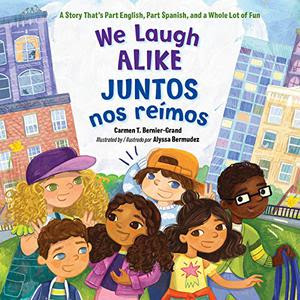
We laugh alike / juntos nos reímos: a story that’s part Spanish, part English, and a whole lot of fun

author: Carmen Bernier-Grand 
illustrator: Alyssa Bermudez 
Charlesbridge, 2021
pre-kindergarten-grade 3 


Six children are playing in a city park in an ethnically and linguistically mixed neighborhood that appears to be in Brooklyn or the Bronx. 


On the cover, the first thing young readers will see is a group of six young friends. Their varying skin tones, eye colors and hairstyles hint of their ethnicities, and they are laughing together. On the first few pages, the two groups of children haven’t yet met.


At the story’s beginning, the two groups are separate: three are hablantes and three are English-speakers, and neither understands the others’ language. The Spanish-speakers have a soccer ball and the English-speakers have a baseball. On beginning double-page spreads with the English-speakers (and text) on the left, and the hablantes (and Spanish text) on the right, both groups of children cautiously observe each other. As each listens to the words the others sing and watches the rhythms as they dance and jump rope—still not comprehending the words but noticing how alike the two groups play—they gesture to the others to join them. 


And they do. Soon, the text evolves as well: While at the beginning, each language is on a separate page that matches that of the particular speakers, as they begin to play together, both Spanish and English in the text come together as well. Towards the end, the children jump rope (“double Dutch”) and count from one to twelve in alternating Spanish and English. Afterwards, they’re thrilled:


¡Ja! ¡Ja! ¡Ja!

¡Contamos en inglés!

Ha! Ha! Ha!

We counted in Spanish!


¡Ja! ¡Ja! ¡Ja!

Juntos nos reímos. 

Ha! Ha! Ha!

We laugh alike.


One of the brilliant cultural markers here (and a clue to the care and empathy of the author, who may be writing from her own culture) is that the Spanish and English are not word-for-word translations of each other. Rather, Bernier-Grand presents the two languages as idiomatic: This is the way some kids think and talk in Spanish and this is the way some kids think and talk in English. So the title, for instance, “We laugh alike” becomes, in Spanish, “together we laugh.” If the translations from one language to the other here were literal, they would have “sounded” awkward.


In the beginning, English and Spanish text occupy separate pages, with each language “belonging” to the children who speak it. As the children begin to play together, Spanish and English texts also begin to come together. By the end, the children have become friends, their images fill the spreads, and the author flips the languages: the “English-speakers” wave good-bye with “¡Hasta mañana, amigos!” and the “Spanish-speakers,” with “See you tomorrow!”


It would be a mistake to assume that each “thought” that passes between the Spanish-speaking and English-speaking children is a translation of the other. While the two groups of friends come together and get to know each other, their initial narratives also voice their linguistic and cultural misunderstandings: 


As the English-speaking children watch the Spanish-speaking children jump rope, they think, “They know how to jump rope! But we don’t understand their rhyme.” And the hablantes think, “Nuestra rima los invita a saltar con nosotros, pero no nos hacen caso.” (“Our rhyme invites them to jump with us, but they ignore us.”) 


But as six kids start to interact, laughter and play become their “social” language—and they learn some of each other’s blended spoken language as well. 


Bermudez’s computer-generated art, using scanned textures and bold, bright colors, is perfect. On vivid green-grass or yellow backgrounds, the children’s joy is palpable. Chasing each other on the Merry-go-round, dizzily falling down laughing, making dandelion crowns, counting to twelve inside a spinning double-Dutch rope, laughing so hard they have to hold their bellies—it may be difficult for a moment for young readers to discern which kids are the Spanish-speakers and which ones are the English-speakers. Which is just the point. 


Unlike a lot of picture books, there is no conflict here that calls for resolution—and no adults are necessary to “teach” anyone anything. 


We Laugh Alike / Juntos nos reímos is a celebration of friendship across language and culture.


*Highly recommended for all home, classroom, and library collections.


—Beverly Slapin

(published 3/31/21)


[Note: Carmen Bernier-Grand is a talented bilingual poet and storyteller who understands and appreciates children. ¡Bienvenida, Carmen!]


Paletero Man

author: Lucky Díaz
illustrator: Micah Player
Harper, 2021
grades 2-up
(Mexican American) 


On the cover, a young Mexican American boy is daydreaming. With the L.A. skyline behind him, his thoughts are framed by a virtual rainbow of delicious paletas (fruit ices) of differing shapes and flavors. What a struggle it is to choose!


Paleteros are street sellers of paletas and helados, Mexican-style ice and ice cream pops in a variety of gelato and sorbet flavors. They’re sold from pushcarts called paleterías. Although the words don’t have English translations, paleteros and their paleterías are a beloved cultural icon in Mexican and other Latino communities across the U.S. and in many Latin American countries as well.


Paletero Man—the song and story—honors the paleteros, much like the song, Watermelon Man (written by Herbie Hancock and recorded by Oscar Brown, Jr.) honored the Black street vendors who sold fresh watermelon slices back in the day.


It’s the hottest day of the year in L.A. and, with his pocket full of change, a young child runs off to find the neighborhood paletero. Along the way, he greets friends, relatives, and other street vendors and shop keepers; among them, Tío Ernesto, who sells tamales; Ms. Lee, who sells Korean BBQ; and Frank, who repairs bikes. 


The youngster’s first-person narrative, in A-B-C-B rhyme and code-switching, is well done and a fun read. For instance, when he finally reaches Paletero José, the child says:


But today I’d like piña

Do you have that sabor?

He smiles a big smile—

“¡Claro! Para ti, ¡el mejor!”


But as he reaches into his pocket, the child finds that all the change he had saved up—is gone! Fortunately, Tío Ernesto, Frank, and Ms. Lee had seen the coins fall to the ground, picked them up, and returned them. And Paletero José, moved by their deed, gives everyone in the neighborhood a free paleta:


Whether it’s stormy

or whether it’s sunny,

whether or not 

you have any money,

I’ll always help out

an amigo in need.

Yo te prometo—

an amigo indeed!


Selling paletas is not a great money-making gig, so it would be a rare event for a low-income neighborhood paletero to give away his entire inventory. But it could happen—and especially, as an acknowledgment of generosity to neighbors who do the right thing. Paletero Man is a celebration of Mexican life and culture in the U.S.—and its as sweet as a paleta. 


In Paletero Man, Díaz recognizes a common experience grounded in goodness. While small deeds are rarely rewarded, youngest readers can share with each other the different ways that a community can come together in a time of need.


Players bright digital illustrations are vibrant and joyous, and complement the exuberance of a young child who—with his relatives, friends, and neighbors—live, work and play together in a multicultural, multiethnic, multigenerational community. Here, complexions, clothing and hairstyles vary, several men sport tattoos, and, in the  park, there’s a hijabi with her child.  


And worth noting is that, in this story, the Spanish words and phrases are not italicized. Rather, Spanish and English—like the people in the community—are mixed.


Paletero Man is Lucky Díaz’s and Micah Player’s homage to Mexican culture—both in Mexico and in the U.S. The story is as delightful as a juicy paleta de horchata or melón. 


Warning to young readers and their adults who find the song, “El Paletero” performed by Latin Grammy-winning Lucky Díaz and his Family Jam Band on The Friday Zone on PBS (scroll down at luckydiazmusic.com): Make sure you have nothing else to do but dance all day. The song and rhythm are that catching. 


*Highly recommended for all home, classroom and library collections.


—Beverly Slapin

(published 3/18/21)

[Note: Horchata and mélon are my favorite flavors.]


Not a Bean

author: Claudia Guadalupe Martínez illustrator: Laura González 
Charlesbridge, 2019
preschool-grade 3
(Mexican)

On the cover, a young child is astonished at having discovered a Not a Bean clicking and clacking on the desert floor. Above the child’s head, the book title appears to be in motion as well. 

González’s bright, naturalistic digital art, laid out on spacious double-page spreads, reveal the wide expanse of the northern desert mountains of Mexico—and its inhabitants—from early morning to night. It is here that seven young friends, with skin tones that reflect the varying ethnicities of the Mesoamerican peoples, explore the desert and find a bean that is Not a Bean


Young readers and listeners will learn that the Not a Bean is actually a small seed pod that combines into larger pods that grow on the yerba de la flecha, a desert shrub—and that each Not a Bean is the home and food source of a caterpillar who burrows into the seedpod.


The text consists of delightfully patterned code-switching in which Spanish words and phrases are accompanied by engaging illustrations that young Spanish-speakers will enjoy and young English-speakers will easily decode. (“At noon tres cascabeles slither from their nests among the rocks. Their tails rattle.”)


As a group of young girls and boys—“siete amigos”—explore “for treasures washed up by the rain,” they find a feather, an old boot, a piece of wood, and “nueve saltarines” (nine jumpers). They draw in the dirt “ocho óvalos” (eight ovals) which they surround to see how many saltarines will jump inside. They poke their saltarines with a stick, and cheer as the jumping beans roll into the ovals.


Days later, the amigos return and poke the Not a Bean with a stick, but it doesn’t jump because it’s busy spinning a cocoon. Finally, 


A majestic polilla burrows out. 

It is not a caterpillar anymore. 

It was never a bean. 

The moth spreads its wings

…and soars into the sky.


González’s limited palette of mostly greens, blues and browns virtually glows as it reflects the textures of the desert and the homes of its inhabitants. 


In addition to counting from one to ten and identifying animals in the Spanish-and-English glossary, the back matter contains an Author’s Note full of scientific and cultural material about Laspeyresia saltitans (female jumping bean moths) for students who want to learn more.


Not-a-Bean is an excellent read-aloud—and a joyous celebration of science, friendship, language-learning, and culture—all in a calm, beautifully illustrated “counting book” for the youngest readers and listeners (and everyone else). 


*Highly recommended for all home, classroom and library collections.  


—Beverly Slapin

(published 3/12/21)

Facing Fear: An Immigration Story

author: Karen Lynn Williams
Illustrator: Sara Palacios
publisher: Eerdmans Books for Young Readers (2021)
grades 2-4 (Mexican)

On the cover, Mamá and Papá embrace their daughter and son. The boy holds a soccer ball and smiles at the reader. In Tía’s Mexican kitchen, she sits at a table with Mamá and Papá. There is an altar to the Virgen de Guadalupe, a canary in a cage, and a bookshelf that divides the kitchen from the living room. It holds some books, Mexican art and a doll, a bread basket and some pots and pans. 


Palacio’s bright, naturalistic digital art, depicting a loving Mexican extended family, is beautiful and heartwarming. Her dead-on cultural details, which many artists might easily mess up, include the family’s Mexican haircuts and Papá’s goatee. 


However, Williams’ story is disingenuous, including its predictably happy ending.


Ten-year-old Enrique, born in the United States and therefore a US citizen, has a chance to play in his team’s big soccer tournament “across the checkpoint”—in Mexico—but it’s too risky for his undocumented family members, who could be deported. When his papá refuses to sign his son’s school’s permission form, Enrique is enraged—and forges his papá’s signature. 


Reality check 1: No kid in a family of mixed immigration status would consider crossing the US-Mexican border to play in a tournament. He would know how dangerous that would be, and he’d make an excuse to be “absent.” He might be on a soccer team, but he’d never think of crossing the border with his team. And it wouldn’t even occur to him to take a permission slip home for his parents to sign—much less forge a parent’s signature.


In a sudden sequence-switch, Enrique’s older sister, Rosa, grabs him, and together the family hurries to Tía’s house to spend the night because of “la migra.” There’s a rumor of a “roundup”: “Tomás was stopped for a broken taillight,” Papá says. “With no documents, look what happened.” Apparently, “what happened” is that Tomás was jailed and deported.


At Tía’s house, Papá tells Enrique the story of how the family got to the US. It was a dangerous journey with another family via coyote and van. During a raid, a crying baby “took la migra off (their) trail.” Everyone escaped and navigated north through the desert. After crossing the border, pregnant mom had her baby, so Enrique is a US citizen.


Reality check 2: “La migra” (ICE agents) work in the US, not Mexico. 


Reality check 3: By the age of ten, Enrique would not only know this story, but have it memorized because his safety depends on knowing that he’s a US citizen.


The following week, teammates attempt to convince Enrique to play in the tournament: “You’re a citizen—you don’t have to worry about the checkpoint…. It’s just your dad. He’s scared.” Enrique is angered because “in his heart he knew the real truth.” 


“My dad has courage!” he shouts at his teammates. “He and my mom walked across the desert with hardly any water, and men chasing them. They did it for me and Rosa. They protected us.” 


Reality check 4: Any family who crosses the border illegally—with or without the aid of a coyote —knows how dangerous it is. And children in mixed-status families do not argue with their parents or schoolmates about issues involving citizenship. They keep their heads down and their mouths shut.


All families everywhere who face danger from la migra or from the police have “the talk” when their children are young (e.g., how to walk, how to talk, how to interact at school), about the dangers in certain behaviors—way before the behaviors happen—to protect them. The family is at stake and the kids would know that. They learn to be careful so as not to endanger the family. 


[See The Talk: Conversations about Race, Love & Truth, edited by Wade Hudson and Cheryl Willis Hudson, Crown Books for Young Readers, 2020.]


This is not to say that immigrant kids don’t join school clubs for fear of being nabbed. They do join clubs. And they’re careful not to have conversations about their families.


The author has chosen not to look at this or any other mixed-status family or their structures. Apparently she has neither understanding of nor empathy for what these or other such families endure, how they fear for their children—and how they could be deported in a minute. Rather, the author has taken the main character out of his immigrant status by making him a “citizen”—which allegedly frees him from danger.


[For a real story about what it feels like to be an undocumented child, Alberto Ledesma’s Diary of a Reluctant Dreamer: Undocumented Vignettes from a Pre-American Life (Ohio State University / Mad Creek Books, 2017) is excellent.]


Williams probably attempted to write a story about how difficult it is to be an immigrant, but instead of doing appropriate research about immigrant families, she apparently chose to present her story as an empathetic pop. What is left is a story through the eyes of an immigrant Mexican child whose POV and behavior resemble those of a white child of privilege.


On Saturday, the day of the tournament, a despondent Enrique sits on his bed, wondering “what his father’s courage was worth if he couldn’t even go to a soccer tournament…. His friends were all at the big game. Maybe he didn’t even have any friends.”  


Wait, what? “What his father’s courage was worth if he couldn’t even go to a soccer tournament”? Here, the author (through the thoughts of a Mexican child whose family is undocumented) draws an equivalence between Enrique’s family’s surviving an incredibly harsh journey through the desert with the boy’s playing in a soccer tournament.


They hear a knock at the door. It’s the coach and Enrique’s soccer team. This multiethnic team has decided that if Enrique can’t go to the tournament, neither will they. 


“Papá looked at Enrique. ‘Tus amigos tienen valor, Enrique. You ask why we came here to this country. This is why we came to the U.S.’ ”


Enrique’s papá tells his son that Enrique’s American friends have courage because they’re willing to sacrifice the tournament for their friend. He adds, “You ask why we came here to this country. This is why we came to the U.S.,” he implies that the family has courage as well. 


Of course, Enrique’s parents were and are courageous—as are all immigrants who come here without papers and risk their lives in a strange place where they face deportation and worse so that their families can survive. 


Perhaps Enrique will eventually understand what his papá is trying to tell him. Maybe he won’t. Everything else about him signals that his behavior more resembles a self-centered American kid than a Mexican immigrant kid who understands the importance of what his parents have taught him. 


So what might be the author’s intended audience for Facing Fear: An Immigration Story? Not Mexican kids and their families. Or young children in mixed-status families. Or so-called “illegals.” Rather, her intended audience appears to consist of white kids and their parents and their teachers who seek some kind of “connection” with “the other”—as long as “the other” is just like them. 


And that “the other is just like them” has been accomplished. Here is a Mexican immigrant kid with no sense of survival; a Mexican immigrant kid who presents as a spoiled, self-centered white middle-class brat; a Mexican immigrant kid who is rewarded for his bad behavior while his Mexican immigrant father beams with pride. 


[According to her author’s note, Williams’s sources include “an FBI agent who worked along the border,” “a reporter who covered stories on both sides of the Mexico-U.S. border,” “border patrol agents,” and “a school social worker who worked both in Mexico and the U.S.” What’s missing are immigrant people.]


Finally, the title. It’s confusing about who is “facing fear,” what the fear is, and how it’s being faced.


Facing Fear is an immigration story about a mixed-status Mexican family, conceived and written through a white-privilege lens. Sara Palacios’ gorgeous art and the eye-catching book design are not enough to save it. Not recommended.


—Beverly Slapin

(published 5/5/21; revised 5/8/21)


Míl gracias a mi amiga y colega, Judy Zalazar Drummond.


Niños: Poems for the Lost Children of Chile

author: María José Farrada 
illustrator: Maria Elena Valde 
translator: Lawrence Schimel 
Eerdmans Books for Young Readers 
2021 
grades 3-up 
(Chilean)


On September 11, 1973, a U.S.-led coup d’etat assassinated Chilean President Salvador Allende and overthrew his populist government; and installed in its place the fascist regime of General Augusto Pinochet. For the next 17 years—until democracy was restored—Pinochet ruled with an “iron fist”: imprisoning, torturing, murdering and “disappearing” thousands of Chilean citizens. Among these 3,197 desaparecidos, 34 were children. 


In Niños: Poems for the Lost Children of Chile, Chilena author María José Ferrada and illustrator María Valdez remember and honor those disappeared children whose names and ages are listed on a final page. Each poem and illustration, titled with a child’s first name, is a gift to the children and their parents—and to the people of Chile, who still mourn and remember.


That none of these short, beautifully illustrated poems mentions Pinochet or the despicable things that he did is a metaphorical payback to him and to dictators in general. All children’s lives should be full of love and beauty, and, in a sense, Ferrada’s tender poems and Valdez’s soft illustrations name and remember these children as their lives should have and would have been. In imagining these children’s lives without violence, they’ve returned to these niños desaparecidos the lives and childhoods that the fascists stole from them. 


Here, young readers meet, among others:


Alicia, who releases her birthday balloons to give a gift to the wind

Jaime, who learns to sing from a bird nesting nearby

Soledad, who writes a symphony from the sound of raindrops on the roof

Paola, whose heart buzzes when she sees an insect for the first time

Eduardo, who watches the flight of the first leaf of autumn 

Jessica, who leaves a gift for the ants disappearing over the edge of a table

Felipe, who turns a light bulb on and off like a miniature sun

Jose, who invents his own dictionary

Orlando, who draws insects to march in single file

Sergio, who plants words in a flowerpot so he can watch them bloom


Valdez’s double-page spreads of soft-edged artwork—accomplished in watercolors, charcoal, graphite, and pastels, on a muted palette of grays, greens, blues, and browns with touches of yellows—are serene and beautiful. They complement the gentleness of the poems and the imagination of the children.


In her dedication, Ferrada, who works as the children’s editor of Memoria Chilena (Chilean Memory), a digital resource center of the National Library of Chile, writes:


This book is an homage to those thirty-four Chilean children, who in these pages play, dream, and listen to the voices of their mothers. Because this is what we think children should do. But this book is also a reminder, an alarm. For we tell this story knowing that at this moment, many children feel afraid, suffer tragedies, and even lose their lives because of political violence. To those children, and to the memory that helps us defeat monsters, we dedicate this book. 


Towards the end is a list of the full names and ages of the 33 children, victims of Pinochet’s fascist regime. Some were only a few months old. The final poem, opposite a blue sky with animals leaping in the clouds, is for a child named Pablo:


When I grow up I’ll be a tree, a cloud,

a wave,

a snail.

And all those shapes

that can be seen in the clouds I’ve learned to stare at.

A tree, a cloud, a wave, a snail.

When I learn to speak,

these words will be the first things I’ll say.


Below this poem, there is another name: “Pablo” is Pablo Athanasiu, who had been disappeared as an infant and was found, alive, as an adult:

Niños is also dedicated to Pablo Athanasiu, who had been part of this list until August 7, 2013, when the Abuelas of the Plaza de Mayo found him alive. We dedicate this book to him and hope the stars always shine for him.


*Highly recommended for all home, library and classroom collections.


—Beverly Slapin

(published 2/25/21)


Notes: 


In its previous edition, Niños received recognition from the Academia Chilena de la Lengua (Chilean Academy of the Language) for the best literary work published in Chile, the Premio Municipal de Literatura de Santiago (Municipal Prize of Literature of Santiago) in the category of youth literature, and was chosen to represent Chile in the catalog, La Organización Internacional para el Libro Juvenil (International Organization for Children’s and Young People’s Books; in English, from IBBY, or International Board of Books for Young People). 


For older students (high school-up) and their teachers, I highly recommend the documentary film, The Judge and the General, which chronicles the investigation by Chilean Judge Juan Guzmán, a former backer of the Pinochet regime, of the mysterious disappearances of countless political opponents—and his own personal and political transformation—BHS