Showing posts with label Yanitzia Canetti. Show all posts

Pablo encuentra un tesoro // Pablo Finds a Treasure

author: Andreé Poulin

translator (Spanish): Yanitzia Canetti 

illustrator: Isabelle Malenfant

Annick Press, 2016 (English), 2018 (Spanish) Grades 1-5 

Latin American


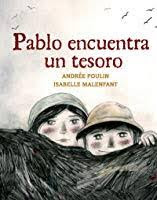
On the cover are two children with dirty faces, behind what will soon be revealed as a mountain of trash. Slightly smiling, they invite young readers into their lives. The two represent the thousands of children who work as garbage pickers in parts of Latin America, and hundreds of thousands in parts of Asia and Africa.


These young garbage pickers comb the smelly mountains of trash, looking for anything that can be sold as recyclables—or even barely edible food—to bring home to their families. Going to school is a fantasy, as may be owning a book or a pair of boots. It’s filthy and dangerous, mind-numbing work: deadly accidents and robberies are everyday occurrences, and parents pray that their children will return home safe at the end of the day.


Pablo encuentra un tesoro and Pablo Finds a Treasure tell the story of a resilient young brother and sister who experience the impoverishment of thousands of anonymous children who live in unnamed slums and daily scour the dumps of Mexico (“pepenadores” is Mexican Spanish for “trash-pickers”) or one of the countries known as the Northern Triangle of Central America—El Salvador, Guatemala, and Honduras. 


While Pablo works, he dreams of a better life, but his older sister, Sofía, is more realistic. When he finds un tesoro—a treasure of a torn-up book—and tells Sofía that he wants to learn to read, she’s not impressed: ¿Para qué? she asks. ¡La lectura no llenará tu estómago! (“Reading won’t fill your stomach!”) Later, Sofía finds “el segundo tesoro del día”: two carrots—soft but not yet rotten—which they eat quickly and silently: “En la montaña, es mejor comerse enseguida cualquier comida que uno encuentre, o alguien se la robará.” (“On the mountain, it’s best to gobble up any food that you find, or someone will steal it.”)


Pablo finds the third tesoro, a broken gold chain: “En su mano sucia, el metal precioso brilla como un rayo de sol”—whose precious metal, “in his dirty hand, shines like a ray of sun”—that has Sofía and Pablo fantasizing about what it will buy.


Pablo dreams of a book, a soccer ball, a new pot for their mamá, and an ice cream; and Sofía dreams of a chicken for dinner every day of the week, a bag of caramels, a new dress for their mamá, and gloves to protect their hands while digging in the trash.


But when “Cara-Sucia”—“Dirty Face,” one of the violent and menacing robbers who roam the dump, accosts the two children, he takes everything that they’ve worked for all day, and they return home, empty-handed.


Except not. After a scolding from his frustrated sister, Pablo opens his mouth—and reveals the hidden treasure. In the final illustration, the two children, relaxed and happy, are leaning against their casita. Pablo is looking at his tattered book, Sofía is savoring a caramel, and their dog is licking at a large bone. A well-deserved respite from a hard day.


Malefont’s smudged, dark gray charcoal illustrations, heavy with symbolism, effectively portray both the children’s harsh reality and their sometimes-hopeful expressions; while light splashes of pale color call attention to their successful treasure-hunting moments. Young readers will notice, for instance, Sofía’s waving a blue boot in the air, while the children’s brown dog runs to show them a newly killed rat. Their floating fantasies are in color as well: a red book, brown chicken in a pot, green gloves, cherry ice cream, and wrapped caramels.


Young children know about poverty, and Pablo encuentra un tesoro and Pablo Finds a Treasure provide an excellent opportunity for educators to introduce a conversation about poverty and power and the connection to their own lives; and about child labor and children’s rights. At higher grade levels, Pablo encuentra un tesoro and Pablo Finds a Treasure are invaluable in extended conversations about the roots of power and how it can build or destroy entire communities and even governments; and about community, national, and world movements to redirect power for the benefit of everyone. Pablo encuentra un tesoro and Pablo Finds a Treasure are treasures. 


*Highly recommended for all home, classroom, and library collections.


—Beverly Slapin

(12/31/19)


Zombies Don’t Eat Veggies! // ¡Los zombis no comen verduras!


author: Megan Lacera
illustrator: Jorge Lacera 
translator (Spanish): Yanitzia Canetti 
Lee & Low, 2019
kindergarten-grade 3 
Zombie

In the latest series of Kraft Foods TV commercials, non-Zombie parents who insist that their children eat nutritious foods chase them around the room or verbally battle with them—until discovering that offering them macaroni and cheese solves everyone’s problem. 

Ineffectual parenting
notwithstanding, the point is that just about all families want their children to be healthy. Although their definitions of “healthy” might be different from those of the rest of ours, Zombie families want the best for their kids, too. 

In Zombies Don’t Eat Veggies! and its Spanish version, ¡Los zombis no comen verduras!, young Zombie Mauricio (“Mo”) Romero cannot and will not abide his parents’ cultural food preferences. Among them are—yum!—arroz con spleens, chili con ojo, dori-toes, and arm-panadas. No, Mo is different. He has a secret, “deep, dark, dreadful, devious” craving for something “absolutely despicable”—horrors!—vegetables. Vegetables of all kinds! 

Mo earnestly attempts to convince his parents to integrate vegetables into their Zombie culinary world. First, he presents them with the stomach-churning (to them) book, Eating Vegetables by "Jonathan Saffron Gore," a Zombie tongue-in-cheek reference to Eating Animals, in which author Jonathan Safran Foer challenges readers to examine their eating habits.

When that argument fails, what Mo secretly concocts for his parents—with ingredients from his hidden veggie garden and prepared in his secret kitchen—is too good to divulge. (OK, it’s a delicious vegetarian gazpacho disguised as a delicious bloody mess, which he calls “blood bile bisque.”) Although Mo’s ploy is a bust—his Zombie parents hate the gazpacho—they know they must support their young Zombie son because they are a Zombie family and they love him beyond death.

Megan Lacera fills her tale with hilariously exaggerated puns (Mo’s mom offers him a bowl of delicious “finger foods,” and Mo begs his parents to “give peas a chance”), which Jorge Lacera complements with over-the-top cartoon images on a Zombie-centric palette of mostly darkened browns and greens. Here, for instance, young readers will see Mo and Mom proudly gazing at Dad, who displays his first-place trophy in the much-(Zombie)-coveted “competitive brain-eating contest.”

Lacera’s digitally rendered illustrations, in which the individuals in this Zombie family have varying complexions—Dad is brown, Mom is dark green, and Mo is light green—authentically reflect the multiethnic reality of the Zombie community. Plus, they’re very, very funny.

While the English version contains appropriate conversational code-switching, super-talented translator Yanitzia Canetti’s Spanish version not only reflects the cultural nuances of the spoken language, but effortlessly blends in spot-on Zombiana, which she has apparently studied. While Mom hopefully presents Mo with a bowl full of (literal) “finger foods,” the Spanish might be “comida de dedos.” But Canetti refers to it as “deditos en salsa” (literally, “little fingers in sauce”). She also adds or subtracts words or word parts to Zombify the Spanish, creating delightful names for the foods to reflect an unmistakable Zombie-centric flavor. For instance, she uses a hyphen to morph “patatas” (potatoes) into “pata-tas,” with “pata,” of course, meaning “foot.” As well, she employs Espanglish phrases in a way that will have young hablantes giggling. For instance, when Mo’s parents hesitantly agree to try his vegetarian dishes, an illustration shows them grimacing and taking (in English) “only a teeny tiny bit,” while in Espanglish, it’s “una probadita rechiquitita” (“a tiny retch-inducing taste”).

Hablantes and English-speakers—Zombies and non-Zombies alike—will love this well-done and totally silly story of the meaning of family, yearning to belong and daring to be different. And non-Zombie kids will see connections to their own lives as well. 

*Highly recommended for home, classroom and library collections. 

—Beverly Slapin
(published 7/18/19)


Muchísimas gracias a mis amigas Zombistas, Judy Zalazar Drummond y Lyn Miller-Lachmann.