Showing posts with label Elizabeth Gómez. Show all posts

ABC El Salvador

author: Holly Ayala

illustrator: Elizabeth Gómez

Luna's Press Books, 2021

preschool-up

El Salvador, Salvadoreños


On the front cover, raised lettering in glossy relief—large ABCs on which two Indigenous children climb—invites young readers to touch the painted block letters similar to the wood block letters that El Salvador is known for. And as they “visit” the country and towns in El Salvador, the carefully crafted ABC format shows them aspects of rural life and some history as well. 


Within the country of El Salvador, the author highlights the city of San Salvador and the town of Santo Domingo de Guzman (Witzapan). Here, youngsters from el Norte will get to meet Xiomara and her familia—and learn about some history and culture of El Salvador. 


In the voice of Xiomara, a young Indigenous Salvadoreña, this beyond beautiful abcdario is about and especially for the children of El Salvador, who will see themselves reflected here. The child’s mixed family has darker and lighter complexions. 


The author highlights the city of San Salvador and the town of Santo Domingo. When she is in the city, Xiomara wears an orange shirt with a green skirt. When she is in the town, she wears a blue shirt with a red skirt. And a few times, she is in athletic clothes. Kevin wears his soccer outfit with ES and A for Alianza (his favorite soccer team). 


Forefronting the Indigenous-influenced Salvadoran Spanish with the English translation below, Xiomara introduces young readers to her relatives, her friends and her neighborhood. The Spanish and English, as well as the illustrations, are personal and cultural, and community specific.


[In a personal communication, the author told me that she based the words and illustrations on her own experiences. For instance, “atol” is her favorite beverage; and for “quesadilla,” she remembers that, “when I was little, my father’s friend, Doña Aida, would always make me quesadilla. I still have her recipe!”]


Rather than beginning with “who I am” (which is more like an American English way of beginning this genre), the young narrator here uses the A for “atol” to describe what she likes: “Me gusta el atol de elote bien calientito” (I like my sweet corn beverage nice and warm). In this first illustration, as she holds the bowl of atol to show young readers, Xiomara is dressed in sandals, a red skirt and blue patterned blusa, her hair neatly tied with blue cloth. Behind her is a meadow with some corn growing, and flowers, birds and butterflies circling. 


The other letters of the alphabet name and show who and what Xiomara finds meaningful: “barro” (clay, out of which her grandma makes pans and pots); “cipotes” (the neighborhood kids who join her at play), “chucho” (her dog, whose name is “Chocolate”), “dulces” (her favorite candies), El Salvador, “farolitos” (her favorite lanterns), “garrobo” (a gigantic lizard who visits her backyard); “huacales” (the large and small bowls in her house). Readers also meet her relatives and the things she enjoys eating, the delightful rain, the music in the town plaza, the Nahuat language, and all the people, places and things that encompass her life. 


For “O,” there’s a painting on Abuelita’s wall of the beloved Archbishop Óscar Arnulfo Romero in the park, surrounded by children. Young readers will not learn here that he was an advocate for the poor who was assassinated while celebrating mass—and later, beatified—for his passionate voice against injustice. That’s a story for another time; but it’s an important part of young Xiomara’s and her family’s lives and El Salvador’s history.


Gomez’s art, done with gouche, has a rustic look, accomplished by sanding the colors down and uncovering a previous acrylic layer. What results is a bright “painting” of a small town in El Salvador and an invitation to celebrate Xiomara’s and her Indigenous family’s life, culture and neighborhood. ABC El Salvador is an extraordinary little book. 


*Highly recommended for all home, classroom and library collections.


—Beverly Slapin

(published 8/11/2021)


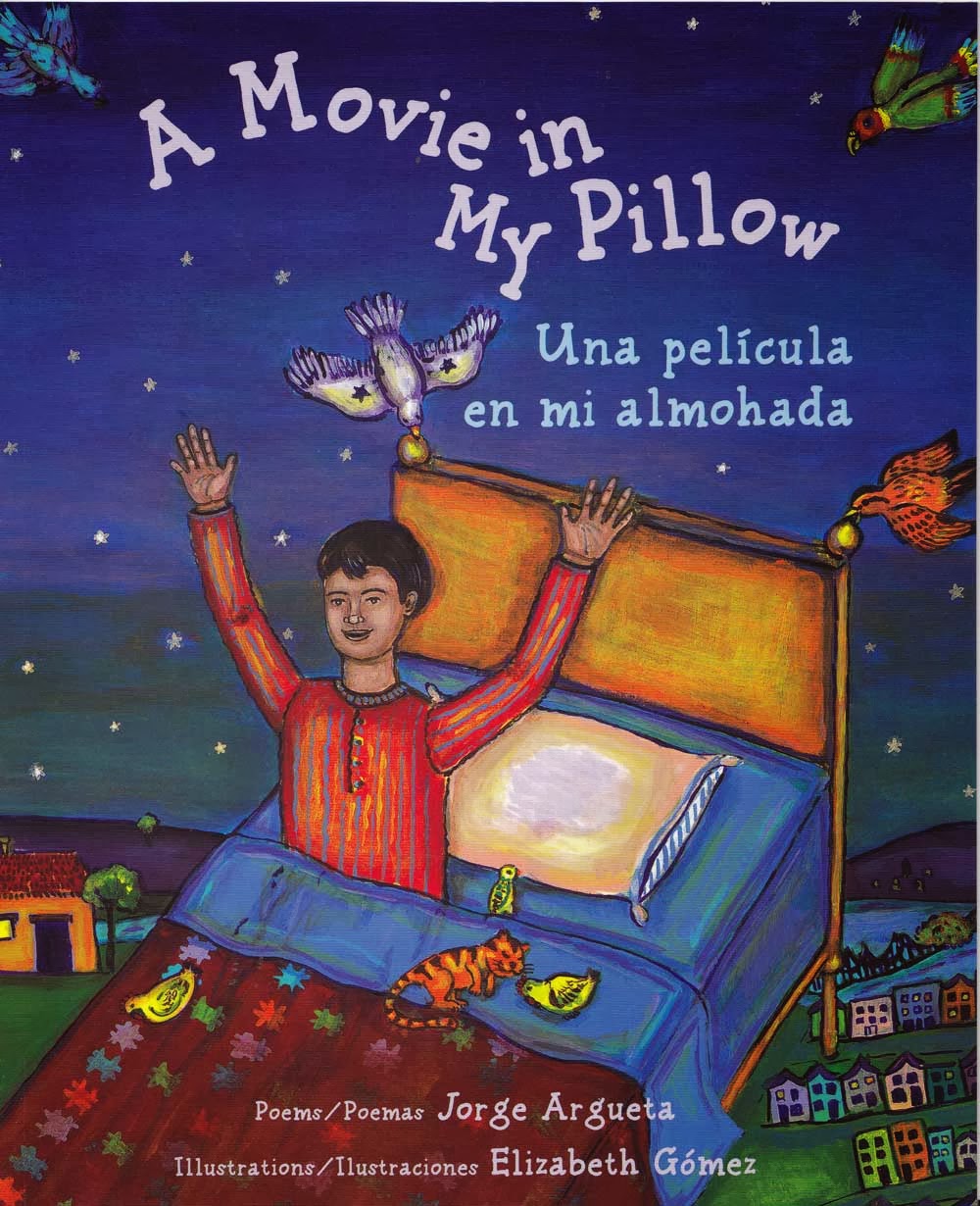
Movie in My Pillow / Una película en mi almohada


author: Jorge Tetl Argueta
translator: Jorge Tetl Argueta
illustrator: Elizabeth Gómez
Children’s Book Press / Lee & Low, 2001
grades 2-up
Pipíl, Salvadoran, Salvadoran American

During the bloody Salvadoran Civil War (1979-1992) between the military government representing the 12-family oligarchy of wealthy landowners, and leftist forces representing mostly impoverished peasants, US-supported government death squads terrorized, tortured, murdered and disappeared thousands of civilians, especially targeting students, intellectuals, and Indian people in the rural areas. By the time the UN-brokered peace agreement was signed, it’s estimated that more than 75,000 people had been killed and more than half a million refugees had fled to the US.

In this lovely bilingual collection of autobiographical poems, young Jorge tells the story of how he and his father, fleeing from the war, arrive in San Francisco. Eventually, the rest of the family will join them, but for now, father and son, leaving in the middle of the night—and without saying goodbye to anyone—must travel alone.

In an introductory note, Argueta writes about the beauty of his home country and the war that forced his family to leave. “These poems are my memories, my dreams,” he writes, “the movies in my pillow.” This brief history of his “transplantation” reminds me of the stories my grandmother told me about having to leave Mexico with her brother packed into a trunk so he would not be taken to become a soldier. Although my grandmother always longed for the homeland of her childhood, still she embraced this country for the safety it provided. Like my grandmother was, young Jorge is also resilient. While holding tight to the memories of his homeland, he is able to put down roots in San Francisco with its “sopa de lenguas en el viento / soup of languages in the wind.”

When his uncle sends him an audiotape of his grandma, talking and singing to him in Nahuatl and Spanish, we know that Jorge, wherever he is, will always remain connected to his culture and community:

Jorge, Jorge, maybe
you will never come back.
Remember when you sat
next to me on the river bank?
Jorge, Jorge, don’t forget
that in Nahuatl “tetl”
means “stone” and “niyollotl”
means “my heart.”

 Argueta’s writing—both in Spanish and English—are pure poetry, with brilliant metaphors that will resonate with young children. On one page, for instance, he is a yo-yo, and his poem is a long unpunctuated sentence: 

I have a yo-yo that makes me crazy but I can’t stop playing yo-yo in the mornings yo-yo in the middle of the day yo-yo in the afternoon yo-yo at night yo-yo yo-yo yo-yo I dream yo-yo I walk yo-yo I eat yo-yo I am a yo-yo.

Gómez’s brightly colored acrylics beautifully illustrate Argueta’s beautiful poems. She has a lot to work with: Here is Jorge, avoiding cobras on the sidewalk; riding a dragon dancing the cumbia; with his family flying like parakeets between San Francisco and El Salvador; and turning into a yo-yo. One of my favorites is the image of Jorge’s family members, embracing each other in a huge nest—“abrazando nos sentimos como un gran nido con todos los pájaros adentro.”

The Spanish is wonderful, depicting Jorge’s struggle and emotions of his abrupt immigration to San Francisco; the translation was most likely accomplished from Spanish to English. I especially like the way the Spanish and English versions alternate on each spread, with both languages presented as equal in importance.

In A Movie in My Pillow / Una película en mi almohada, Argueta gives young readers insight into the one of the most difficult experiences a child can have—being uprooted from your homeland and transplanted far away to a very different place. For young Jorge, landing in “la misión” provides him with a world of adventures and enough cultural connections to El Salvador to make his transition a little less traumatic than if he had landed somewhere else. This book is a welcome addition to a collection of stories about the immigrant experience and is highly recommended.

—María Cárdenas
(published 1/24/14)

Upside Down Boy/ El niño de cabeza


author: Juan Felipe Herrera
translator: Juan Felipe Herrera
illustrator: Elizabeth Gómez
Children’s Book Press / Lee & Low, 2000
kindergarten-up
Mexican, Mexican American

Appointed California’s poet laureate in 2012, Juan Felipe Herrera grew up as the child of migrant farm workers. His bilingual picture books exemplify the type of literature that the teachers in my district are calling for. Written in fluent, vibrant Spanish, drawing upon the lived experiences of Latina/o children and families in the United States, they are full of engaging, lively stories with illustrations that fascinate students. And themes of social justice are always at the heart of his stories.

The Upside Down Boy / El niño de cabeza is a story drawn from Herrera’s own life as a child struggling to learn English and to adapt to a new community. Juanito, the child of migrant farm workers, attends school for the first time, where he is thrust into an unfamiliar environment and lost in a new language. He feels like un niño de cabeza—an upside down boy, who worries as his tongue turns into a rock. Young readers will see Juanito’s shyness, with the help of caring adults in his life—eventually turn to confidence. While his tongue remains a rock for a while, his art expresses who he is:

We are finger-painting.
I make wild suns with my open hands.
Crazy tomato cars and cucumber sombreros—
I write my name with seven chiles.

This is an excellent story to use with English language learners because it eloquently describes the feelings that Juanito experiences as he struggles with English. It also serves to remind English-speaking students (and their teachers) of the challenges that some of their classmates face.

However, the English version of the book can be confusing, especially because it is narrated by a child who does not initially speak English and yet contains a lot of dialogue in English. And as Juanito becomes more proficient in English, the question of what language he is speaking and writing becomes even more confusing. For example, on the last page he is directing the class choir. The Spanish reads: “¿Listos para cantar sus poemas?” le pregunto a mi coro. Uno… dos… !and three!” And the English reads: “Ready to sing out your poems? I ask my choir. Uno, dos… ¡and three!” Here, it’s unclear what language Juanito is speaking to his classmates.

Gómez’s brightly colored acrylic illustrations attempt to capture the colorful, surrealistic tone of the story. Readers will see Juanito’s name spelled out in chiles, for instance, and cattle (“reses”) flying in the sky as he watches the other children play during a time called “recess.” However, the characters are mostly expressionless and, with their thin and awkwardly angled limbs, almost look like stick figures.

Yet, despite the somewhat unappealing artwork, I find it impossible not to fall in love with the story’s rich, metaphorical language and the fact that it is an authentic story from the author’s own life. Recommended.

—Grace Cornell Gonzales
(published 10/5/13)