Showing posts with label Mexican. Show all posts

Mis Dos Pueblos Fronterizos // My Two Border Towns


David Bowles
Mis Dos Pueblos Fronterizos // My Two Border Towns 
illustrated by Erika Meza 
Kokila Books, 2021 
Mexican (preschool-grade 4)


Every other Saturday, a young child’s father wakes him up early. It’s time to go shopping, and then to el Otro Lado—the Other Side, across the U.S.-Mexican border. As they cross, the father reminds his son of the time when the Indigenous people—Coahuiltecans—once lived here, before both riverbanks were Mexico.


For the boy, their shopping trip is a large part of his education. On the way, the child’s dad quietly instills in his young son important values, such as respect for elders. As he holds out a dollar and calls to an elderly newspaper seller, “Aqui tiene, Don Memo. Thanks!”—his dad refers to him as “Don,” an honorific. Although the child appears to be unaware that he is learning something important, he is, in fact, learning. Later, he notices that his dad has tipped another elderly man, Don Chava, for washing his truck.


After breakfast at their favorite restaurán, father and son go shopping. They’ve done this often, and the child recites what’s on the list for their friends: medicine, T-shirts, chanclas, bottled water. And “cold, sweet Gansitos and lots of chewy Glorias, too.” And one last stop, for comics, notebooks, pencils, and game cartridges. “I add the things we bought today,” he tells young readers. “I hope all the kids will enjoy them.” 


His dad calls the child’s friends “refugees” …. “stuck between two countries. The U.S. says there’s no room, and Mexico says it can hardly look after their own gente.”


A line of people from the Caribbean and Central America camp along the edge of the bridge, waiting for their numbers to come up; and a border patrol cop, hanging on to his guard dog, suspiciously eyes father and son.


Dad pulls over, and the boy’s young friend, Élder—who lives on the bridge with his mom and siblings—runs to greet him. While he distributes the comics, games, snacks, bottled water and medicine that he and his dad had bought for them, a group of white tourists passes. They look straight ahead, as if the people sitting at the curb with their children and everything they own—hanging laundry, a blanket, a mattress—are invisible. Several women tightly clutch their purses.


The boy may not notice the white tourists who look away, pretending not to see the poverty right in front of them. But the boy’s father tells him and models for him this family’s duty to care for their gente. “I add the things we bought today,” he tells young readers. “I hope all the kids will enjoy them.” (They will. Among the games, snacks and bottles of water are great children’s books: They Call Me Güero and Gustavo, el Fantasmita Tímido.)


Neither Bowles’ Spanish version nor his English is a translation of the other. Rather, he tells the story in Spanish and in English, with each complementing the other. A piece in English reads, for instance, “This town’s a twin of the one where I live…,” and in Spanish reads, “El pueblo es como el nuestro en un espejo…” (“The town is like ours in a mirror…”)


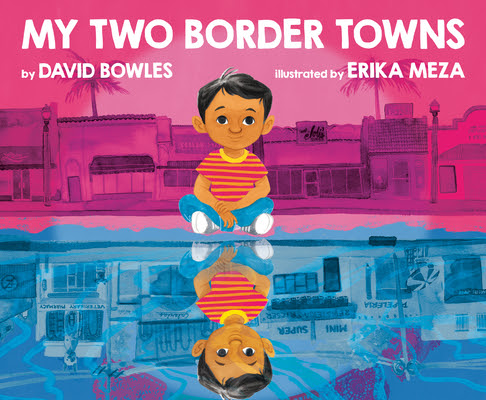
Meza’s artwork—using gouache, soft watercolors, pencil illustrations and “digital gimmicks”—is rich in detail. The broad river does, indeed, resemble “a watery serpent that glints with the dawn.”


Young readers look intently at the cultural images and define them: In dad and son’s favorite restaurán, a string of delicate papel picado hangs overhead and an altar to the Virgen de Guadalupe and el Niño Dios contains a fresh flower in a glass of water as an offering. As an elder woman flips tortillas with her hands, a waiter carefully balances a large basket full of them and a bowl of salsa, and the boy uses a rolled-up tortilla to scoop up his food.


Other illustrations almost force young readers to notice things they otherwise might not. A white woman, for example, looks straight ahead and tightly clutches her purse in fear of the line of Mexican and Central American asylum seekers at the border.


The young boy’s empathy is real. This Mexican kid knows who he is and what he comes from because he absorbs his parents’ compassion—and because they teach him by word and example his responsibilities for his gente. This kind and generous child—of kind and generous parents—is learning that he is part of his gente and his gente are part of him. My Two Border Towns and Mis Dos Pueblos Fronterizos tell an important story. 


Compassionately written and beautifully illustrated, both Spanish and English versions are highly recommended for all home, classroom and library collections.


—Beverly Slapin

(published 9/12/2021)


*Highly recommended for all home, classroom and library collections.


Papa Gave Me a Stick

author: Janice Levy

illustrator: Simone Shin

Star Bright Books, 2015

preschool-grade 3

Mexican


On the cover, a young Mexican child sits on the ground in his barrio. With his dog serving as a cushion, the child uses a stick to carve out his dream: owning a mariachi guitarra with a leather strap and fringes.


When they hear music in their courtyard, Antonio and his father run out to enjoy a performance by the local mariachi.


Papá y niño see and hear a traditional Mexican mariachi—one plays una vihuela Mexicana (a Mexican violin), another plays una trompeta (a mariachi horn), and several play their guitarras. The child is mesmerized, and tells his father that he wants a mariachi guitar. But his dad can’t afford one (“Ay, hijo, I have no money for such things”), so he gives his young son a stick instead. 


Papa Gave Me a Stick transforms a Japanese Buddhist folk tale, “the straw millionaire”—in which a poor man, starting with a single piece of straw, becomes wealthy through a series of successive trades—into a morality tale: a “give and ye shall receive” for young children.


Antonio selflessly helps a number of animals, who show their gratitude in various ways: He uses the stick his father had given him to start a fire in the comal, which warms a shivering dog, who gives him a tortilla, which he feeds to a hungry bird, who gives him a piece of string, which he uses to help a donkey with a rotten tooth, who gives the boy his blanket, which he uses to save a drowning cat, who gives him a gold ring from his collar, which Antonio gives to a young mariachi who had lost his bride’s wedding ring. And the grateful mariachi gives the boy a beautiful—guitarra! 


Simone Shin used a combination of pen and ink with acrylic paints and digital finishing, to create her spare, uncluttered illustrations. Her style, especially in the backgrounds, evokes soft colors and subtle textures. The Mexican characters are individuals, with varying skin tones and body types. The detailed mariachi instruments are right on target, and the backgrounds, many of which are white or a single muted color, leaves plenty of room for Antonio, his father, and his animal friends.


When the boy brings home his cherished prize and tells his father how he earned it, his father laughs: “All that to earn your guitarra” (which diminishes all that this child has done and the value of what he has earned). Then he divulges that, as a boy, he also earned a guitarra after his papa had given him a stick. 


If the boy’s father earned his guitarra in the same way as his son, what happened to it? (In mariachi families, the instruments are passed down. And there’s a lot of serious study with teachers and relatives and a ton of practicenot to mention fundraising and community service—before someone is recognized as a mariachi.)


Pros

Papa Gave Me a Stick is a warm story that demonstrates kindness to animals without asking anything in return. The story is soft and gentle, with a rhythmic cadence, uncluttered artwork, and an unspoken message of reciprocity. The story demonstrates a close relationship between a Mexican father and his young son.


The adobe buildings with gates at the windows, a cobblestone street, and a hanging string of papel picado in the courtyard, are reflective of small Mexican towns in which street mariachi often play.


Cons

Papa Gave Me a Stick contains multiple errors in colloquial Mexican Spanish. For instance, a mariachi band should be referred to as a “mariachi.” A mariachi singer should also be referred to as a “mariachi.” And “mariachi” should be used as both a singular and plural noun (no “s” at the end). 


In the illustration where two mariachi are playing their instruments, the “violin” should be violín, and the “horn” should be trompeta (trumpet). (The names of the five major mariachi instruments are shown in the back matter, but not as part of the story. This takes away important cultural information.)


• As Antonio accepts each gift from a particular animal, he dismisses its value: “What good is this?” What’s the point of his reacting rudely in a story that focuses on empathy and generosity?


• While everyone else is enjoying the mariachi performance, the story reads: “The mariachis [sic] sing as they strum their strings. But Antonio hardly listens. He is too busy staring at the mariachi’s guitar.” Why is Antonio portrayed as an empathetic kid who helps animals in need—and as an obsessively materialistic little boy who doesn’t even appreciate his own people’s music? Although he longs to own a mariachi guitar, he has no particular interest in becoming a mariachi. In a sense, this story objectifies both the mariachi culture and its material aspects.


• Another problem is that the Spanish words and phrases appearing in the story are italicized. Why are they italicized? And they’re immediately translated into English, even in dialogue. Like this: “ ‘¡Qué bueno! Good for you!’ Papa laughs.” Bilingual people do not talk like this—unless they’re kindergarten teachers of English as a Second Language (ESL).


• And finally, except for the bride, who “stands alone at the altar, (stereotypically) scowling and tapping her foot” because her novio misplaced the wedding ring, why is just about everyone else (including the animals) male?


The author’s intended audience is clearly not Mexican or Chicano kids. Rather, she apparently envisioned and wrote this story to appeal to a “universal” child audience, which dismisses those young people who want and need books that speak to them.


Papa Gave Me a Stick is not recommended.


—Beverly Slapin

(published 7/31/2021)


[Random note: The second creature young Antonio helps appears to be a male bluebird (el pájaro). “ ‘¡Qué hambre! I am so hungry!’ chirps el pájaro. ‘I am too weak to build my nest.’ ” (Actually, male and female bluebirds gather material and build the nest, but the male generally does more gathering and the female generally does most of the work.) Bluebirds eat insects, and will eat fruit if they can’t find any insects. But tortillas? No.]


21 Cousins // 21 Primos


author: Diane de Anda

illustrator: Isabel Muñoz

Star Bright Books, 2021

Mexican, Mestizo

grades: preschool-up


Against a brightly colored background of blue sky, growing greens, and festive papel picado, the 21 cousins—with 21 hair textures, styles and colors; and 21 complexion tones ranging from chocolate to café con leche—sit, stand, wave, laugh, and make funny faces for the cover shoot. 


On the frontispiece, the young narrators—grade-schoolers Alejandro and Sofia—stand on a stairwell, talking with each other. They’re about to introduce readers to each of their 21 cousins. Young readers will see that this book is, in effect, a “photo” album, with one page for each member of this diverse, loving family. 


The first spread, which contains black-and-white wedding photos—of Abuelo Pedro and Abuela María in 1953; Abuelo Juan and Abuela Marta; and tías Rosa María and Juanita as teenagers—are together a testament to the family’s mestizaje. As with all mixed families, relatives “look different in many ways.”


Alejandro and Sofía invite young readers to meet their “primos and primas.” Some of them: Cousin Enrique (“Kiki”) is a football player who has “long, strong legs.” Cousin Elena, whose nickname is “Guera” (“Whitey”) because she is light-complected, wants to teach in English and Spanish. Twins Tony (who plays soccer) and Tonia (who plays basketball) are tall. Young Teresa, who’s called “Morena” because she has “milk-chocolate skin,” likes to jump rope. Baby Miguel has no hair yet, so his nickname is “Pelón (“Baldy”). Martina (“Teenie”) is a gymnast.


Some adult readers from outside the culture may find offense at some of the nicknames the relatives give each other. Don’t. Loving teasing among close friends and relatives is indigenous to Mexican culture and to other cultures as well.


Lesser authors would have called undue attention to some of the relatives for their disabilities or differences. Diane de Anda doesn’t. Rather, she sometimes mentions a disability as one element of a child’s life, and then lets it go. For instance:


Eight-year-old Beto “goes to a special class in school. He has Down syndrome. Sometimes he needs our help to do things.” Alejandro and Sofía make sure that readers also know that Beto has fun playing games with them and sharing their favorite flavor of ice cream, dulce de leche. Another page shows Maricela, who “can spell words in Spanish and English” and “won the third-grade spelling bee.” That Maricela uses a wheelchair is shown but not even mentioned. Rather, everyone “cheered when she rolled up the ramp to get her trophy.” 


In the final spread at the end of Alejandro and Sofía’s introduction to each family member, the two pose for a family portrait—in which they welcome cousin number 22, Baby Christina. 


Using a bright spectrum of colors, soft strokes, and a lot of background detail, Isabel Muñoz created her vibrant, expressive artwork on a digitally manipulated “canvas.”  


Writing and illustrating a children’s picture book that describes the lives of 21 individuals in a family—and holds the attention and imagination of very young children—is no easy task. But Diane de Anda and Isabel Muñoz have pulled it off, seemingly effortlessly.


Diane de Anda’s outstanding writing and Isabel Muñoz’s gorgeous artwork give new meaning to the term, “We are all related.” 


*Highly recommended for all home, classroom and library collections.


—Beverly Slapin

(published 7/27/2021)

El Cucuy Is Scared, Too!

author: Donna Barba Higuera

illustrator: Juliana Perdomo 

Abrams Books for Young Readers, 2021, preschool-grade 3


In Spanish-speaking countries, everyone knows El Cucuy. He comes in many forms, all of them horrible. He kidnaps disobedient children—especially little kids who don’t stay in bed at night.


A cucuy lives with Ramón and his single mom in their new little house in the US. This cucuy shares a pot along with a cactus, and on the cover and title page, young readers will see him—black, gray and white—peeking out of the large clay pot. This cucuy is not scary—he’s scared.


As Ramón sits next to the potted cactus, his mom warns him to go to bed, or El Cucuy will come and get him. But Ramón can’t sleep—and neither can this cucuy, who jumps out of the pot and noisily knocks over Ramón’s table lamp and vase of flowers. 


Both Ramón and his new friend miss their old casita in Mexico, and, Cucuy adds, “the desert wind and the coyotes singing.” He’s especially afraid of the night noises which, Ramón tells him, are “only the new sounds of where we live now.” The place called “school” is different as well. There’s no quiet place for Ramón to read and there’s no “small, dark place” where Cucuy can hide. But Ramón is protective of his new friend, offering to ask a teacher or librarian to show them a safe place should his friend need one. As Ramón worries about not fitting in—something that worries all immigrant kids—Cucuy worries about not having any amigos, and that no one will know to be afraid of him.


When they get home, Ramón consoles his little monster-friend: “Eres fierce…and brave,” and tells him that he will have to show the other kids that he is “strong and valiente.” The two think about the times that each was afraid of the other, and how they worked out their fears in order to become fast friends. 


Perdomo’s digitally created illustrations are bright and appealing, with each double-page spread having its own background color. The dialog between boy and monster is honest and engaging as well, with touches of Spanish words and phrases seamlessly woven in (and not defined or italicized). This warm story is of two friends—one human, one monstruo, sort of—who share their immigrant experience.  


*Highly recommended for all home, classroom and library collections.


—Beverly Slapin

(published 6/20/2021)


Not a Bean

author: Claudia Guadalupe Martínez illustrator: Laura González 
Charlesbridge, 2019
preschool-grade 3
(Mexican)

On the cover, a young child is astonished at having discovered a Not a Bean clicking and clacking on the desert floor. Above the child’s head, the book title appears to be in motion as well. 

González’s bright, naturalistic digital art, laid out on spacious double-page spreads, reveal the wide expanse of the northern desert mountains of Mexico—and its inhabitants—from early morning to night. It is here that seven young friends, with skin tones that reflect the varying ethnicities of the Mesoamerican peoples, explore the desert and find a bean that is Not a Bean


Young readers and listeners will learn that the Not a Bean is actually a small seed pod that combines into larger pods that grow on the yerba de la flecha, a desert shrub—and that each Not a Bean is the home and food source of a caterpillar who burrows into the seedpod.


The text consists of delightfully patterned code-switching in which Spanish words and phrases are accompanied by engaging illustrations that young Spanish-speakers will enjoy and young English-speakers will easily decode. (“At noon tres cascabeles slither from their nests among the rocks. Their tails rattle.”)


As a group of young girls and boys—“siete amigos”—explore “for treasures washed up by the rain,” they find a feather, an old boot, a piece of wood, and “nueve saltarines” (nine jumpers). They draw in the dirt “ocho óvalos” (eight ovals) which they surround to see how many saltarines will jump inside. They poke their saltarines with a stick, and cheer as the jumping beans roll into the ovals.


Days later, the amigos return and poke the Not a Bean with a stick, but it doesn’t jump because it’s busy spinning a cocoon. Finally, 


A majestic polilla burrows out. 

It is not a caterpillar anymore. 

It was never a bean. 

The moth spreads its wings

…and soars into the sky.


González’s limited palette of mostly greens, blues and browns virtually glows as it reflects the textures of the desert and the homes of its inhabitants. 


In addition to counting from one to ten and identifying animals in the Spanish-and-English glossary, the back matter contains an Author’s Note full of scientific and cultural material about Laspeyresia saltitans (female jumping bean moths) for students who want to learn more.


Not-a-Bean is an excellent read-aloud—and a joyous celebration of science, friendship, language-learning, and culture—all in a calm, beautifully illustrated “counting book” for the youngest readers and listeners (and everyone else). 


*Highly recommended for all home, classroom and library collections.  


—Beverly Slapin

(published 3/12/21)

Facing Fear: An Immigration Story

author: Karen Lynn Williams
Illustrator: Sara Palacios
publisher: Eerdmans Books for Young Readers (2021)
grades 2-4 (Mexican)

On the cover, Mamá and Papá embrace their daughter and son. The boy holds a soccer ball and smiles at the reader. In Tía’s Mexican kitchen, she sits at a table with Mamá and Papá. There is an altar to the Virgen de Guadalupe, a canary in a cage, and a bookshelf that divides the kitchen from the living room. It holds some books, Mexican art and a doll, a bread basket and some pots and pans. 


Palacio’s bright, naturalistic digital art, depicting a loving Mexican extended family, is beautiful and heartwarming. Her dead-on cultural details, which many artists might easily mess up, include the family’s Mexican haircuts and Papá’s goatee. 


However, Williams’ story is disingenuous, including its predictably happy ending.


Ten-year-old Enrique, born in the United States and therefore a US citizen, has a chance to play in his team’s big soccer tournament “across the checkpoint”—in Mexico—but it’s too risky for his undocumented family members, who could be deported. When his papá refuses to sign his son’s school’s permission form, Enrique is enraged—and forges his papá’s signature. 


Reality check 1: No kid in a family of mixed immigration status would consider crossing the US-Mexican border to play in a tournament. He would know how dangerous that would be, and he’d make an excuse to be “absent.” He might be on a soccer team, but he’d never think of crossing the border with his team. And it wouldn’t even occur to him to take a permission slip home for his parents to sign—much less forge a parent’s signature.


In a sudden sequence-switch, Enrique’s older sister, Rosa, grabs him, and together the family hurries to Tía’s house to spend the night because of “la migra.” There’s a rumor of a “roundup”: “Tomás was stopped for a broken taillight,” Papá says. “With no documents, look what happened.” Apparently, “what happened” is that Tomás was jailed and deported.


At Tía’s house, Papá tells Enrique the story of how the family got to the US. It was a dangerous journey with another family via coyote and van. During a raid, a crying baby “took la migra off (their) trail.” Everyone escaped and navigated north through the desert. After crossing the border, pregnant mom had her baby, so Enrique is a US citizen.


Reality check 2: “La migra” (ICE agents) work in the US, not Mexico. 


Reality check 3: By the age of ten, Enrique would not only know this story, but have it memorized because his safety depends on knowing that he’s a US citizen.


The following week, teammates attempt to convince Enrique to play in the tournament: “You’re a citizen—you don’t have to worry about the checkpoint…. It’s just your dad. He’s scared.” Enrique is angered because “in his heart he knew the real truth.” 


“My dad has courage!” he shouts at his teammates. “He and my mom walked across the desert with hardly any water, and men chasing them. They did it for me and Rosa. They protected us.” 


Reality check 4: Any family who crosses the border illegally—with or without the aid of a coyote —knows how dangerous it is. And children in mixed-status families do not argue with their parents or schoolmates about issues involving citizenship. They keep their heads down and their mouths shut.


All families everywhere who face danger from la migra or from the police have “the talk” when their children are young (e.g., how to walk, how to talk, how to interact at school), about the dangers in certain behaviors—way before the behaviors happen—to protect them. The family is at stake and the kids would know that. They learn to be careful so as not to endanger the family. 


[See The Talk: Conversations about Race, Love & Truth, edited by Wade Hudson and Cheryl Willis Hudson, Crown Books for Young Readers, 2020.]


This is not to say that immigrant kids don’t join school clubs for fear of being nabbed. They do join clubs. And they’re careful not to have conversations about their families.


The author has chosen not to look at this or any other mixed-status family or their structures. Apparently she has neither understanding of nor empathy for what these or other such families endure, how they fear for their children—and how they could be deported in a minute. Rather, the author has taken the main character out of his immigrant status by making him a “citizen”—which allegedly frees him from danger.


[For a real story about what it feels like to be an undocumented child, Alberto Ledesma’s Diary of a Reluctant Dreamer: Undocumented Vignettes from a Pre-American Life (Ohio State University / Mad Creek Books, 2017) is excellent.]


Williams probably attempted to write a story about how difficult it is to be an immigrant, but instead of doing appropriate research about immigrant families, she apparently chose to present her story as an empathetic pop. What is left is a story through the eyes of an immigrant Mexican child whose POV and behavior resemble those of a white child of privilege.


On Saturday, the day of the tournament, a despondent Enrique sits on his bed, wondering “what his father’s courage was worth if he couldn’t even go to a soccer tournament…. His friends were all at the big game. Maybe he didn’t even have any friends.”  


Wait, what? “What his father’s courage was worth if he couldn’t even go to a soccer tournament”? Here, the author (through the thoughts of a Mexican child whose family is undocumented) draws an equivalence between Enrique’s family’s surviving an incredibly harsh journey through the desert with the boy’s playing in a soccer tournament.


They hear a knock at the door. It’s the coach and Enrique’s soccer team. This multiethnic team has decided that if Enrique can’t go to the tournament, neither will they. 


“Papá looked at Enrique. ‘Tus amigos tienen valor, Enrique. You ask why we came here to this country. This is why we came to the U.S.’ ”


Enrique’s papá tells his son that Enrique’s American friends have courage because they’re willing to sacrifice the tournament for their friend. He adds, “You ask why we came here to this country. This is why we came to the U.S.,” he implies that the family has courage as well. 


Of course, Enrique’s parents were and are courageous—as are all immigrants who come here without papers and risk their lives in a strange place where they face deportation and worse so that their families can survive. 


Perhaps Enrique will eventually understand what his papá is trying to tell him. Maybe he won’t. Everything else about him signals that his behavior more resembles a self-centered American kid than a Mexican immigrant kid who understands the importance of what his parents have taught him. 


So what might be the author’s intended audience for Facing Fear: An Immigration Story? Not Mexican kids and their families. Or young children in mixed-status families. Or so-called “illegals.” Rather, her intended audience appears to consist of white kids and their parents and their teachers who seek some kind of “connection” with “the other”—as long as “the other” is just like them. 


And that “the other is just like them” has been accomplished. Here is a Mexican immigrant kid with no sense of survival; a Mexican immigrant kid who presents as a spoiled, self-centered white middle-class brat; a Mexican immigrant kid who is rewarded for his bad behavior while his Mexican immigrant father beams with pride. 


[According to her author’s note, Williams’s sources include “an FBI agent who worked along the border,” “a reporter who covered stories on both sides of the Mexico-U.S. border,” “border patrol agents,” and “a school social worker who worked both in Mexico and the U.S.” What’s missing are immigrant people.]


Finally, the title. It’s confusing about who is “facing fear,” what the fear is, and how it’s being faced.


Facing Fear is an immigration story about a mixed-status Mexican family, conceived and written through a white-privilege lens. Sara Palacios’ gorgeous art and the eye-catching book design are not enough to save it. Not recommended.


—Beverly Slapin

(published 5/5/21; revised 5/8/21)


Míl gracias a mi amiga y colega, Judy Zalazar Drummond.


Mexique: A Refugee Story from the Spanish Civil War

author: María José Ferrada 

illustrator: Ana Penyas

translator: Elisa Amado

Eerdman’s Books for Young Readers (2020)

grades 2-up (Spanish, Mexican)


During the Spanish Civil War (1936-1939), Generalísimo Francisco Franco led the fascist Nationalist forces—with the assistance of Nazi Germany and fascist Italy—in overthrowing the democratically elected Second Republic. From 1939-1975, his dictatorship—known as the “White Terror”—was marked by forced labor, concentration camps, assassinations and summary executions, leading to an estimated death toll of between 160,000-200,000. During this time, Franco’s deals with US corporations financed his war and the dictatorship that kept him in power. 


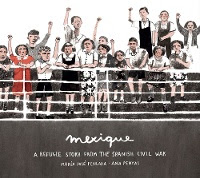
Mexique: A Refugee Story from the Spanish Civil War (originally published by Alboroto Ediciones, Mexico, in 2018 as Mexique: El nombre del barco (Mexique: the name of the ship) is an illustrated photo album from that time, depicting for young children the horrors of what it is to be alone and lost and not knowing what lies ahead. The story is based on interviews with some of the children—now adults—part of a group of 456 refugees whose Spanish Republican families sent them to the safety of Morelia, Mexico, aboard the Mexique at the start of the Spanish Civil War. Their parents were seeking something that most children don’t think about: a life without fear. The art is derived from photographs of the “Children of Morelia” and the ship that brought them to Mexico. The story is dedicated:


To the Children of Morelia. 

And to all those who are moving in search

of a life without fear.


Through the words of a frightened child, young readers will feel the fear of the unknown as the children try to sleep while a volunteer comforts them:


Some cry. Especially at night.

They say that they dream that the ground is crumbling.

The houses are crumbling, and their memories are blank.

Clara, Sonia, Eulalia, María wake us up.

They say it’s just a dream,

one that we all dream together.

Clara, Sonia, Eulalia, María, our sisters,

collect our tears in their handkerchiefs and in the morning

return them to the sea.


The story’s stark, sepia-toned illustrations—many offset with touches of peach and rusted red—complement the fears and uncertainty of the children on the Mexique and their parents, who will never see them again.


On the cover, a large group of children hang off the railings of the ship. Most look forward. With both hands on the railing, a young boy in a white shirt smiles directly at the reader. Many others have their fists in the air. Their expressions range from excitement to sadness to fear. One girl wears a bright red dress. Two boys hold hands. Young readers will see many of these same children, some identified from their clothing, portrayed in the book. 


The final illustration shows 12 adults standing in a semicircle, looking out at the young readers. These people represent some of those who defeated the Spanish Republic and transformed it into the violent and terrifying world that the children have fled. They are soldiers, a nun and priest, spies, businessmen, fascists, and government officials. Sprawled at their feet are tiny figures of dead people: revolutionaries, bloodied and mutilated. They represent the parents, whom the children will never see again. And overhead soar two buzzards. 


Mexique is a photo album of sorts. It is, as artist Ana Penyas (ana penyas libros) writes (in Spanish), “a story that recovers one of the first episodes of the Spanish exile, and at the same time, evokes the history of all the ships that cross the ocean every day, transporting human beings who have the right to a life without fear.”


Here is a mom giving a last hug to her baby. Here is a father embracing his young son for the last time. Here is another mom, handing her little girl over to a stranger as her eyes plead: We trust you with our life’s blood. And here is the stranger, walking up the ship’s ramp with the little girl, looking down at her mom for the last time. 


Elisa Amado is an amazing storyteller and translator, and she pulls no punches here: 


War is a very loud noise. 

War is a huge hand that shakes you 

and throws you onto a ship.


Of course, young children will not understand the violent roots of fascism, how easily it can take hold, and the destruction it leaves in its path. What they will understand, through text and illustrations, is, as the United Nations Universal Declaration of Human Rights (Article 3) states: “We all have the right to live in freedom and safety.” 


*Highly recommended for all home, classroom and library collections.


—Beverly Slapin

(published 2/17/21)

My Tata's Guitar / La guitarra de mi tata

author: Ethriam Cash Brammer

illustrator: Daniel Lechón

Piñata Books / Arte Público Press, 2003

kindergarten-grade 2

Chicano, Mexican


On the cover, musical notes fill the air as an elderly mustached grandfather, wearing a woven straw sombrero and a green shirt, shows his young grandson, who wears a white shirt, how his fingers glide along the frets of his guitar. This cover image is repeated later in the story, as young readers ascertain that the youngster on the cover is the narrator’s grandfather (his tata) in the story, and the grandfather on the cover is his great-grandfather (his tata’s tata).


Narrated by a child who finds an old guitar while exploring “the mazes of boxes and discarded furniture” in his tata’s dusty garage, this warm story of family and community takes young readers into the lives of a Chicano child and his Mexican tata—and how music and culture are passed from one generation to another.


Lechón’s attractive, full-page pen-and-ink and watercolor illustrations, mostly in primary colors—are as gentle as the story. Although each scene is framed, in most of them, the characters step out of the frame. Since this story spans several generations, the artist circumvents confusion by assigning specific colors to the clothing of each character. For instance, the child narrator wears a black shirt, his tata wears a white shirt (as does his tata as a child), and his tata’s tata wears a green shirt and sometimes a sombrero. 


The short, boxed English text on top and the Spanish below both read with a rhythm that youngsters enjoy. (Since this is a story about a Mexican American family, forefronting the Spanish text would have been a benefit.) 


Rather than an attempt at literal translation, for the most part the English and Spanish texts appear as similar versions of the story or scene. For instance, in showing Tata’s grandpa and others in the community playing in the posadas, the English text reads:


“My tata played in the posadas every Christmas. ‘In the name of Heaven, won’t you give us shelter? My dear beloved wife, tonight can go no further.’ ” And in the Spanish text is the traditional rhymed Mexican version:


—Mi tata tocaba en las posadas cada Navidad: “En nombre del cielo, pedimos posada, pues no puede andar mi esposa amada.” 


In both of the group scenes—the people gathered together to portray las posadas navideñas and children celebrating a friend’s birthday—the people are shown with varying skin tones and hair color and textures that reflect the Indigenous and colonial heritages of the Mexican and Mexican American people. 


And when the story focuses on the music that Tata’s tata plays, he’s shown as singing Mexican songs in Spanish that are compatible with well-known American songs. As a young man, he serenades the young woman who will soon become his wife. “Dulce amor de mi vida, despierta, si te encuentras dormida” (“Sweet love of my life / wake up if you find yourself asleep”) is well matched with the English: “I’m in the mood for love / simply because you’re near me.” 


There’s also the traditional (English) birthday song, “Happy birthday to you, happy birthday to you, happy birthday, dear ….” which, in Mexican Spanish, becomes: “Éstas son las mañanitas que cantaba el Rey David, hoy por ser tu cumpleaños, te las cantamos a tí.” (“These are the mañanitas that King David sang, because today is your birthday, we sing them to you.”)


And, while the child’s tata relates the story from his tata of when the family came to the United States from Mexico, there’s a beautiful scene of farmworkers, wearing woven straw sombreros, sitting around the campfire after a hard day of labor. They sing the traditional Mexican song, “Cielito Lindo” (“Ay, ay, ay, ay, canta y no llores…”).


As Tata gently and lovingly passes on the music of his culture, musical notes and moths flit out of the guitar and transform into butterflies and flowers and fill the background. In gifting his young nieto with the family’s guitar, Tata both passes on a family treasure and transmits the cultural history of the community.


As Tata gifts his nieto with this guitar—as his own tata did with him—it becomes more than “just” a gift from grandpa to grandson. Rather, his tata’s guitar is a gift from and for the generations. It’s the gift of love, the gift of language and song, the gift of historical and cultural continuity.


*Highly recommended for all home, library and classroom collections.


—Beverly Slapin

(published 11/23/20)


Note: On the CIP page, the publisher thanks Teresa Mlawer of Lectorum Publications “for her professional advice on this book.” I want to acknowledge Teresa, who left us in March of this year, for her great talent and gentleness and love of the culture. She helped shape many children’s stories and their translations, and her loss is deeply felt in the community.


Tiny Travelers: Mexico Treasure Quest // Tiny Travelers: Puerto Rico Treasure Quest

authors: Steven Wolfe Pereira and Susie Jaramillo
illustrators: Susie Jaramillo, Mei Li Tan and Magali Reyes McDonald
Encantos Media Studios, 2019
preschool-grade 3 
Mexican, Puerto Rican

Tiny Travelers is a fun series of board books for travelers of all ages. Aimed at young audiences from preschool-grade 3, readers voyage to different countries and are introduced to various cultural traditions, culinary histories and a sense of geographical places worth visiting.

For my own tiny travel, I chose to read Mexico and Puerto Rico. The authors and illustrators introduce both countries in captivating ways that invite youngsters to take in and embrace the cultures. Each spread contains information presented in one or two quatrains, along with a small “did you know?” fact and a “can you find?” question that engage young readers to connect more fully with the cultures. In addition, this design uses a minimum of space that allows plenty of room for the bright, vibrant digitally “painted” illustrations. 


Mexico begins with a map of the country and lets children know that the quest is not for gold “but another special kind.” Given Mexico’s colonial history, this is a subtle reminder of the past, something that older students can research. Moving forward in curiosity and celebration exhibits page upon page of bright illustrations with multiethnic children of varied complexions interacting in diverse parts of Mexico. Emulating the “Where’s Waldo?” concept is an indigenous dog—“xoloitzcuintli”—who can be found on just about every spread.

Youngsters learn about traditional foods, cultural icons, music and famous places in Mexico. (And it’s also refreshing to see tiny details that Mexican children will note, such as a girl mariachi.) Throughout the text, connections are made with various cities or regions that invite further investigation later. The final pages include a world map that puts Mexico in context with the rest of the world. This book was an engaging read for this aging “tiny traveler.”


From Mexico, this traveler flew to Puerto Rico. As with Mexico, readers learn easy Spanish greetings and are transported to the capitol, San Juan, for a celebration. The legendary monster, “Vejigante,” shows up a few times and, of course, everyone is partying and he’s one of the musicians. But just in case, the text reads “If you see a monster, don’t be afraid! People love wearing masks of the Vejigante…”

The repeating cultural motif—on every spread—is PR’s beloved national symbol, the tiny coqui (whose loud, chirping call sounds like its name), hiding out, partying, sunbathing at the beach, watching TV, flying a kite… I’m reminded of a dicho: “Soy de aquí como el coquí.” It literally means, “I am from here, like the coquí.” 


The nearby island of Vieques lends a note of local biological beauty with a bioluminescent bay. This occurrence is in direct contrast with the island’s colonial history of the United States military presence, so is a welcome natural beauty addition. The reader continues discovering beaches, “coco frios” (cool coconut juice), culturally relevant sports such as boxing and outdoor spots for kite-flying such as El Morro on San Juan Bay.


My one suggestion for this series is that the names of places visited be included on each map. Map searching is less important for the preschoolers, but second-and third-graders could happily cross-reference towns on the map.


Although both Mexico and Puerto Rico follow a formula in describing the places and cultures, there is little that is formulaic in the Tiny Traveler series. Rather, as these gorgeously illustrated board books introduce young people to each place and culture, they nurture a healthy curiosity and encourage youngsters to want to know more. As well, Mexican and Puerto Rican children will see themselves as belonging to a land that is part of their own rich heritage. 


*Highly recommended for all home, classroom and library collections. 


—Rose Veda Berryessa

(published 9/10/20)


[Note: One of the “Did You Know?” entries tells young readers that “Puerto Rico has officially been a territory of the United States since 1898, making all Puerto Ricans American citizens.” This is true. However, the people of what’s currently known as Puerto Rico have been struggling for independence—first, from the Spanish Empire from 1493 to 1898, and since 1898, from the United States. In this review, I refer to Puerto Rico as a country. ¡Que viva Puerto Rico libre!--RVB]