Soap, Soap, Soap / Jabón, Jabón, Jabón

author: Elizabeth O. Dulemba 
illustrator: Elizabeth O. Dulemba 
Raven Tree Press, 2009 
preschool-grade 3 
Mexican American


The illustrator of Paco y La Planta de Chile Gigante / Paco and the Giant Chile Plant is back now with her own work. With the same structure as Paco, Soap is a modernized version of the classic “Appalachian Jack” tale written in English with Spanish words peppered throughout and highlighted in red, and primarily featuring Latina/o characters. Also like Paco, Soap is marketed as bilingual, which, of course, it’s not.

Here, Hugo’s mother sends her forgetful child to the market to buy soap. Although the market is only a short walk from his house, he chooses a roundabout path through the playground, down the sidewalk, past a ditch, through the schoolyard into the market. Sort of like the comic strip, “Family Circus.” Along the way he encounters multiple obstacles, neighbors, and misunderstandings, which sometimes lead to violence. Each time, he forgets what he was supposed to buy, but is reminded by something someone says until his next encounter.

Hugo slips and falls into a puddle of mud, his friend also falls into the mud puddle, an elderly neighbor drops her groceries and grabs and scolds Hugo, and a bully hurls him into a ditch. Finally, Hugo gets to the market, purchases the soap, jumps back over the ditch, past his fuming neighbor—still yelling about her groceries—and through the playground to his house. His mother, agape when she sees her stinky, filthy child, marches him to the tub to bathe himself with his newly purchased soap, soap, soap.

Dulemba’s acrylic paintings on a palette of bright oranges, yellows, greens and earthy browns, are inviting; and the story’s premise is silly but appropriate for the age range for which it is intended. However, Soap, Soap, Soap is a tour de force of racial and ethnic stereotypes.

Hugo’s mother appears to be single. Certainly, single mothers exist in all cultures and ethnicities, but it is exasperating to see Latinas consistently cast as women who must raise their children alone. In addition, both women here—Hugo’s mother and the elderly, hotheaded Latina who drops her groceries and remains incensed for what could be hours—are heavyset with prominent derrières. Hugo’s young friend, an African American child, is named “Jellybean,” which is a racial slur for Black people [1]. And, as with Paco, there is not one actual cultural marker in this story [2], and the highlighting of a few Spanish words in red sends a negative and confusing signal to Spanish-speaking children while teaching English-speaking children little of value.

And, although Dulemba’s bright images make it appear that Hugo lives in a cheerful and safe neighborhood, he experiences violence multiple times while trying to run a simple errand for his mother. This plays out like the lives of minority young people growing up in impoverished and violent neighborhoods where at any moment they can get hurt, or worse, just for being at the wrong place at the wrong time.

Soap, Soap, Soap / Jabón, Jabón, Jabón is not recommended.

—Lisette Silva
(published 7/12/15)


[1] “Jellybean,” as a name for Black people, is a racial slur that means, “no one likes the black ones.” (Racial Slur Database, www.rsdb.org/slur/jellybean)

[2] The one Spanish expression used here, “Ay, caramba!” more likely befits “Pancho,” the not-so-bright sidekick of the 1950’s “Mexican” TV hero, “The Cisco Kid.” It was also the catch phrase of Bart Simpson.

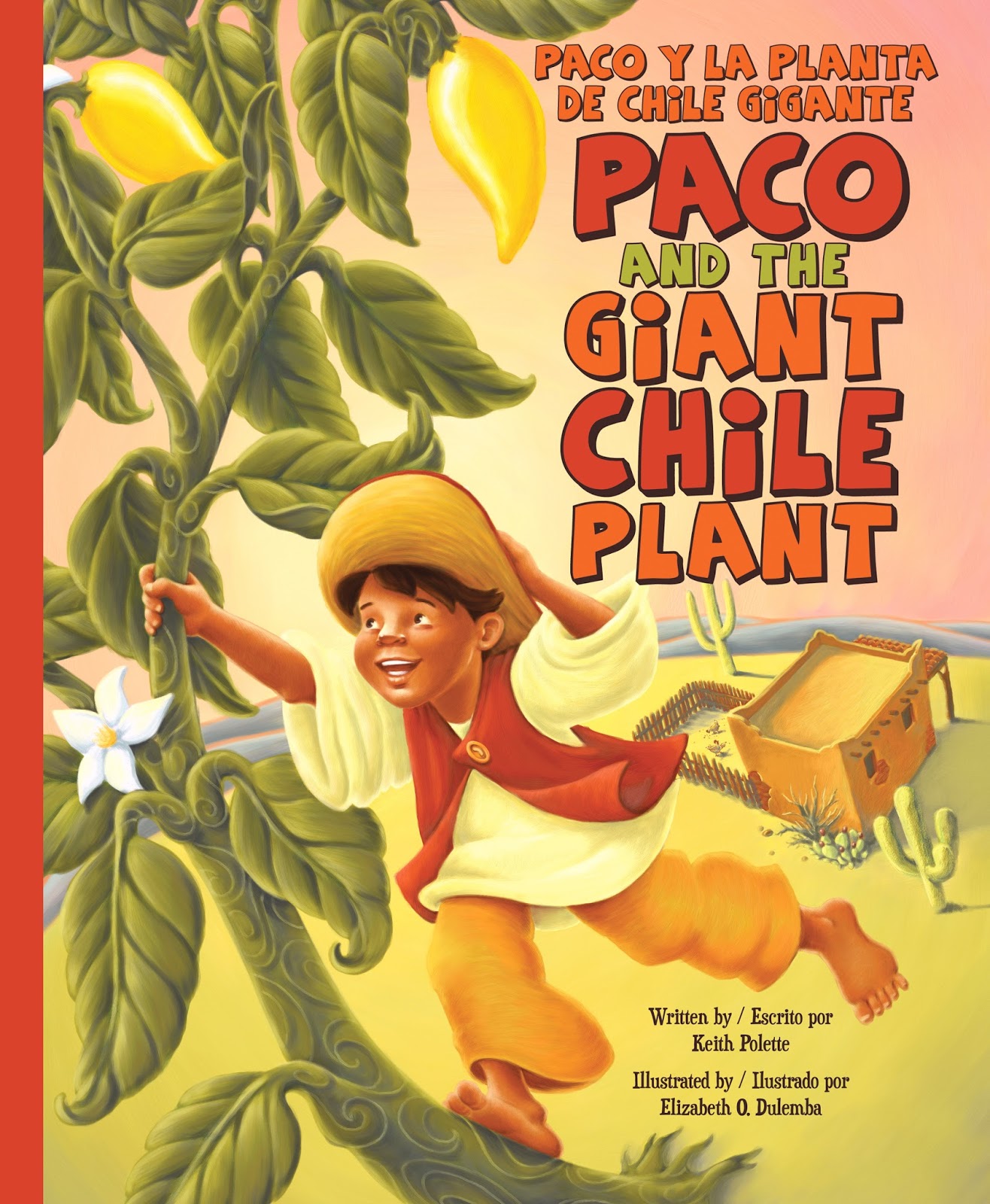
Paco y La Planta de Chile Gigante / Paco and the Giant Chile Plant

author: Keith Polette  
illustrator: Elizabeth O. Dulemba 
Raven Tree Press, 2008 
preschool-grade 3 
Mexican American


Set in the Southwestern United States, Paco y La Planta de Chile Gigante is a re-imagined version of Jack and the Beanstalk, the classic English tale of a poor widow and her son who sells their dairy cow for magic beans. Upon learning of her son’s action, the outraged mother throws the beans on the ground where, overnight, they grow into an enormous beanstalk. Looking for treasure, Jack climbs the beanstalk to find a horrible, nasty, greedy giant who attempts to eat him, but ultimately Jack prevails in stealing the giant’s gold and other stuff and the giant falls to his doom.


In Paco, the English boy and his family morph into Latinos. Here, a poor, presumably widowed, mother sends Paco off to town to sell their dairy cow—which he does, for magic chile seeds. But rather than proudly presenting the chile seeds to his mother as Jack did with his beans, Paco plants the seeds himself to see what happens. The chile plant quickly grows up to the sky and Paco climbs it, looking for treasures.

Upon reaching the top, Paco harvests the chile blooms, enters a house of enormous proportions and meets the giant himself. Like the original tale, the giant is terrifying and tries to eat Paco; but unlike the original, he sees Paco as the savory filling for a thin, flat Mexican pancake of masa or flour:

FEE-FI-FO-FUM, I SMELL THE BLOOD OF A HUMAN ONE. BE HE THIN OR BE HE FAT, FOR MY TORTILLA I’LL GRIND HIM FLAT.

In an attempt to save himself, Paco offers the giant his chiles de oro. The chiles burst in the giant’s strong grip and spray their juice all over his face. The juice is so hot that the giant begins to cry a river of tears. With each tear, he begins to shrink and shrink until he is the size of an average man. Once the crying and shrinking stuff stop, Paco recognizes the man as—his father! Yes, years before, the father-cum-giant-cum-father tells Paco, he had climbed a giant chile plant, also looking for treasures. When he got to the top, like his son, he found chiles de oro. But, rather than just picking them, he ate them—and turned into a terrible giant.

So Paco and his father clamber down the chile plant and chop it down as the mother comes out of their house to find her long lost husband with their son. And they live happily ever after.


Paco could be seen as a charming “Latino” rendition of the original, but the devil is in the details. Dulemba’s digitally rendered artwork—on a palette of mostly desert browns, yellows and greens—is designed to reflect a “beautiful desert setting in the American Southwest.” It does. But I couldn’t make sense of the time period(s) in which it’s supposed to be set. Paco and his father appear to be dressed as Mexican campesinos who look like they came out of an old Clint Eastwood movie set in the 1800s, while the mother’s clothing and hairstyle appear to be from the 1930s or 40s.

And Polette portrays his Mexican American characters (including the giant) stereotypically:

• A Latina mother who is single and abandoned rather than a widow

• A deceptive Latino child who plants the seeds himself, rather than an innocently precocious boy, who proudly shows his mother how he is “helping” her

• A Latino father who is a dimwitted dreamer looking for treasures in the clouds, who abandons his family, and who becomes a violent thug (before he changes back)

• And finally, Latina/os who eat hot chiles turn into monsters

Then there’s the language: Although there’s a vocabulary page in which each of the Spanish words is translated into English, Paco demonstrates the type of structure that is all too often falsely marketed as “bilingual,” as this one is. But it’s not a bilingual story. It’s not a story in Spanglish, either. Rather, it’s an English-language story with Spanish words casually tossed in throughout—and worse, each Spanish word is embedded in red type. This technique, according to the liner notes, aids in the fun and learning of both languages. But the reality is that it relegates the “other” language to second-class citizenry.

I don’t know what the purpose of Paco is. If it’s an attempt to teach Spanish to English-speaking children, it fails: A few words do not make a language. If it’s an attempt to teach English to hablantes, it fails as well. If it’s an attempt to change a well-known fairy tale into a “diverse” story, placing it in another time and locale and stereotyping the characters is exactly the opposite of what it purports to do.

Paco y La Planta de Chile Gigante / Paco and the Giant Chile Plant is not recommended.

—Lisette Silva
(published 7/7/15)

Can You See Me Now?

author: Estela Bernal  
Piñata Books / Arte Público Press, 2014 
grades 4-7 
Mexican American

On Mandy Silva’s 13th birthday, her father goes out to pick up her gift and never returns. Instead, a police officer comes to the door to tell her and her mother that a drunk driver had struck his car, instantly killing him. Consumed by grief, Mandy’s mother looks for someone to blame: “If she hadn’t insisted on that stupid watch for her birthday, he would still be alive.”

Mandy feels both guilty for leading her father into harm’s way and invisible in her own grief. Her mother takes on extra shifts at work, leaving Mandy in the care of her grandmother. And the school bullies cut her no slack—just days after she returns to school, they glue her skirt to the chair.

A local history project leads Mandy to Paloma, another “invisible” girl whose hippie parents, studious demeanor, and interest in yoga have also knocked her off the social radar. Mandy also realizes her own complicity in marginalizing other students when the house across the street from her grandmother’s burns down, and she discovers that Rogelio, the overweight boy who lives there, has been her classmate for years but she has never spoken to him. Now she does, and it leads to another friendship both with him and with his dog.

In writing letters to her father, Mandy comes to terms with her grief and with the changes in her life. She realizes that many people feel invisible—including her classmates and the older people in her community—and in making the effort to reach out to others, she, too, heals.

Mandy, whose given name is Amanda, is Latina, as are nearly all the other characters in this middle grade novel that immerses readers in a small town in Texas populated by Latina/o residents who have lived there for many generations. Bernal’s vivid descriptions of “San Fulano” (the town’s name, which implies anonymity) give the setting depth, as if it’s a character in the story. It also challenges the stereotype of Latina/os as recent immigrants or having lived here for no more than two or three generations. In fact, there are many in the West and Southwest whose families have lived in that area since before 1848, when the United States seized those lands from Mexico.

The other Tejana/o characters are diverse as well, countering stereotypes. There are popular kids and social outcasts, people of all economic strata (though in this novel, Mandy and her friends are solidly middle- or upper middle income) and with a variety of interests from yoga to dogs. Still, heritage is important. Mandy’s teacher, Ms. Romero, is an outspoken opponent of a large development project that threatens to wipe out sites of historic value, and the class’s local history project leads Mandy and her friends to meet the town’s elderly residents and to learn about their lives. Can You See Me Now? is recommended.


—Lyn Miller-Lachmann
(published 7/5/15)

Summer of the Mariposas


author: Guadalupe García McCall
Lee & Low, 2012 
grades 7-up 
Mexican American

Following the success of her verse novel, Under the Mesquite, Guadalupe García McCall’s excellent second novel explores the Mestizo heritage of her characters through a story filled with mystery and magic realism. Fifteen-year-old Odilia Garza, the eldest of five girls living in a Texas town across the river from Mexico, has always thought of herself as descended from the Spanish conquistadores. Although her mother is darker, her father, who abandoned the family several years earlier, has the complexion of a European.

After Odilia and her sisters discover the dead body of a man floating in their favorite swimming hole, the ghost of La Llorona—the mythical woman who drowned her children and is doomed to wander the earth forever—visits her. Here though, La Llorona is mourning not only her own children but also the Aztec people who have lost their connection to their noble past. As La Llorona tells Odilia,
It is an eternal atonement, to watch over the children of the sun, the children of my people, the Azteca bloodline…Yes. You are descendent of a great people. 
La Llorona gives Odilia a magic pendent—the ear pendant of the Aztec Serpent God Cihuacoatl—and together with her bickering sisters, Odilia drives across the border to return the dead man to his family and to find her estranged paternal grandmother. McCall interweaves traditional legends, magic realism, and the hero’s journey to create a powerful tale of understanding and triumph featuring a resourceful and memorable heroine.

One of the major contributions of this novel is the reconsideration of the legend of La Llorona, who, like La Malinche, has been used for centuries to enforce patriarchy and the subjugation of women. Even Odilia has absorbed the myth that portrays women as weak and treacherous, needing protection from their own impulses:
I had heard so many awful things about Llorona that I couldn’t help it, I pulled away from her and took a few steps back. “But you . . . killed your children.” It was common knowledge, more than a legend. 
In Summer of the Mariposas, the male adults are the weak ones—the father who abandons the family and the dead man who needs the girls to return his body and spirit to his wife and children. As La Llorona explains to Odilia, 
“You were chosen for the goodness in your heart…. Like Juan Diego, the most humble of the Virgen’s children, you are noble and kindhearted. You displayed great courage when you jumped into the water to save my sons. Your sister was right when she said finding the body of the drowned man was not an accident.” 
Also memorable are the other sisters, each of whom has her own personality and strengths, as one of Odilia’s tasks is to get them to work together rather than against each other. Summer of the Mariposas is a gripping tale that is also a welcome commentary on going beyond what’s “common knowledge” to get at the truth, and the importance of discovering and appreciating one’s mixed heritage. Highly recommended.

—Lyn Miller-Lachmann
(published 7/4/15)

Surviving Santiago

author: Lyn Miller-Lachmann
Running Press, 2015 
grades 7-up 
Chilean, Chilean American

Surviving Santiago, Miller-Lachmann’s companion-sequel to Gringolandia, takes place in 1989, in the waning days of the US-sponsored Pinochet dictatorship in Chile, after the plebiscite that removed him from power, and before he actually stepped down. It’s told from the POV of 16-year-old Cristina Isabel Aguilar Fuentes, known in her adopted country and by her friends as “Tina Aguilar.”

Tina’s mom—who, in Gringolandia, had relocated with her family to Wisconsin, and now is divorced from Marcelo and remarried—has sent her to live with her papá for the summer; and returning to her homeland is the last thing Tina wants to do. It’s a strange place, Santiago de Chile, not a place she remembers, and not a father she remembers. Marcelo, a revolutionary who had been tortured by the regime, has come out scarred, inside and out. He is addicted to alcohol and when he drinks, he becomes violent and abusive. Papá had wanted Tina to spend the summer with him, but when she arrives, she finds she’s on her own.

Throughout, Miller-Lachmann paints a complex and realistic picture of what torture under the dictatorship did to individuals and families—in this case, post-traumatic stress causes Papá to lash out at those he once loved. Tina soon sees how he dehumanizes Tía Ileana—who is lesbian and the only person who takes care of him. Tina remembers her papá from childhood—how he would drive the children to school, how they would go to the beach, how they would play cards together. But now, she abhors that he has become, as she spits out, “a bigot and a jerk.”

Indeed, Marcelo is a broken person, yet he never drinks at work, because this work is too important to screw up. His friend and colleague, Ernesto, adores him. “We worship him, Ernesto says. “He taught us everything we know about investigative journalism.” “During the plebiscite,” he tells Tina, “he was on the air for thirty-five hours straight. Said he couldn’t sleep until he knew the bastard was going down so he might as well work, but I’m sure it’s an on-air record.”

As in Gringolandia, there’s a metaphor here that’s not really a metaphor: Papá has rescued two parrots who had been abused by a bird torturer; one was un desplumado who eventually grew back his feathers, and the other has chewed off part of his foot. What will happen to Papá as a result of the torture he suffered at the hands of the Pinochet regime? Will he heal or will he remain physically and emotionally broken?

When an attractive, motorcycle-riding dude—a delivery boy—arrives on the scene, something is not right. Although Tina and Frankie share a love of Metallica and both are dealing with fathers who have alcoholism, Frankie’s extreme right-wing views of the regime and Chile’s history and world events—such as how “Franco stopped the Communists” in the Spanish Civil War—are the opposite of what Tina knows to be true. And they’re the opposite of all that her papá has fought and suffered for. Still, Tina sees Frankie in a way that only a love-struck teenager can: she senses, yet ignores, the oncoming danger. This is Chile, after all, and Augusto Pinochet is still in control. The military police and the regime’s hired guns are still “disappearing” people. In this tense, dangerous scenario, what’s Frankie’s role? Who is he, really?

As the tension builds and careens to a satisfying conclusion, everyday people try to survive and families continue to search for the bodies of their “disappeared” relatives, those who had been imprisoned and tortured struggle to become whole again, and Pinochet and his thugs do their best to see that his fascist legacy continues. This is 16-year-old Tina’s narrative—usually on-point, sometimes naïve, but every word believable.

Where appropriate in narration or dialogue, Miller-Lachmann uses idiomatic Chilean Spanish, and seamlessly inserts English interpretations (some of which will be a hoot for Spanish-speakers):

The moment I set Pablo down, he fluffs his tail and takes a dump on the counter. Tía Ileana yells at me. She hasn’t yelled at me since I got here, but I guess I’d yell too if a bird pooped where I sort of cooked.

¡Pégame un tiro ya! Pablo screams back.

“It’s okay. I’m not going to hurt you,” I murmur, stroking his head.

He keeps screeching, “Just shoot me,” in Spanish….

When the parrot quiets, I say, “Hello. How are you?”

“¡Alfonso, conch’e tu madre!” the parrot squawks at me.

I don’t reward him for calling someone named Alfonso his mother’s private parts. Instead, I repeat, “Hello. How are you?”

This time, the bird squawks, “Vamos, pajero dormilón.”

Laughing, I say, “I did get my lazy ass out of bed.”

Like Gringolandia, Miller-Lachmann’s latest effort is one I’ve read several times and I’ve wanted to quote from practically every page. It’s that good. And, like Gringolandia, Surviving Santiago is an important historical novel, and is highly recommended.

—Beverly Slapin
(published 6/26/15)

I Know the River Loves Me / Yo sé que el río me ama

author: Maya Christina González
translator: Dana Goldberg 
illustrator: Maya Christina González 
Children’s Book Press / Lee & Low, 2009 
all grades 
Mexican American  

Deep inside, young children everywhere know that all the elements of Creation are alive and have volition and feelings. Young Maya is no different. She knows the river loves her and that her love comes with the responsibility to take care of the river. 

With lyrical prose and flowing pictures, González shows the relationship between child and river—the river holds her reflection, sings her name, cools her down, holds her up, and is always there for her. In return, young Maya collects the garbage others have left—bottles, papers, plastic six-pack holders—and takes it all away.

González’s ink-and-charcoal illustrations, on double-page spreads, are sparse and lovely. In every illustration, Maya is smiling: waving to the river, dipping her feet, communing with her reflection, jumping on the river’s back and leaping into the river’s arms. While she paints Maya in monochromatic browns with long, flowing hair, González uses generous swirling and whirling lines on a palette of vibrant blues, aquas and greens to capture the river’s flow; browns for the birds, greens for the fishes and frogs, and a smattering of pinks and purples for the flowers and butterflies. One of my favorite illustrations is a smiling Maya (of course), standing on a bridge; her dress is patterned in the swirling blue lines that actually join with the river.

Dana Goldberg’s Spanish translation reads as elegantly as the English—“I watch her change like me” becomes “Veo que el río cambia como cambio yo”—so the youngest readers and listeners in either or both languages will enjoy this charming little book over and over.  I Know the River Loves Me / Yo sé que el río me ama is highly recommended. 

—Beverly Slapin
(published 5/21/15)

Tortilla Factory // La Tortillería

author: Gary Paulsen  
translator: Gloria de Aragón Andujar 
illustrator: Ruth Wright Paulsen 
Harcourt Brace, 1995 
grades 1-4 
Mexican, Mexican American [1]


With spare and measured prose (a total of 134 words), accompanied by thick, unsaturated oil paintings on linen, author and illustrator present a circular telling of the elements involved in the process of making tortillas—from working the earth to planting the seeds to harvesting and grinding the corn into flour to shaping and baking the tortillas. Both the pastoral settings and poetic language—“black earth” worked by “brown hands,” “yellow seeds” that become “green plants” and “golden corn,” etc.—are straightforward and expressive.

The major reviewers lauded The Tortilla Factory. Booklist praised it for its “simple yet evocative language” and “strong, attractive paintings.” The Horn Book reviewer wrote,

By concentrating on hands, rather than the individual faces of the workers responsible for the tortillas’ creation, Ruth Wright Paulsen’s warm oil-on-linen paintings demonstrate respect for the ethic of hard work and hold broad, universal appeal. Readers will embrace The Tortilla Factory for its clear emphasis on the simple beauty found in the cycles of life for plants and human beings.

What the reviewers left out is this: That the agricultural and factory workers—depicted here in both text and illustration—literally have neither faces nor voices means that they have no agency.[2] All they have is “brown hands.” Both author’s and illustrator’s “clear emphasis on…simple beauty” deftly erases the backbreaking labor of agricultural workers, erases the decades old “fight in the fields” for justice and fair wages, erases the omnipresent danger of cancer-causing pesticides; and, indeed, erases everything that Edward R. Murrow’s TV documentary, “Harvest of Shame,”[3] brought to public attention in 1960—55 years ago.

A few words about multiculturalism and power dynamics[4]: For all intents and purposes, The Tortilla Factory can be considered both “multicultural” and “diverse” because it portrays people with “brown hands.” By minimizing and romanticizing agricultural and sweatshop work, by referring to and depicting ethnic workers only as “brown hands,” by disappearing poverty and real struggle, author and illustrator—intentionally or not—elevate white people and subordinate everyone else.


The Spanish version, La Tortillería, has many of the same flaws with a few of its own. For example, while the English version reads, “…where laughing people and clank-clunking machinery mix the flour into dough…,” the Spanish reads, “…donde gente alegre y máquinas ruidosas mezclan la harina en la masa…” (“…where happy people and noisy machines mix the flour in the dough…”). While laughing workers may be laughing at the boss, for instance, the Spanish version tells readers that the workers are “happy.” Similarly, the clank clunking of the machinery is flattened out into generic “noise.”

By erasing their voices and erasing their hardships—by (please forgive the following metaphor) neatly wrapping farm workers and factory workers into tortillas of pastoral prose and paintings, both author and illustrator romanticize their subjects to leave child readers (if they are not themselves agricultural workers) peering, as strangers, from the outside in. And for children who are agricultural workers and happen to come upon this book, there is only shame.

The Tortilla Factory // La Tortillería are not recommended.

—Beverly Slapin
(published 5/21/15, revised 6/27/15)


[1] In depicting Mexican pottery on a table with veggies (green chilies, garlic, onions, and tomatoes) that would traditionally be cooked with beans, and a shop whose sign reads, “tortillería,” Paulsen’s illustrations hint at the ethnicity of the people with “brown hands.”

[2] In fact, the tortillas themselves appear to have more agency than the workers who make them. The tortillas “come off the machine and into a package and onto a truck and into a kitchen…”

[3] “Harvest of Shame” was aired on CBS Reports on the day after Thanksgiving, 1960.

[4] For an excellent discussion of this topic, see Stuart H.D. Ching’s essay, “Multicultural Children’s Literature as an Instrument of Power,” in National Council of Teachers of English’s Language Arts, vol. 83, No. 2, November 2005.

Sky Painter: Louis Fuertes, Bird Artist

author: Margarita Engle  
illustrator: Aliona Bereghici 
Two Lions / Amazon Children’s Publishing, 2015
grades 1-3 
Puerto Rican

How many children know the name of Louis Agassiz Fuertes, whom Engle calls “the world’s greatest bird artist”—the New York-born Puerto Rican artist who painted birds in the wild and whose work helped encourage wildlife conservation all over the world? Now, because of Engle’s amazing picture biography in verse, more will.

Like John James Audubon, Fuertes had a talent for drawing and a particular interest in birds. But unlike his predecessor—who killed his “subjects” in order to pose them “naturally”—Fuertes taught himself how to paint living birds in flight, in their own habitats. As Engle writes in his voice, “I practice/ painting quickly, while wings/ swoop/ and race/ across/ wild/ blue/ sky,/ so swift,/ and so alive!”

Engle’s brilliant economy of words is matched only by her affection for her subjects. In a series of free-verse poems, she tells Fuertes’ story in the first person, so young children will identify with the boy whose passions and talents would not be reined in by his parents’ staid ambitions for him. Engle writes, “Papi scolds in Spanish, and Mama scolds/ in English; but they are both proud/ of my serious/ bird art.”

As a young man, Fuertes travels the world to observe and paint his beloved birds. In Alaska:

I whistle.
Birds answer.
I follow.
Blue shadows.
White snow.
Clear ice.
The beauty
of flight
like a dance
in the clouds,
a graceful ballet
of wild swans.

And as an adult—now an accomplished and famed artist—he invites neighborhood children, who call him “the Bird Man,” into his studio, where he regales them with stories of his travels and invites them to draw “their own funny/ wild/ silly/ strange/ beautiful/ birds.”

Bereghici’s lovely illustrations, rendered in watercolor and ink on a palette of bright natural colors with lots of white space, both highlight the details of Fuertes’s wild bird paintings and leave room for the birds’ common names, each penned on its own ribbon banner.

Young readers will be enticed by other illustrations as well, such as a wild crow on the windowsill, holding young Louis’s paintbrush. Or a not-so-bemused Eastern Screech Owl chick, loosely tied to a table leg, “posing” for Louis. Or Louis’ having bandaged the wing of an injured bird, while a cat, aghast at a missed opportunity, looks on.

Throughout, Bereghici’s illustrations complement Engle’s story of a boy, then a young man, then an adult, always with an expression of wonder at what he’s been given to do. I especially like the scene of Fuertes’s children, with that same wondrous look on their faces, as their father paints a portrait of a captive loon who’s been given temporary residence in the family bathtub. After all, how many children get to host a wild loon? In the bathtub?

After reading this lovely book, I hope that teachers and librarians will plan field trips—even in the city, even just around the block—so that children can appreciate (and draw, if they want to) elements of the natural world all around them, including, but not limited to, “their own funny/ wild/ silly/ strange/ beautiful/ birds.” The Sky Painter is highly, highly recommended.

—Beverly Slapin
(published 2/13/15)

Mountain Dog

author: Margarita Engle
illustrators: Olga and Aleksey Ivanov 
Square Fish / Macmillan, 2013 
grades 4-6 
Cuban American

In Engle’s elegant free verse, Mountain Dog relates the story of 11-year-old Tony, whose mother is imprisoned for running a dog-fighting ring in Los Angeles; and his partnership with his Tío, a forest ranger in the Sierra Nevada, with whom he is sent to live; and with Gabe, Tío’s search-and-rescue dog. In alternating narratives by Tony (“the boy”) and Gabe (“the dog”), young readers see how the boy slowly grows from a confused, distrustful, fearful young person to someone who has learned to deal with conflict, inherited his great-uncle’s passion for rescue—and is beginning to know his path.

Tony begins his narrative matter-of-factly:   

In my other life there were pit bulls.
The puppies weren’t born vicious,
but Mom taught them how to bite,
turning meanness into money,
until she got caught.

As he deals with his sadness, Tony’s suffering is palpable, but as Tío Leonilo and Gabe welcome him into their lives, the healing process begins. Here, Tony learns how to navigate the wilderness:

I learn how to estimate
the temperature of soil
at a 6-inch depth
by counting beats
per minute
in the song
of a cricket.
Fast insect music
means the earth is warm.
Slow bug songs come only
On long, cold cricket nights.

And Gabe, in his dog way, learns about Tony:

My nose has wishful moods
when the nostrils imagine sniffing
adventure smells that I can’t quite name
with my dog words.

Tony, you look wishful too.
Does your boy nose dream
of exploring wild scent trails
in unknown air?

On many levels, Mountain Dog is a story about a boy’s recovering from the traumas of child abuse and learning to trust again, about discovery, about making life-affirming choices and finding his path. And in this, it succeeds, beautifully. As well, Engle has a plethora of details—about wildlife and wilderness, about physical survival in a harsh environment, about selecting a puppy and training a search-and-rescue dog, and about the absolute necessity of mastering mathematical calculations—seamlessly woven into this emotion-filled story of a boy’s coming to terms with his past life and opening himself to the possibilities of moving forward.

Olga and Alexsey Ivanov’s black-and-white, pen-and-ink illustrations are appealing and evocative. Some are simply rendered and, where needed, hatchlines add detail and perspective to humans, domestic and wild animals, and the wilderness. On the frontispiece (repeated on an interior page), for instance, we see Gabe’s head leaning into Tony’s left hand, while Tony’s body, drawn in far less detail, faces the other direction. It’s clear that Tony is barely allowing Gabe to make contact—and Gabe is doing what he’s been trained to do, being there, being available, waiting to see what more is required of him. Opposite the first page of text, we see Tony, looking almost directly at the reader. His large eyes are mistrusting—he’s been through a lot—and he’s thinking, as the chapter title says, “no no no maybe.” The book’s final illustration is of Tony’s new puppy, whom Tony will train to be a rescue dog. The puppy’s eyes are also large—open to all the possibilities that await him with his new family.

My one problem with Mountain Dog is Tío’s brief story of his childhood and early teenage years in revolutionary Cuba (“the troubled island”): “Strange rules. Censored books./ Rationed food. Secret police./ Neighborhood spies”; his escape from the secret police on a homemade raft during hurricane season, and his subsequent rescue at sea by a fisherman.


In truth, the Cuban people had to protect their revolution and defend their tiny country to the death—to prevent CIA-funded counterrevolutionaries, giant US corporations, and organized crime, from taking back the island. At the beginning, life was very difficult and people fled because of the US embargo, which strangled the Cuban economy and caused serious shortages and the rationing of food. As some say today, “teníamos hambre”—“we were hungry.” But, absent any historical context, Tío’s story will lead young readers to think of Cuba as a regimented, controlled country that oppresses its people.

To lend balance and encourage discussion, teachers and librarians might supplement this section of Mountain Dog with George Ancona’s beautiful photo-essay, Cuban Kids (Cavendish, 2000), which gives an honest picture of life on the island. “Despite the hardships, the shortages, and the embargo,” Ancona writes, “Cuban kids are growing up with a love of their country, traditions, and culture. Their many skills will contribute to making a better future for Cuba and the world.”

Mountain Dog is highly recommended.

—Beverly Slapin
(published 2/12/15)

Call Me Tree / Llámame árbol

author: Maya Christina González  
translator: Dana Goldberg 
illustrator: Maya Christina González
Children’s Book Press / Lee & Low, 2015 
all grades 
Mexican American

Using watercolor, ink and pencil on a gorgeous, vibrant palette of mostly pinks, oranges, blues and greens, González constructs double-page spreads full of magical realism. In this inviting scenario, there are children and trees, in some places leaning into each other; in some places, so close they actually enjoin. The clouds are pink cotton-candy puffs, the roots are curlicues, and different patterns of leaves and bark imply different species as the children’s faces imply varying ethnicities. 

It’s not much of a stretch to imagine the children as the trees and the trees as the children; rather, they are a part of each other, hair/ leaves blowing in the wind, little feet reaching down into the earth to join with the roots, arms/ branches open wide to take in new experiences; at one with each other and the world. For children, Call Me Tree/ Llámame árbol is about knowing who you are and your place in the world; for adults, it’s about appreciating children for the amazing little beings they are.

González’s spare text in English and Goldberg’s Spanish version are both lyrical and expressive, so young hablantes and English learners, as well as English speakers and Spanish learners, will appreciate both.

Some sing songs / Some sing along / All trees have roots / All trees belong

Unos cantan canciones / Otros se unen al coro / Todos los árboles tienen raíces / Todos los árboles tienen un lugar

“Some sing songs, others join the chorus; all trees have roots, all trees have a place.” What a lovely and loving message for all children!

By portraying the children as gender-neutral in addition to multi-ethnic, González opens up more possibilities for child readers and listeners: young children who identify as girls or boys or both or neither can see themselves in everyone. In this sense, Call Me Tree/ Llámame árbol may be a first. It’s brilliant, loving, compassionate, and a thing of beauty—a treasure to be savored, over and over.

This beautiful little book brings to mind something that the great Cuban revolutionary, José Martí, said: “Trabajamos para los niños porque los niños saben amar, porque los niños son la esperanza del mundo.” (“We work for children because children know how to love, because children are the hope of the world.”) Call Me Tree / Llámame árbol is highly recommended. Thank you, Maya and Dana.

—Beverly Slapin
(published 2/6/15)